
Introduction
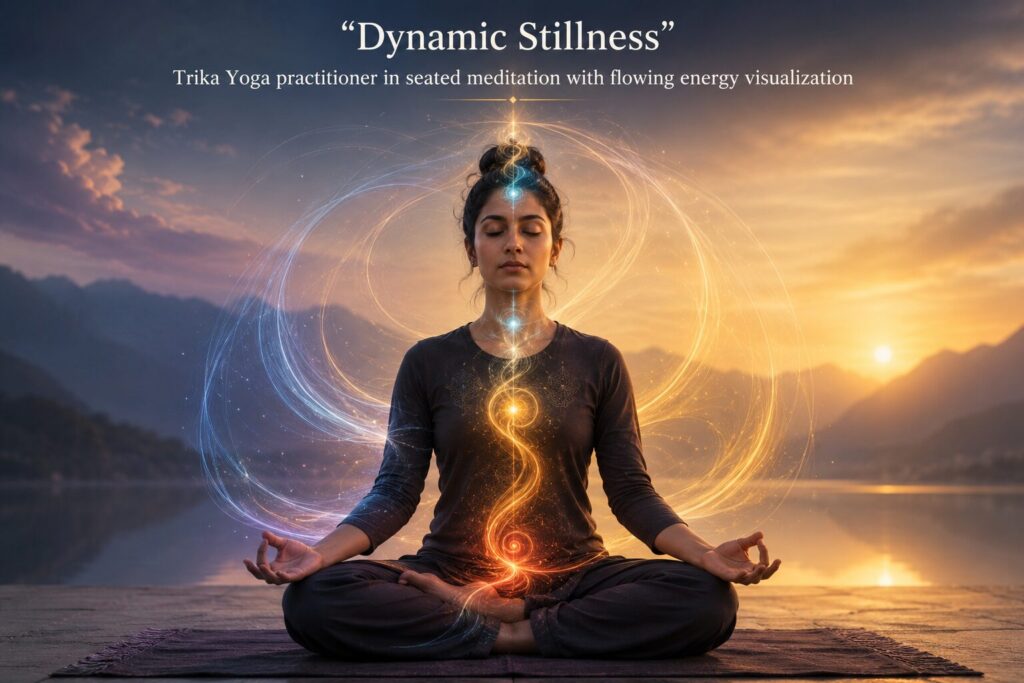
Dynamic Stillness: The Practice of Trika Yoga is not a contradiction in terms—it is an invitation. Dynamic Stillness: The Practice of Trika Yoga points to something the ancient sages of Kashmir understood thousands of years ago: that true stillness is not the absence of movement but the living ground beneath all movement. Dynamic Stillness: The Practice of Trika Yoga offers a path back to that ground—for anyone willing to look inward with honesty, courage, and an open heart.
In a world shaped by the medicalization of yoga in modern society, where yoga is increasingly sold as a fitness product and stripped of its spiritual architecture, Trika Yoga stands apart. It does not offer you a six-pack. It offers you yourself—whole, pulsating, luminous, and free.
This article is a complete guide: the origins, the philosophy, the practice, the benefits, and the steps you need to begin. Whether you are a seasoned practitioner or someone who has never rolled out a mat, what follows will change how you understand stillness, movement, and the nature of your own awareness.
The Medicalization of Yoga in Modern Society: What We Have Lost
Before exploring Dynamic Stillness: The Practice of Trika Yoga, we must be honest about the cultural moment we are living in.
The medicalization of yoga in modern society is a documented phenomenon. Researchers from the Journal of Yoga Studies (2021) and scholars such as Mark Singleton (Yoga Body, 2010) have traced how classical yoga—once a complete system of liberation—has been progressively reframed as physical therapy, stress management, and preventive medicine.
This is not entirely wrong. Yoga does reduce cortisol levels. A 2018 meta-analysis in Frontiers in Human Neuroscience confirmed yoga’s measurable effects on the autonomic nervous system. But when the medicalization of yoga in modern society reduces an entire cosmological tradition to “evidence-based stress relief,” something essential is amputated.
What gets lost in the medicalization of yoga:
- The recognition that consciousness is primary, not the body
- The map of the inner landscape — chakras, nadis, koshas, and the field of pure awareness
- The understanding that liberation (moksha) is the goal, not flexibility or relaxation
- The living transmission between teacher and student
The medicalization of yoga in modern society has produced millions of people who are physically fit but spiritually hollow. Dynamic Stillness: The Practice of Trika Yoga is an antidote—not a rejection of science, but a restoration of depth.
The Origin of Trika Philosophy: A River from Kashmir
The Origin of Trika Philosophy in Historical Context
The origin of the Trika philosophy traces back to the Kashmir Valley of northern India, approximately between the 8th and 12th centuries CE. Kashmir was then one of the most intellectually fertile regions on earth—a crossroads of Buddhist, Shaiva, and Vedic thought, producing scholars and mystics of extraordinary sophistication.
The origin of Trika philosophy is inseparable from the name of Abhinavagupta (circa 950–1016 CE), the polymath philosopher-saint whose masterwork Tantra Loka remains one of the most comprehensive treatises on non-dual consciousness ever written. His student Kshemaraja further systematized these teachings in texts such as the Pratyabhijnahridayam (Heart of Recognition).
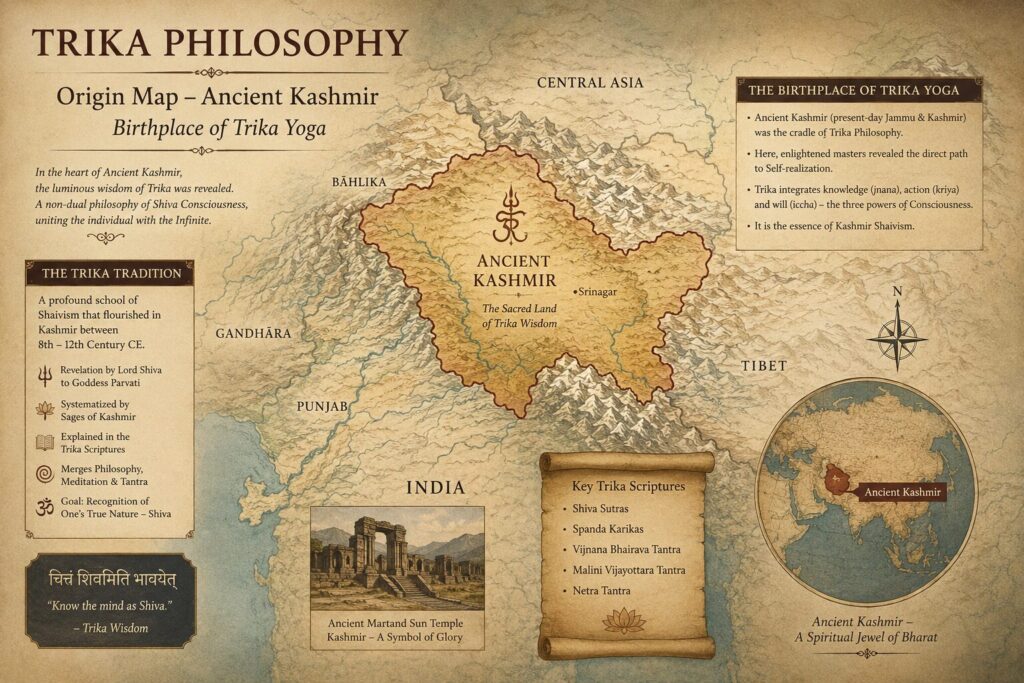
The word “Trika” means “three” in Sanskrit. The origin of the Trika philosophy rests on three foundational triads:
- Pati – Pashu – Pasha (Lord, bound soul, and bondage)
- Shiva – Shakti – Nara (Absolute consciousness, divine energy, and the individual being)
- Para—Parapara—Apara (Supreme, intermediate, and lower levels of reality)
The origin of Trika philosophy thus posits a universe that is neither dualistic (where matter and spirit are forever separate) nor nihilistically monistic (where individual experience is dismissed as illusion). Instead, Trika holds that the universe is a self-expression of divine consciousness—Shiva playing with Himself through the infinite forms of existence.
Trika Yoga and the Mystical Traditions of the World
Here, a remarkable convergence becomes visible. The origin of Trika philosophy, with its insistence that divine consciousness is present within all things and all beings, resonates deeply with the mystical teachings attributed to Jesus Christ.
In the Gospel of Thomas (Logion 3), Christ is recorded as saying, “The Kingdom of God is inside you, and all around you.“ In the Gospel of John (10:34), he quotes the Psalms: “Is it not written in your Law, ‘I have said you are gods‘?”
These statements are not metaphors. They are precise descriptions of what Trika Yoga calls “Chit”—the self-luminous awareness that constitutes both the individual and the cosmos. The origin of Trika philosophy and the mystical teachings of Christ share a single revolutionary claim: you are already what you are seeking. The practice is one of recognition (pratyabhijna), not acquisition.
This cross-traditional resonance is why Trika Yoga has found such a deep response among Western practitioners who carry the memory of contemplative Christianity alongside their curiosity for Eastern wisdom.
The Concept of Dynamic Stillness: The Heart of Trika Yoga
What Is the Concept of Dynamic Stillness?
The concept of dynamic stillness is the most distinctive and, initially, the most puzzling element of Trika Yoga. In most Western traditions, stillness is understood as the absence of activity—you go still by stopping. In Trika, stillness is understood as the ground of activity—the unchanging awareness within which all change occurs.
Think of a cinema screen. Films project on it: action, drama, color, and sound. The screen itself remains untouched. Dynamic Stillness: The Practice of Trika Yoga is the training of attention to rest in the screen—to be the screen—even while fully engaged with the film.
The concept of dynamic stillness has three dimensions:
| Dimension | Description | Practical Experience |
| Stillness
as Ground |
Awareness that does not move even when thoughts, emotions, and sensations arise | “I notice thoughts, but I am not swept away.” |
| Dynamic as Aliveness | The recognition that this stillness is not dead but vibrantly alive | A felt sense of presence, energy, wakefulness |
| Integration | Carrying this aliveness into all activity | Meditative awareness during daily life |
The concept of dynamic stillness is not a state you achieve and then maintain. It is a recognition you return to—again and again, with each breath, each moment of forgetting, each moment of coming home.
Spanda and Dynamic Stillness: The Pulse of the Universe
Understanding Spanda in Trika Philosophy
If Dynamic Stillness: The Practice of Trika Yoga has a heartbeat, it is Spanda. Spanda and Dynamic Stillness are inseparable in Kashmir Shaivism — together they describe the fundamental nature of reality.
Spanda (Sanskrit: स्पन्द) means divine pulse or sacred vibration. It is the throbbing aliveness of pure consciousness — not a vibration in something, but the pulsation of being itself. Kshemaraja’s Spandakarika opens with the declaration that Shiva, the absolute, is characterized by Spanda—an eternal, self-aware trembling that is the source of all manifestation.
Spanda and Dynamic Stillness illuminate each other perfectly. Dynamic stillness is the recognition of this pulse. Spanda is the nature of what is recognized. To practice Trika Yoga is to tune your entire being—body, breath, mind, and heart—to this pulse.
Spanda and Dynamic Stillness in the Body
Modern neuroscience inadvertently supports this. Research from the Heart Math Institute shows that the heart generates an electromagnetic field that permeates the body and extends beyond it. The heart’s rhythm — its variability, coherence, and resonance — directly affects neural function, emotional regulation, and cognitive clarity.
Spanda and Dynamic Stillness describe this biological reality from the inside out. When you sit in Trika meditation and feel the subtle pulse at the root of awareness—before thought, before image, before sensation—you are touching what the ancient masters called “Spanda.”
Spanda and Dynamic Stillness are not poetic abstractions. They are the felt texture of your own existence when the noise settles down.
Benefits of Practicing Trika Yoga
The Benefits of Practicing Trika Yoga: Physical, Psychological, and Spiritual
The benefits of practicing Trika Yoga operate on every level of the human being simultaneously. This is not the case with most modern yoga systems, which typically target one layer — the physical body — while leaving the others largely untouched.
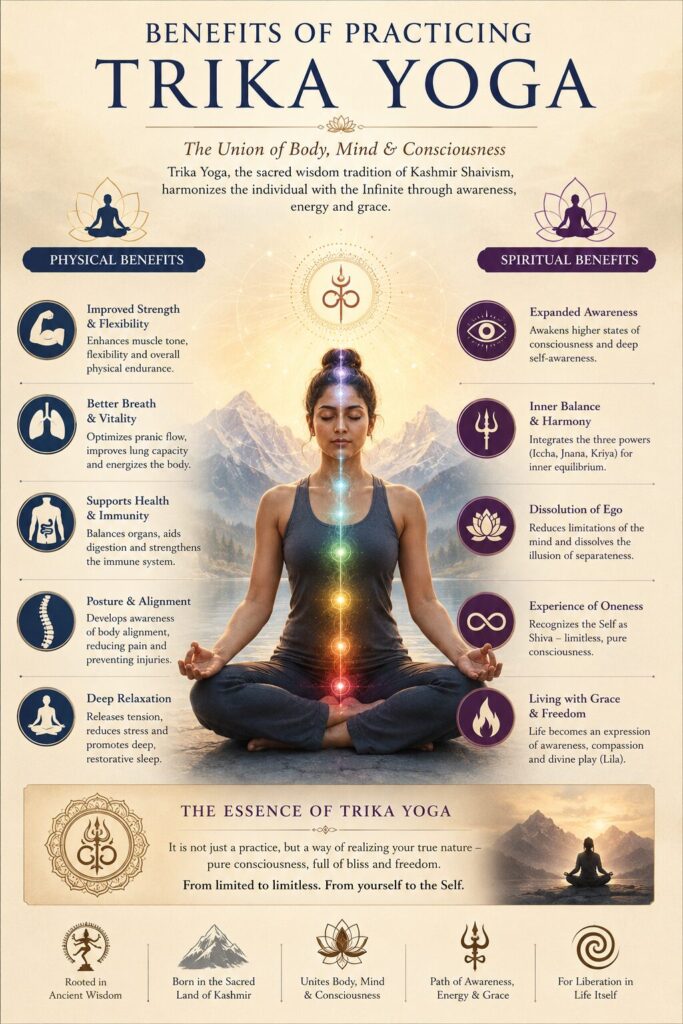
Physical Benefits
- Regulation of the nervous system: Trika’s breath-centered practices directly engage the vagus nerve, producing measurable shifts in heart rate variability (HRV). A 2020 study in PLOS ONE found that contemplative breathing practices increased parasympathetic tone within eight weeks.
- Improved sleep architecture: Practitioners consistently report deeper, more restorative sleep — a result of reduced cortisol and increased melatonin synthesis.
- Pain reduction: By shifting attention from the pain signal to the awareness of the pain signal, Trika practices create neurological distance from chronic pain perception.
Psychological Benefits
- Reduction in anxiety and depression: A 2019 randomized controlled trial in the Mindfulness journal found that non-dual awareness practices reduced anxiety scores by 38% over 12 weeks.
- Emotional regulation: Rather than suppressing or amplifying emotions, Trika teaches the practitioner to witness emotions as energy in awareness—a skill with direct impact on relationship health and professional performance.
- Resilience and post-traumatic growth: The recognition of an indestructible awareness at the core of one’s being provides an anchor that trauma cannot reach.
Spiritual Benefits
The benefits of practicing Trika Yoga at the spiritual level are harder to quantify but no less real:
- Direct recognition of one’s nature as consciousness (pratyabhijna)
- Freedom from the compulsive identification with thought as “me.”
- The lived experience of interconnectedness — not as a concept, but as felt reality
- A sustainable sense of meaning, purpose, and belonging
The benefits of practicing Trika Yoga accumulate over time. Unlike a pharmaceutical intervention, there is no tolerance or diminishing returns. Each layer of recognition deepens the next.
Benefits of Practicing Dynamic Stillness
Benefits of Practicing Dynamic Stillness in Everyday Life
The benefits of practicing dynamic stillness extend far beyond the meditation cushion. The very point of Trika Yoga is integration—yoga means union, and the union being pointed to is between the meditative state and the waking state, between the sacred and the ordinary.
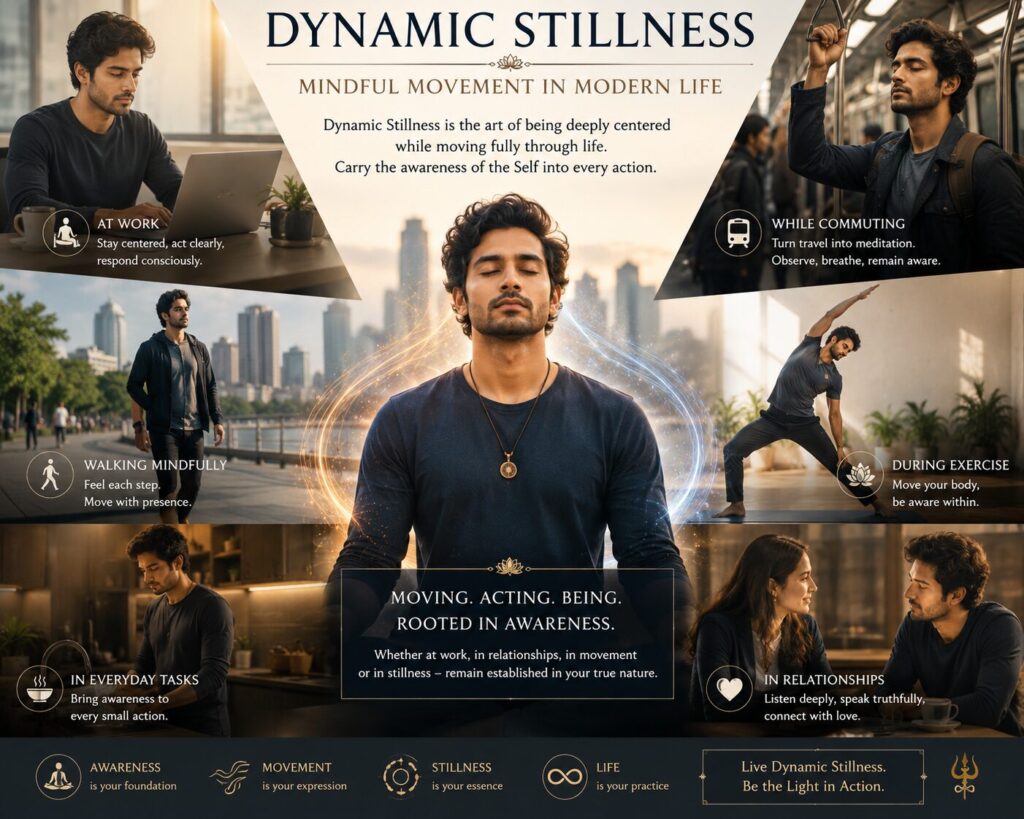
The benefits of practicing dynamic stillness include the following:
- Presence without performance. Most of us perform presence—nodding, listening, and appearing engaged—while internally churning through thoughts. Dynamic Stillness cultivates actual presence: a quality of attention that other people feel immediately and respond to with trust.
- Creativity and flow states. Research on flow by psychologist Mihaly Csikszentmihalyi maps almost precisely onto the Trika description of Spanda and Dynamic Stillness. When the internal noise quiets, creative intelligence flows through unobstructed.
- Conflict resolution. When you are established in the stillness beneath reactivity, you respond rather than react. This is not suppression — it is the most powerful form of emotional intelligence.
- Sense of aliveness. Perhaps the most poignant benefit of practicing dynamic stillness is the recovery of a felt sense of being alive—not just surviving, but shining. Many long-term practitioners describe this as returning to something they knew as children and lost.
The benefits of practicing dynamic stillness are multiplied when practice is consistent, anchored in a valid lineage, and supported by community.
Dynamic Stillness in Daily Life
Integrating Dynamic Stillness in Daily Life: Practical Pathways
Dynamic stillness in daily life is not about meditation retreats or monastery walls. It is about the grocery store, the office meeting, the argument with your teenager, and the first cup of tea in the morning.
Dynamic stillness in daily life begins with micro-practices—brief, consistent moments of returning to the ground of awareness throughout the day.
Five Micro-Practices for Dynamic Stillness in Daily Life
- The Three-Breath Return: At any moment — before a meeting, after a difficult email — take three slow breaths. On each exhale, let everything settle. Notice what remains when the surface activity quiets. That remainder is dynamic stillness in daily life.
- Sensation Anchoring: Choose one physical sensation—the weight of your feet on the floor, the feeling of air at the nostrils—and return to it periodically throughout the day. This trains the nervous system to have a stable anchor beneath thought.
- Pausing Before Responding: In conversations, practice a one-second pause before speaking. This single-second gap is the space of dynamic stillness in daily life—the difference between reaction and response.
- Nature Contact: Even five minutes in contact with the natural world — barefoot on grass, watching clouds, listening to birdsong — restores access to the ground of Spanda. Nature does not perform itself. It is dynamic stillness in daily life.
- Evening Review from Stillness: Before sleep, spend three minutes in silence reviewing the day not as a story of success and failure but as a sequence of moments, each arising and passing in awareness. This is the Trika practice of Pratyahara in its most accessible form.
Dynamic stillness in daily life transforms ordinary moments into portals of practice. This is the genius of Trika Yoga: it does not require you to leave your life. It asks you to inhabit it more completely.
Dynamic Stillness in Modern Life
Why Dynamic Stillness in Modern Life Is Not Optional
Dynamic stillness in modern life has moved from spiritual luxury to psychological necessity. Consider the data:
- The American Psychological Association’s 2023 “Stress in America” report found that 76% of adults reported significant stress symptoms in the preceding month.
- The World Health Organization classifies burnout as an occupational phenomenon, with global economic costs exceeding $1 trillion per year in lost productivity.
- A 2022 report in Nature Human Behaviour found that digital media consumption has structurally reduced the average duration of sustained attention.
Dynamic stillness in modern life is a direct response to each of these crises. Not by escaping the modern world, but by bringing a quality of awareness to it that renders it workable—even beautiful.
The medicalization of yoga in modern society has tried to address these crises with yoga-as-therapy. And yoga therapy has genuine value. But dynamic stillness in modern life points deeper: not just symptom relief, but a fundamental shift in the relationship between awareness and experience.
Dynamic Stillness in modern life also addresses what psychotherapist Gabor Maté calls the “crisis of disconnection” — the epidemic of loneliness, purposelessness, and meaninglessness that underlies addiction, depression, and chronic disease. When you recognize yourself as the living stillness within which all experience arises, disconnection becomes literally impossible.
How to Start Trika Yoga Practice
How to Start Trika Yoga Practice: A Step-by-Step Guide
Knowing how to start Trika Yoga practice requires guidance that is both honest and practical. Trika Yoga is not a DIY system—it is transmitted through lineage. But the door is wide open, and the first steps are accessible to anyone.
Step 1: Begin with the body.
Before engaging in Trika philosophy intellectually, spend two weeks simply observing your body’s sensations. Sit quietly for 10 minutes each morning. Notice what’s present—tension, warmth, heaviness, vibration. Do not analyze. Simply observe. This is the foundation of how to start a Trika Yoga practice.
Step 2: Find a Qualified Teacher
How to start Trika Yoga practice safely requires transmission. Look for teachers trained in the lineages of Kashmir Shaivism—the Shaiva Tantra traditions, or teachers trained under masters such as Swami Muktananda or Paul Muller-Ortega, or within the Pratyabhijna traditions. Lineage matters because it carries the living thread of recognition.
Step 3: Study the Root Texts
The Vijnanabhairava Tantra is the most accessible entry point. Its 112 practices (dharanas) are precise, poetic, and immediately applicable. Jaideva Singh’s translation with commentary is the recommended starting point. Reading the root texts is a non-negotiable part of how to start Trika Yoga practice responsibly.
Step 4: Establish a Formal Meditation Practice
Begin with 20 minutes twice daily. Sit comfortably, close your eyes, and rest attention in the space of awareness itself—not on any object in awareness, but on the field in which objects appear. This is the core practice of dynamic stillness: the practice of Trika Yoga.
Step 5: Integrate Spanda Practices
Once formal sitting is established, introduce Spanda awareness—the recognition of the subtle pulse of aliveness throughout the day. Notice moments of heightened aliveness: a sunset, a burst of laughter, a moment of deep listening. These are Spanda recognitions, and they are the foundation of how to start Trika Yoga practice at its deepest level.
Step 6: Join a Community
How to start Trika Yoga practice is accelerated dramatically by the sangha—a community of fellow practitioners. The recognition of dynamic stillness is contagious. Time with others who are established in this recognition is one of the most efficient accelerants on the path.
Expert’s Perspective: What the Research and the Masters Agree On
Dr. Daniel Siegel, clinical professor of psychiatry at UCLA and developer of Interpersonal Neurobiology, describes meditation’s effect on the brain in terms that are strikingly Trika: “The mind is a process that regulates the flow of energy and information.” His research on neural integration maps almost exactly onto the Trika description of consciousness recognizing itself through its own self-regulation.
Paul Muller-Ortega, one of the foremost Western scholars of Kashmir Shaivism, writes that Dynamic Stillness: The Practice of Trika Yoga is ultimately about “the radiant recognition of one’s own deepest nature as the source of all experience.” This, he argues, is not a belief to be adopted — it is a direct perception to be cultivated.
From the ancient perspective, Abhinavagupta himself stated in the Tantraloka: “Shiva, whose nature is light and bliss, is the Self of all.” This declaration, made in 10th-century Kashmir, resonates across traditions. In Christian mysticism, Meister Eckhart wrote: “The eye through which I see God is the same eye through which God sees me.“ The insight is identical. The tradition is the one that works for you.
Conclusion
Dynamic Stillness: The Practice of Trika Yoga is one of humanity’s most sophisticated maps of inner life. At a time when the medicalization of yoga in modern society threatens to reduce a vast wisdom tradition to a wellness commodity, Trika Yoga holds the fullness of the teaching—the origin of Trika Philosophy, the vibratory intelligence of Spanda and Dynamic Stillness, the integration of Dynamic Stillness in daily life, and the transformative benefits of practicing Trika Yoga on every dimension of the human being.
The concept of dynamic stillness is not passive. It is not a withdrawal. It is the most active thing a human being can do: to stand so firmly in the ground of awareness that nothing—no stress, no loss, no noise—can uproot you from your own deepest nature.
You already have what you are seeking. That is the teaching. Dynamic Stillness: The Practice of Trika Yoga is simply the path that leads you to stop looking anywhere else.
Begin today. Sit down. Close your eyes. Notice what remains when everything else settles. That noticing—that luminous, unmoving, utterly alive awareness—is dynamic stillness. It has always been here. It has always been you.
FAQ
Q1: What is Dynamic Stillness in Trika Yoga? Dynamic Stillness in Trika Yoga is the recognition of a living, unmoving awareness that underlies all mental and physical activity. It is called “dynamic” because it is vibrantly alive—not the stillness of absence, but the stillness of pure, pulsating presence. It is the experiential core of Dynamic Stillness: The Practice of Trika Yoga.
Q2: What is the origin of the Trika philosophy? The origin of the Trika philosophy is in the Kashmir Valley of northern India, flourishing between the 8th and 12th centuries CE. It was systematized by the philosopher-saint Abhinavagupta and represents a non-dual school of Kashmir Shaivism that holds all of reality to be the self-expression of divine consciousness (Shiva-Shakti).
Q3: What is Spanda in Trika Yoga? Spanda is the Sanskrit term for the divine pulse or sacred vibration that is the fundamental nature of consciousness. Spanda and Dynamic Stillness are complementary: Spanda is the aliveness of awareness, and Dynamic Stillness is the groundedness of that aliveness. Together, they describe the felt quality of awakened consciousness in Trika Yoga.
Q4: What are the main benefits of practicing Trika Yoga? The benefits of practicing Trika Yoga include physical benefits (nervous system regulation, improved sleep, pain reduction), psychological benefits (reduced anxiety and depression, emotional regulation, resilience), and spiritual benefits (direct recognition of one’s nature as consciousness, freedom from compulsive thought-identification, and a lived sense of interconnectedness).
Q5: How does dynamic stillness in modern life address contemporary stress? Dynamic stillness in modern life addresses stress not by managing symptoms but by shifting the practitioner’s fundamental relationship with experience. By recognizing an indestructible awareness beneath reactivity, Trika practitioners develop genuine equanimity, sustained attention, and creative resilience — qualities documented in peer-reviewed research on non-dual awareness practices.
Q6: How do I start Trika Yoga practice as a beginner? To start Trika Yoga practice, begin with 10 minutes of daily body observation; find a qualified teacher in the Kashmir Shaivism or Pratyabhijna lineage; study accessible root texts like the Vijnanabhairava Tantra; establish a 20-minute, twice-daily formal meditation practice; introduce Spanda awareness throughout the day; and connect with a practice community for support and acceleration.