
Conspirituality is the fusion of spiritual belief systems with conspiracy theory, and it has quietly reshaped wellness culture, yoga studios, and social media feeds over the past decade. This is not a fringe curiosity anymore — it is a measurable trend that researchers, journalists, and psychologists are actively studying. If you have ever scrolled past a meditation influencer sharing anti-vaccine claims or a yoga teacher warning about a secret global conspiracy, you have already witnessed this in action. In this article, we will delve into what conspirituality actually means, where it came from, why it spreads so easily on social media, and how you can protect your own thinking from it.
What Is Conspirituality?
What does this mean, exactly? The term describes a hybrid belief system that merges two worldviews that seem, on the surface, incompatible:
- New Age spirituality — optimistic, focused on personal growth, energy, and consciousness.
- Conspiracy theory — pessimistic, focused on hidden elites, cover-ups, and control.
Conspirituality brings these together into one package. The core idea is simple: a secretive group controls the world’s political and economic systems, and humanity is on the verge of a spiritual “awakening” that will break that control. Someone practicing this might believe in chakras, crystal healing, or manifestation—while also believing that vaccines contain microchips or that a shadow government engineered a pandemic.
This is not two separate beliefs sitting side by side. It’s a single worldview where spiritual language (awakening, energy, enlightenment) is used to explain political and scientific claims (cover-ups, hidden elites, suppressed truths).
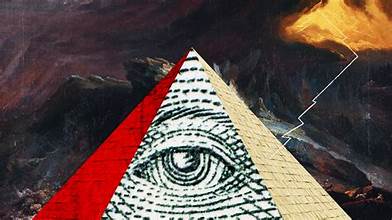
Core Traits of a Conspirituality Belief System
- Belief in a hidden group secretly steering world events.
- Belief that humanity is undergoing a consciousness “pattern of shift.”
- Distrust of mainstream science, medicine, and media.
- A strong sense of personal enlightenment or chosen awareness.
- Heavy reliance on social media and influencer networks for information.
History of Conspirituality
The history is more recent as a formal academic term, but the underlying pattern is old. Researchers Charlotte Ward and David Voas coined the word “conspirituality” in a 2011 paper published in the Journal of Contemporary Religion, describing it as a growing web movement that blends the female-associated optimism of New Age culture with the male-associated pessimism of conspiracy theory. They noted it had already built its own celebrities, bestselling books, and media platforms well before the term existed.
But scholars studying the history point out that the roots go back much further. Western esoteric traditions—Theosophy, occultism, and 19th-century spiritualist movements—have long mixed cosmic belief systems with claims about hidden elites and secret societies. In that sense, conspirituality isn’t a brand-new invention; it’s a modern, internet-accelerated version of a pattern spiritual communities have shown for over a century.
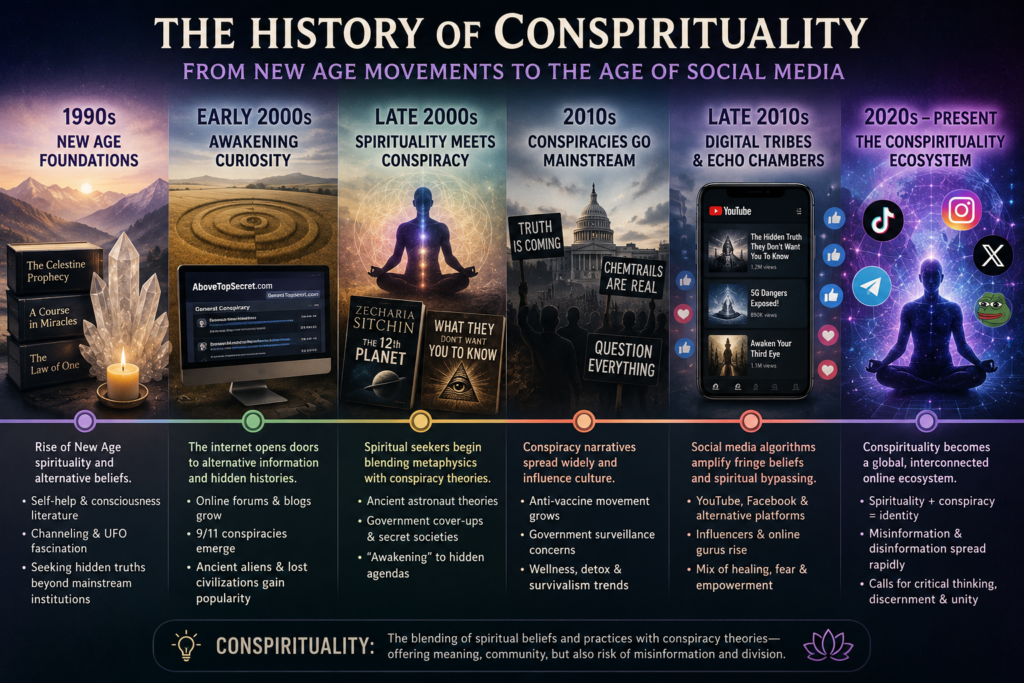
Key Milestones in the History of Conspirituality
- 1990s — New Age communities begin absorbing conspiracy narratives around government cover-ups and secret world orders.
- 2011 — The term is formally defined in academic research.
- 2016–2020 — Wellness influencers on Instagram and YouTube begin blending health advice with anti-establishment claims.
- 2020–2021 — The COVID-19 pandemic becomes a major accelerant, pushing yoga and wellness communities toward QAnon-adjacent beliefs.
- Present day—Podcasts, documentaries, and academic journals now track conspirituality as an ongoing social phenomenon.
Spirituality and Conspiracy Theory: An Unlikely Pairing
At first glance, spirituality and conspiracy theory look like opposites. Spirituality tends to emphasize love, unity, and inner peace. Conspiracy theory tends to emphasize suspicion, threat, and hidden enemies. So why do they merge so easily?
The answer lies in shared emotional needs. Both spirituality and conspiracy theory offer the following:
- A sense of special knowledge that most people don’t have.
- A simple explanation for a complicated, uncertain world.
- A community of like-minded believers.
- A feeling of control during periods of chaos or fear.
When someone already trusts intuition, energy, or “inner truth” over institutional authority, it becomes easier to extend that same trust to a conspiracy theory that also positions itself as forbidden or suppressed knowledge. This is why the bridge between spirituality and conspiracy theory tends to form fastest during collective crises—pandemics, elections, economic downturns—when uncertainty is high, and people are actively searching for meaning.
Psychology of Conspirituality
The psychology of this has become a genuine area of academic research, not just cultural commentary. Studies on cognitive correlates of conspiritual belief have found that people drawn to this worldview often show a strong need for meaning and pattern recognition, even in random or ambiguous events.
Why the Brain Is Drawn to Conspirituality
- Pattern-seeking under uncertainty — Humans are wired to find patterns, even false ones, when facing unpredictable events.
- Need for uniqueness — Believing you have privileged, secret knowledge feels psychologically rewarding.
- Distrust of institutions — Prior negative experiences with medicine, government, or media lower the bar for accepting alternative claims.
- Emotional regulation — Conspirituality can offer comfort by transforming fear into a sense of destiny or mission.
- Trauma response—Some psychological research links trauma histories to more binary, all-or-nothing thinking, which can make black-and-white conspiracy narratives more appealing.
Understanding the psychology of this term matters because it reframes the issue. People who fall into conspirituality are rarely unintelligent—they are often deeply invested in personal growth and meaning-making, traits that are otherwise healthy but that can be redirected toward misinformation under the right conditions.
Social Media Spirituality and the Spread of Conspirituality
Social media spirituality has been the single biggest accelerant of this term in the past decade. Algorithms reward emotionally intense content, and conspirituality content—dramatic warnings, secret truths, and “wake up” messaging—performs extremely well.
How Social Media Spirituality Fuels Conspirituality
- Algorithmic amplification: Platforms push emotionally charged spiritual content because it drives engagement.
- Influencer trust: Wellness influencers build years of personal trust before introducing conspiratorial claims, making followers less skeptical.
- Aesthetic packaging: Soft colors, calming voiceovers, and spiritual language make extreme claims feel gentle and safe.
- Community reinforcement: Comment sections and private groups create echo chambers that validate the belief instead of challenging it.
A Real-World Example
During the COVID-19 pandemic, researchers and journalists documented a sharp rise in wellness and yoga influencers sharing anti-vaccine and anti-mask content alongside their usual spiritual posts. Instagram accounts once focused purely on breathing exercises and affirmations began posting about hidden elites, population control, and “5D consciousness.” This pattern was widely reported by outlets covering the wellness industry and became one of the clearest public examples of social media spirituality merging with conspiracy theory in real time.
Spiritual Conspiracy Theory Examples You’ve Probably Seen
A spiritual conspiracy theory usually follows a recognizable formula: cosmic language plus a secret villain. Common examples include:
- Claims that vaccines interfere with your “energetic field” or spiritual DNA.
- Belief that a secret cabal is blocking humanity’s “ascension” to higher consciousness.
- Claims that mainstream medicine suppresses natural or energetic healing to protect pharmaceutical profits.
- Belief that global events (pandemics, wars, elections) are staged to prevent a spiritual awakening.
- A non-adjacent claim recast in spiritual language, such as “lightworkers” fighting “dark forces.”
Each spiritual conspiracy theory borrows the emotional comfort of spirituality while smuggling in unverified and often harmful claims about the world.
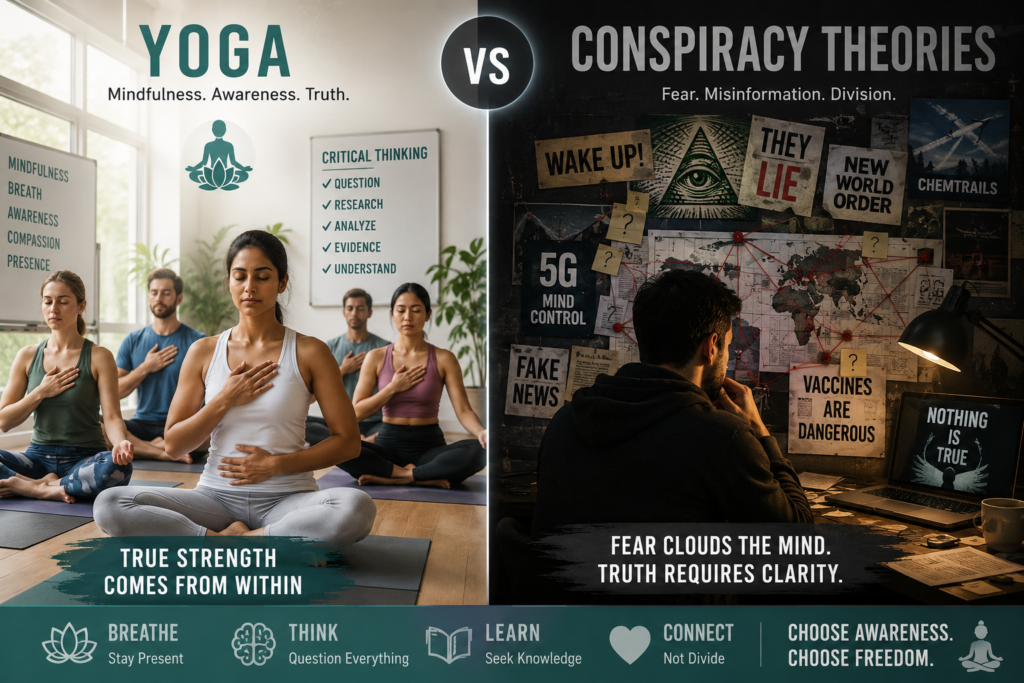
Yoga Vs Conspiracy Theory: Why the Yoga World Became a Hotspot
The yoga vs conspiracy theory debate has become a genuine topic of concern within the wellness industry itself. Yoga teachers, studio owners, and long-time practitioners have publicly pushed back against the rise of conspirituality within their community.
Why Yoga Communities Are Vulnerable
- Yoga philosophy already emphasizes intuition, energy, and skepticism of “mainstream” systems, which can lower resistance to other alternative claims.
- Many yoga teachers work as independent influencers rather than under an institutional body, so there’s little oversight on what they share.
- Physical wellness spaces build high trust and intimacy, making followers more receptive to a teacher’s opinions beyond just physical practice.
How the Yoga Community Is Responding
Some yoga teachers and studios have taken a public stand, explicitly separating the practice of yoga (breathing, movement, physical health) from unverified political or medical claims. This yoga vs conspiracy theory pushback is a healthy sign—it shows the wellness community recognizing the issue and drawing clearer boundaries around what’s opinion versus what’s evidence-based.
Effects of Conspirituality on Individuals and Society
The effects reach further than a single social media post. They show up in relationships, health decisions, and even public health outcomes.
Personal Effects of Conspirituality
- Strained relationships with family and friends who don’t share the same beliefs.
- Rejection of evidence-based medical care in favor of unproven alternatives.
- Increased isolation as believers retreat into like-minded online communities.
- Financial exploitation, since conspirituality often overlaps with paid courses, supplements, or “awakening” programs.
Societal Effects of Conspirituality
- Reduced vaccination rates and public health compliance during outbreaks.
- Spread of misinformation that undermines trust in legitimate institutions.
- Radicalization pathways, where spiritual language becomes a gateway into extremist political movements.
- Erosion of nuanced public discourse, since conspirituality thrives on absolute claims rather than probability and evidence.
Recognizing the effects of conspirituality early—in yourself or someone you care about—is far easier than reversing deep belief once it has taken hold.
Critical Thinking: Your Best Defense Against Conspirituality
Critical thinking is the single most reliable tool against conspirituality, and it can be practiced like a skill, not just an inborn trait.
Practical Steps to Strengthen Critical Thinking
- Ask for the source. Where did this claim originate, and can it be independently verified?
- Check the incentive. Is the person sharing this claim selling something (a course, supplement, or membership)?
- Separate feeling from fact. A claim feeling emotionally true doesn’t make it factually true.
- Look for falsifiability. Can the claim ever be proven wrong, or is it designed to explain away any contradicting evidence?
- Diversify your information sources. Relying on a single influencer or platform increases vulnerability to conspiracism.
- Practice tolerating uncertainty. Not every world event has a tidy explanation—and that’s okay.
Building critical thinking habits doesn’t mean abandoning spirituality. It means holding both curiosity and evidence together, rather than letting one replace the other.
Conspirituality Research: What Scholars Are Finding
Research on this has grown rapidly since Ward and Voas’s original 2011 paper. Academic interest has expanded well beyond sociology into psychology, religious studies, and media studies.
Current Directions in Conspirituality Research
- Studies examining the cognitive traits linked to conspiritual belief and well-being.
- Research tracing conspirituality’s roots deeper into 19th-century Western esotericism, not just recent internet culture.
- Media studies analyzing how platform algorithms accelerate this content specifically.
- Cross-cultural research studying conspirituality’s different expressions in countries like Australia, Israel, and across Europe.
- Podcasts and long-form journalism (such as dedicated podcasts) that track real-time cases as they emerge online.
This growing body of this term’s research matters because it moves the conversation from moral judgment (“these people are foolish”) toward genuine understanding (“this is a predictable psychological and social pattern that can be studied and addressed”).
Pros, Cons, and Key Insights
| Perspective | Insight |
| Pro | Spiritual communities that build genuine critical thinking and evidence-based practices can offer real comfort and community without sliding into conspirituality. |
| Con | Conspirituality can lead to real-world harm: rejected medical care, damaged relationships, and financial exploitation. |
| Key Insight | The line between healthy spirituality and conspirituality isn’t the belief in energy or intuition—it’s whether claims are held open to evidence or defended against all contradicting information. |
Expert Perspective
Researchers who study new religious movements consistently point to one distinguishing feature: healthy spiritual questioning of mainstream systems remains open to genuine evidence and stays non-violent, while it treats feelings and personal certainty as the final arbiter of truth, regardless of contradicting facts. That single distinction is often the clearest test anyone can apply, whether they’re a scholar, a yoga teacher, or someone scrolling their own feed.
Conclusion
Conspirituality sits at a strange crossroads—one path leads to genuine self-reflection and community, the other leads to misinformation and isolation. Understanding what conspirituality is, where it came from, and why it spreads so effectively on social media gives you the tools to recognize it before it takes hold. The antidote isn’t rejecting spirituality altogether; it’s pairing spiritual openness with steady critical thinking, so curiosity about the world never turns into certainty about a hidden one. The next time a spiritual claim online feels too urgent, too secretive, or too certain, pause and ask where the evidence actually lives—that single habit is the strongest protection against this available to anyone.
FQA:
- 1. What is conspirituality in simple terms? Conspirituality is the blending of New Age spiritual beliefs with conspiracy theories, where spiritual language like “awakening” or “energy” is used to explain claims about hidden elites or secret world control.
- Who coined the term conspirituality? Researchers Charlotte Ward and David Voas coined the term in a 2011 paper published in the Journal of Contemporary Religion.
- Why do spiritual communities attract conspiracy theories? Spiritual communities often emphasize intuition and skepticism of mainstream systems, which can lower resistance to other alternative or unverified claims, especially during times of uncertainty.
- What are the effects of conspirituality on public health? Conspirituality has been linked to lower vaccination rates, rejection of medical treatment, and reduced trust in public health guidance during events like the COVID-19 pandemic.
- How can critical thinking help against conspirituality? Critical thinking helps by encouraging people to check sources, question incentives, separate emotion from fact, and stay open to evidence rather than defending a belief against all contradicting information.
- 6. Is conspirituality only found in yoga and wellness communities? While yoga and wellness spaces have been widely documented as hotspots, conspirituality also appears in New Age spiritual communities, alternative health circles, and various online spiritual movements worldwide.