“Bhuta Suddhi“—two words that hold the entire secret of human transformation. Bhuta Suddhi, the yogic science of purifying the five elements that compose your body and the cosmos, is not merely a practice. Bhuta Suddhi is the gateway through which ancient masters walked to attain absolute clarity of body, mind, and spirit. In a world where yoga in the modern world has become synonymous with physical postures and wellness, this profound practice calls us back to something far more essential—the very fabric of existence itself. It is essential for every yoga practitioner to initially practice Bhuta Suddhi for the entire cleansing of the body. Then start Pranayama and other Asanas as per his guru’s advice for achieving the desired result.
If you have ever felt disconnected, heavy, foggy, or emotionally reactive without knowing why, the answer may lie in the imbalance of your five elements: earth (Prithvi), water (Jala), fire (Agni), air (Vayu), and space (Akasha). Bhuta Suddhi offers a systematic, time-tested path to restore that balance—and the effects are nothing short of extraordinary.
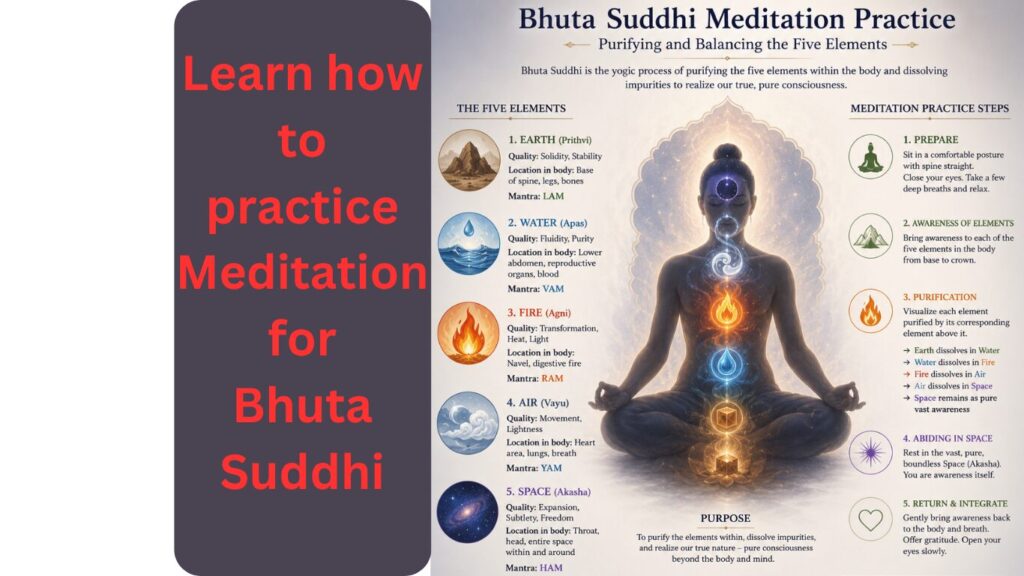
What Is Bhuta Suddhi? The Ancient Foundation of Elemental Purification
The term “Bhuta Suddhi” comes from Sanskrit: “Bhuta” means “something that possesses physicality” or the body, and “Suddhi” means “purification” or “cleansing.” Together, Bhuta Suddhi translates to the purification of the body or the five elements that lie within the body, or the Pancha Bhutas, that constitute every living being and the universe at large.
This is not a metaphor. According to yogic science and Samkhya philosophy, the human body is a microcosm of the cosmos. The same five elements that shape mountains, rivers, flames, winds, and the vast sky also form your bones, blood, body heat, breath, and consciousness. When these five elements fall out of alignment — through stress, poor diet, emotional suppression, or environmental toxins — disease, confusion, and suffering arise.
The Ancient Roots: Where Bhuta Suddhi Comes From
Bhuta Suddhi finds its earliest mention in the Tantric tradition and the Shaiva traditions of India, particularly in texts like the Mahanirvana Tantra, Shiva Samhita, and Gheranda Samhita. It is also a central preparatory ritual in many Hindu worship systems—specifically in Puja, where the practitioner purifies their inner elements before inviting the God or the Deity. Without Bhuta Suddhi, it is very difficult to achieve the desired result.
What is remarkable — and rarely discussed — is the convergence of this elemental understanding across spiritual traditions worldwide. Early Christian mystics, particularly those of the Desert Father tradition, spoke of purifying the “four humors” (analogous to earth, water, fire, and air) as a prerequisite for divine union. Some scholars of esoteric Christianity have drawn compelling parallels between the fasting, breath-prayer, and elemental purification practices of Jesus Christ’s 40 days in the desert and the Bhuta Suddhi process of systematically quieting the elemental nature of the body to reveal the spirit beneath. The purification of the gross body to reveal the divine—this thread runs through every authentic tradition.
The Five Elements: Understanding What You Are Purifying
Before explaining the types of Bhuta Suddhi, it is essential to understand the five elements from the yogic perspective. These are not merely physical substances but dimensions of experience, each governing specific aspects of physiology and psychology.
| Element | Sanskrit | Body Correspondence | Psychological Quality |
| Earth | Prithvi | Bones, flesh, smell | Stability, groundedness |
| Water | Jala | Blood, fluids, taste | Emotional flow, adaptability |
| Fire | Agni | Body heat, digestion, sight | Transformation, willpower |
| Air | Vayu | Breath, touch, movement | Expansion, creativity |
| Space | Akasha | Cavities, sound, consciousness | Stillness, receptivity |
The purification of the above elements by Bhuta Suddhi works on each of these dimensions simultaneously—restoring harmony between the inner world and the outer world.
Types of Bhuta Suddhi: The Different Paths to Elemental Purification
Not all practices labeled Bhuta Suddhi are identical. The tradition recognizes several distinct types of Bhuta Suddhi, each suited to different practitioners and lineages.
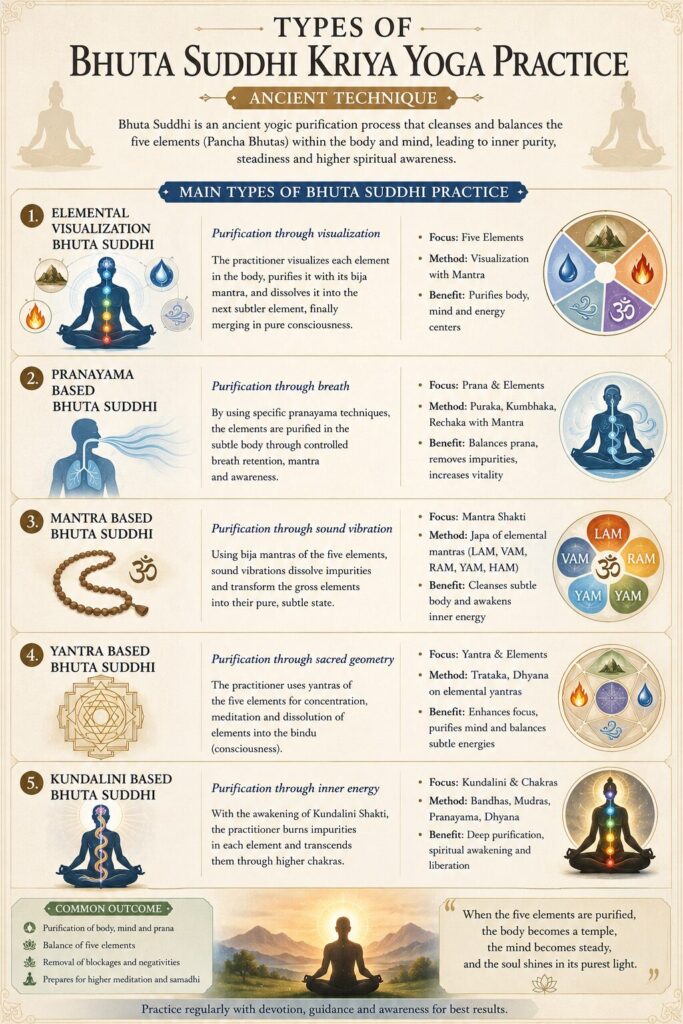
1. Tantric Bhuta Suddhi (Ritual-Based)
This is the classical form practiced before Puja (ritual worship) in Shakta and Shaiva traditions. The practitioner mentally dissolves each element into the next in a meditative sequence—earth dissolves into water, water into fire, fire into air, air into space, and finally space dissolves into pure consciousness. It is done through a combination of mantra, visualization, and pranayama.
2. Hatha Yoga Bhuta Suddhi (Asana and Pranayama-Based)
This form integrates the best yoga asanas like Mahamudra for Bhuta Suddhi with specific breathing techniques and mudras. Each asana family refers to an element—grounding poses for earth, fluid poses for water, dynamic core work for fire, expansive stretches for air, and stillness in meditation for space.
3. Laya Yoga Bhuta Suddhi (Chakra-Based)
Here, the five elements are correlated with the lower five chakras: Muladhara (earth), Svadhisthana (water), Manipura (fire), Anahata (air), and Vishuddha (space). The Bhuta Suddhi practice involves awakening each chakra in sequence through concentration, mantra, and breath.
4. Dietary Bhuta Suddhi
A less-talked-about but powerful form involving conscious food choices aligned with elemental balance. Different foods strengthen or pacify specific elements — a concept deeply aligned with Ayurvedic principles.
5. Isha Bhuta Suddhi (Contemporary Application)
The Isha Foundation under Sadhguru has revived and structured Bhuta Suddhi as a standalone practice widely accessible to modern practitioners, making the wisdom of Bhuta Suddhi available without years of traditional initiation.
Purification of Five Elements by Bhuta Suddhi: The Science Behind the Practice
The purification of five elements by Bhuta Suddhi is simply not blind faith—it is an experience-based science refined over thousands of years. Here is what actually happens during a Bhuta Suddhi practice:
Earth Element Purification
The earth element governs solidity and structure. When purified, bones become strong, the immune system stabilizes, and groundedness replaces chronic anxiety. Practices include seated grounding meditations, the Prithvi mudra, and the mantra Lam.
Water Element Purification
Water governs fluidity—in emotions, in blood, and in lymph. Purification of the water element releases emotional stagnation, improves hormonal health, and cultivates compassion. Mantra: Vam. Associated practices involve fluid movement, hip-opening asanas, and breath retention.
Fire Element Purification
Agni — fire — is the most transformative element. In yoga in the modern world, fire purification translates into metabolic health, courage, and clarity of purpose. Mantra: Ram. Kapalabhati pranayama and core-strengthening asanas are primary tools.
Air Element Purification
The air element governs the nervous system and the quality of thought. A purified air element manifests as calm, creative, flexible thinking. Anulom Vilom Pranayama and full-body expansive stretches are essential here. Mantra: Yam.
Space Element Purification
Space (Akasha) is the most subtle element — the field in which all others arise. Its purification leads to expanded awareness, deep silence, and what contemplatives across traditions have called “inner stillness.” Mantra: Ham. Long periods of meditation in stillness are the primary practice.
How to Perform Bhuta Suddhi Kriya: A Step-by-Step Guide:
Learning how to perform Bhuta Suddhi Kriya requires patience, consistency, and ideally, guidance from a trained teacher. The following is a foundational practice suitable for beginners, drawn from classical sources.
Preparation
- Practice on an empty stomach (at least 4 hours after eating)
- Choose a clean, quiet space—ideally the same spot each day
- Sit in a comfortable cross-legged position (Sukhasana or Padmasana)
- Spend 3–5 minutes simply observing the natural breath
The Core Bhuta Suddhi Kriya Sequence
Step 1 — Earth Dissolution Visualization (5 minutes): Close your eyes. Bring your attention to the base of your spine. Visualize a golden square — the symbol of earth — radiating stability. On every exhale, imagine the earth element becoming luminous, purified, and radiant. Internally chant Lam with each exhale.
Step 2 — Water Visualization (5 minutes): Shift attention to the sacral region. Visualize a silver crescent moon—a symbol of water—and all emotional residue softening and flowing away like water purifying itself. Internally chant Vam.
Step 3 — Fire Activation (5 minutes): Move attention to the navel center. Visualize a bright red, upward-pointing triangle—fire—burning away all impurities, all stagnation. Feel warmth spreading through the torso. Internally chant Ram.
Step 4 — Air Expansion (5 minutes): Bring awareness to the heart and lungs. Visualize a six-pointed star in green — the sign of air — and feel expansion with every inhale. Breathe deeper and fuller. Internally chant Yam.
Step 5 — Space Dissolution (5 minutes): Rest awareness at the throat and then the space between the eyebrows. There is no form here — only vast, open space. Allow all other elements to dissolve into this boundless awareness. Internally chant Ham.
Step 6 — Integration (5–10 minutes): Sit in silence. Allow the purified elements to settle. Experience yourself as a coherent, aligned, whole being. This is the completion of the Bhuta Suddhi practice.
From a yoga trainer’s recommendation: Practice Bhuta Suddhi Kriya for a long period to begin noticing tangible shifts in emotional stability, digestion, energy levels, and mental clarity.
Best Yoga Asanas for Bhuta Suddhi: Embodying the Elements
The best yoga asanas for Bhuta Suddhi work by bringing elemental awareness into physical form. Here is an element-by-element Asana guide:
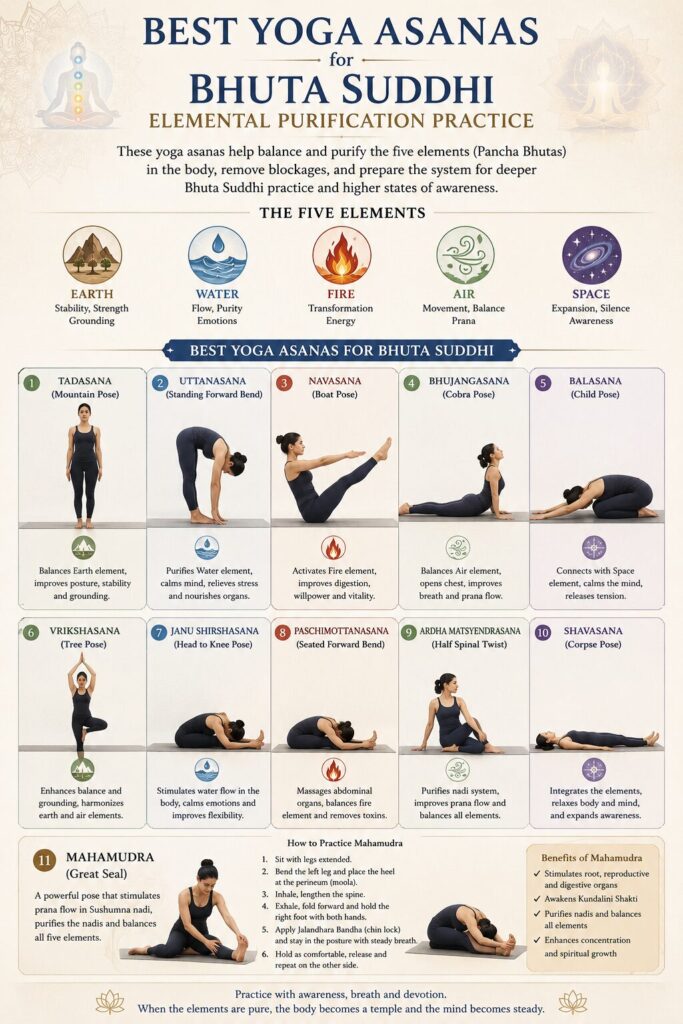
Earth Asanas (Stability and Grounding)
- Tadasana (Mountain Pose) — The quintessential earth posture. Stand rooted, spine tall, breath steady.
- Balasana (Child’s Pose) — Surrendering into the earth, releasing the need to control.
- Virabhadrasana I (Warrior I)—Power meeting the ground.
Water Asanas (Fluidity and Release)
- Baddha Konasana (Bound Angle Pose)—Opens the pelvis, governs the water element.
- Paschimottanasana (Seated Forward Bend) — Surrender, emotional release, fluid movement.
- Supta Matsyendrasana (Supine Spinal Twist) — Wringing out emotional stagnation.
Fire Asanas (Transformation and Strength)
- Navasana (Boat Pose) — Core fire, willpower, digestive strength.
- Surya Namaskar (Sun Salutation) — The complete fire practice, honoring Agni.
- Dhanurasana (Bow Pose) — Ignites the solar plexus and activates the Manipura chakra.
Air Asanas (Expansion and Breath)
- Ustrasana (Camel Pose) — Opens the heart and lungs, expands the air element.
- Bhujangasana (Cobra Pose) — Lifts and opens the chest.
- Vrikshasana (Tree Pose) — Balance, expansion, breathing room.
Space Asanas (Stillness and Awareness)
- Savasana (Corpse Pose) — The ultimate space practice. Surrender to awareness.
- Padmasana (Lotus Pose) — A container for boundless inner space.
The best yoga asanas for Bhuta Suddhi are most powerful when practiced with elemental awareness—not as a physical workout, but as a moving meditation that speaks to each element within you.
So far, as I know, Mahamudra is the best for achieving the greater result of Bhuta Suddhi.
Bhuta Suddhi in the Modern World: Why This Practice Has Never Been More Urgent
Yoga in the modern world faces a paradox. Access to yoga has never been greater — over 300 million people practice some form of it worldwide, and the global yoga market exceeded $37 billion in 2023. Yet anxiety, chronic disease, burnout, and existential emptiness are at historic highs.
The reason is clear to anyone who looks honestly: yoga in the modern world has largely been reduced to its physical dimension. The deeper sciences — pranayama, pratyahara, dharana, and practices like Bhuta Suddhi — have been left behind.
This matters enormously. A study published in the Journal of Alternative and Complementary Medicine found that elemental yoga practices combining breath, visualization, and mantra produced significantly greater reductions in cortisol levels compared to physical yoga practice alone. The ancient practitioners knew what neuroscience is now confirming: to change the mind, you must work with the subtle elements of existence, not merely the body.
Yoga in the modern world needs bhuta shuddhi, not as a mysterious add-on but as a foundational practice.
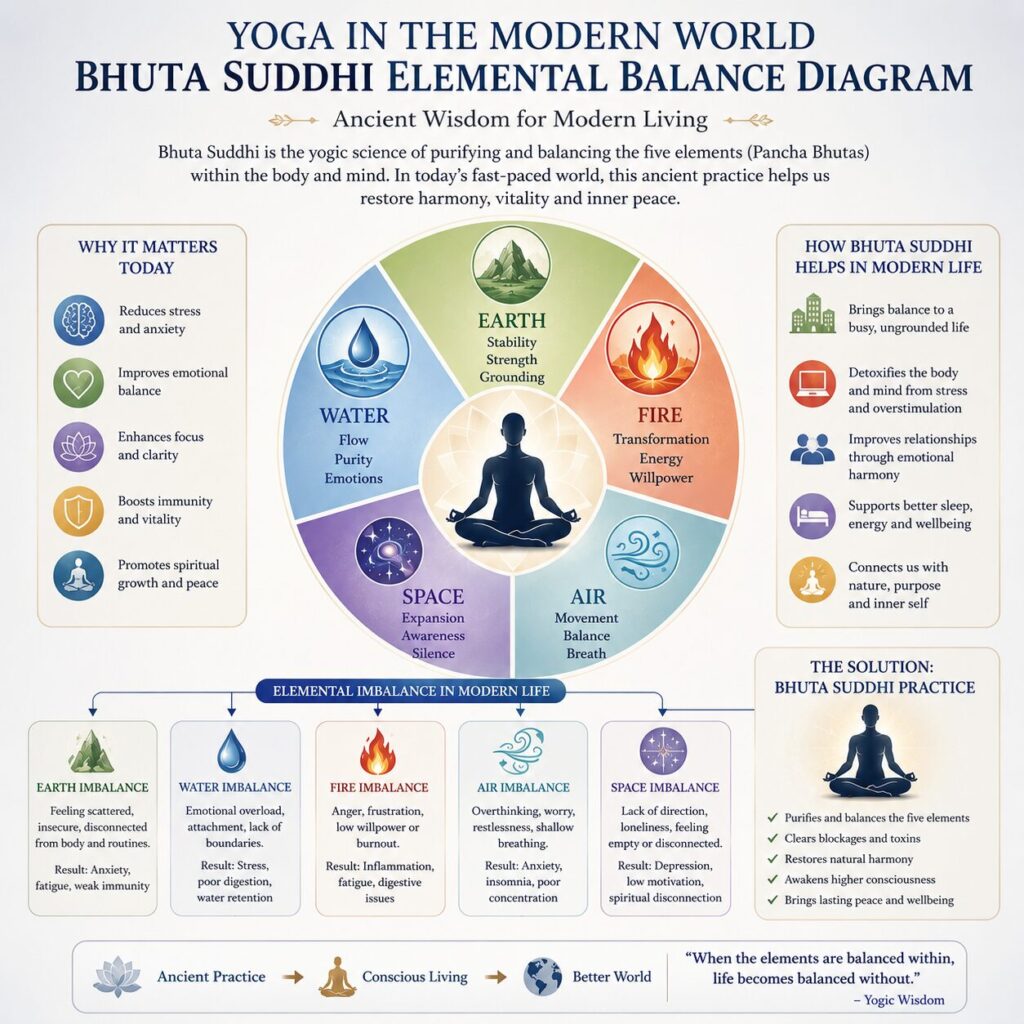
The Emotional Reality: What Elemental Imbalance Costs You
Consider for a moment: How often do you feel genuinely grounded? How often does your emotional life flow freely without getting stuck in loops of anxiety, resentment, or grief? How often do you feel the fire of genuine purpose — not just busy productivity, but real inner burning for something meaningful?
Most people in modern life are living with significant elemental imbalance—and suffering quietly because of it. The purification of the five elements by Bhuta Suddhi is not a luxury for spiritual seekers. It is a necessity for anyone who wants to live fully, love deeply, and function with clarity.
Pros and Cons of Bhuta Suddhi Practice
Pros
- Deep physiological impact — Works on nervous system regulation, digestion, and hormonal balance
- Accessible across traditions — Resonates with yogic, Tantric, Ayurvedic, and even contemplative Christian frameworks
- No equipment required — Breath, awareness, and intention are the only tools
- Cumulative benefits — Effects deepen significantly over weeks and months
- Complements all forms of yoga—Enhances any existing practice
Cons
- Requires consistency—Sporadic practice yields minimal results
- Traditional initiation preferred—Without guidance, subtle dimensions may be missed
- Results are not always immediate—The practice rewards patience, not urgency
- Contraindicated during acute illness — Avoid intense pranayama when unwell
Real-World Transformation: To Whom Is Bhuta Suddhi For?
Bhuta Suddhi is for anyone navigating the complexity of human life. It is for the executive who cannot sleep despite every material success. It is for the mother who gives everything and feels nothing left for herself. It is for the young seeker who has tried every productivity system and still feels empty. It is for the yogi who has mastered the physical practice and senses that there is something more vast beneath it.
The Bhuta Suddhi practice meets you where you are and takes you somewhere you cannot yet imagine.
Take the First Step Today
You do not need years of practice to begin. You do not need to renounce anything or go anywhere. The elements are already within you, waiting to be recognized and refined.
Start with 10 minutes tomorrow morning. Sit, close your eyes, and bring your awareness to the base of your spine. Feel the earth beneath you. Breathe. That is the first step of Bhuta Suddhi.
If you are ready to go deeper, find a qualified teacher, explore the Isha Foundation’s structured programs, or commit to the 21-day sequence outlined above. In yoga in the modern world, few practices carry the transformative depth of Bhuta Suddhi—and few are as urgently needed.
Your body is a cosmos. Treat it like one.
Conclusion: Bhuta Suddhi and the Return to Wholeness
Bhuta Suddhi is not a trend. It is not a technique to add to your wellness routine. It is a remembering—of what you are, what the world is, and how profoundly connected the two have always been.
The purification of five elements by Bhuta Suddhi restores the original harmony that was always there beneath the noise, the stress, and the accumulated imbalances of modern life. Whether you explore the classical types of Bhuta Suddhi, integrate the best yoga asanas for Bhuta Suddhi into your morning practice, or commit to learning how to perform Bhuta Suddhi Kriya in its full depth—every step moves you toward a life lived from wholeness rather than fragmentation.
In the most profound sense, the ancient sages who designed this practice and the mystics across traditions who paralleled its wisdom were pointing to the same truth: that the path inward is the path to everything. Bhuta Suddhi is one of the clearest, most time-tested maps for that journey.
Yoga in the modern world will be transformed not by adding more complexity, but by returning to this depth. Begin today.
FAQ:
Q1: What is Bhuta Suddhi, and why is it important?
A: Bhuta Suddhi is an ancient yogic and Tantric practice aimed at purifying the five elements — earth, water, fire, air, and space — that constitute the human body and the cosmos. It is important because elemental imbalance is considered the root cause of physical disease, emotional instability, and mental confusion. By systematically purifying these elements through specific practices, a practitioner can achieve profound health, clarity, and spiritual awakening. In yoga in the modern world, Bhuta Suddhi offers a depth that surface-level physical practice cannot provide.
Q2: What are the main types of Bhuta Suddhi?
A: The primary types of Bhuta Suddhi include (1) Tantric or ritual-based Bhuta Suddhi, involving mantra, visualization, and mental dissolution of the elements; (2) Hatha Yoga Bhuta Suddhi, integrating asanas and pranayama; (3) Laya Yoga Bhuta Suddhi, working through the chakra system; (4) Dietary Bhuta Suddhi, using conscious food choices aligned with elemental balance; and (5) contemporary structured forms such as those offered by the Isha Foundation. Each type offers a unique pathway into the purification of the five elements by Bhuta Suddhi.
Q3: How do you perform Bhuta Suddhi Kriya at home?
A: To perform Bhuta Suddhi Kriya at home, begin by sitting comfortably in a quiet space on an empty stomach. Sequentially bring awareness to each of the five elemental centers in the body—from the base of the spine (earth) upward through water, fire, air, and space—using visualization, specific bija mantras (Lam, Vam, Ram, Yam, Ham), and conscious breathing. Spend approximately 5 minutes on each element, then sit in silent integration for 5–10 minutes. Practice this Bhuta Suddhi sequence for a minimum of 21 consecutive days for meaningful results. Guidance from a qualified teacher is strongly recommended for deeper practice.
Q4: What are the best yoga asanas for Bhuta Suddhi?
A: The best yoga asanas for Bhuta Suddhi are organized by element. For earth: Tadasana, Balasana, and Virabhadrasana I. For water: Baddha Konasana, Paschimottanasana, and Supta Matsyendrasana. For fire: Navasana, Surya Namaskar, Dhanurasana. For air: Ustrasana, Bhujangasana, Vrikshasana. For space: Savasana and Padmasana. These asanas are most effective when practiced with elemental awareness and combined with the corresponding pranayama and mantra as part of a complete Bhuta Suddhi practice.
Q5: What are the benefits of Bhuta Suddhi practice?
A: Regular Bhuta Suddhi practice produces wide-ranging benefits across physical, mental, emotional, and spiritual dimensions. Physically, it improves digestive health, immunity, sleep quality, and nervous system regulation. Emotionally, it releases suppressed patterns and cultivates resilience, compassion, and emotional fluidity. Mentally, it sharpens focus, reduces anxiety, and expands perception. Spiritually, it accelerates the journey toward self-realization by purifying the gross body and making it a more refined vehicle for consciousness. As yoga in the modern world increasingly recognizes, these multi-dimensional benefits make Bhuta Suddhi one of the most comprehensive practices available.
Q6: How long does it take to see results from Bhuta Suddhi?
A: Results from Bhuta Suddhi vary by individual, but most consistent practitioners report noticeable shifts in energy, emotional stability, and sleep quality within 21 days of daily practice. Bigger physiological and psychological changes — including improved digestion, reduced anxiety, and expanded meditative depth — typically emerge over 3 to 6 months of sustained practice. The purification of the five elements by Bhuta Suddhi is cumulative and progressive; the longer and more consistently you practice, the more profound the transformation. Intensity of practice, diet, lifestyle alignment, and quality of instruction all influence.