The yogic view of Goddess Kali turns a terrifying image into a map of the mind. In the yogic view of Goddess Kali, her dark skin, wild hair, and blood-red tongue are not threats. They are teachings. This yogic view of Goddess Kali asks you to look at fear, ego, and ignorance without flinching. The yogic view of Goddess Kali also says that the power you fear outside you is the power asleep inside you. That is why the yogic view of Goddess Kali still speaks to seekers today.
Introduction: Why Kali Still Unsettles and Calls Us
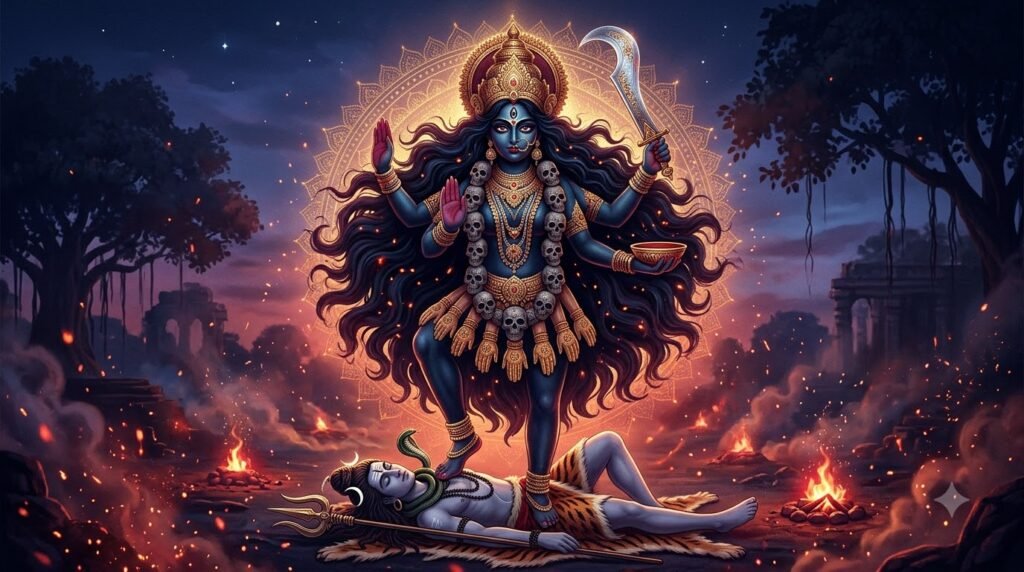
Most people meet Kali through a single image. She is black or deep blue. She is naked or lightly clothed. She wears a garland of heads. Her tongue is out. She stands on her husband’s chest.
The first reaction is often fear. That reaction is the doorway.
In Indian thought, a symbol that scares you is pointing at something you have not yet faced. The yogic tradition does not ask you to worship Kali from a distance. It asks you to recognize her as the force that ends illusion in your own life.
This article explores Goddess Kali and yoga as one path. You will learn the spiritual meaning of Goddess Kali, the layers of Goddess Kali symbolism, and how Kali Tantra, Kundalini, and Shiva Shakti philosophy fit together. You will also get simple practices to begin your own spiritual awakening.
If you have ever felt that something in you must end before something truer can begin, Kali is already speaking to you.
Who Is Kali? The Goddess Kali: Spiritual Meaning and Yogic View of Goddess Kali
The name Kali comes from the Sanskrit word kala. Kala means both “time” and “black.” She is the dark mother of time, the power that eats everything that is born.
This is the first key to the Goddess Kali’s spiritual meaning. She is not evil. She is time itself, and time is the one thing no ego can defeat.
Where Kali Appears in the Texts
Kali’s early literary roots appear in the Devi Mahatmya, a section of the Markandeya Purana usually dated to about the 5th or 6th century CE. In it, she springs from the brow of the goddess Durga during battle and destroys the demon Raktabija. Every drop of his blood created a new demon. Kali drank the blood before it could touch the ground.
A yogic reading sees a deeper story. Raktabija is the mind’s habit of multiplying desires and fears. Each thought breeds ten more. Kali does not fight each one. She swallows the root.
Later, Tantric texts placed Kali at the very center of worship. In the Kali Tantra tradition, and in groups known as the Kalikula, she becomes the highest reality, not just a warrior goddess.
The Bengali Devotional Turn
In Bengal, poets such as Ramprasad Sen (18th century) sang to Kali as a mother. He scolded her, begged her, and loved her like a child. This devotional stream softened the terrifying image without erasing its power. Kali became both the destroyer of fear and the one who holds you when fear arrives.
This double nature is the heart of the Goddess Kali’s spiritual meaning: she is terrifying to the ego and tender to the soul.
The Yogic View of Goddess Kali: Fear, Ego, and Ignorance
To understand the yogic view of Goddess Kali, we need to start with yogic philosophy itself.
Patanjali’s Yoga Sutra (about 2nd century BCE to 4th century CE) names five kleshas, or afflictions, that cloud the mind (Sutra 2.3):
- Avidya—ignorance of our true nature
- Asmita—ego, the sense of “I am this small self”
- Raga–attachment
- Dvesha—aversion
- Abhinivesha—clinging to life, the root fear of death
Now look at Kali again. Each of her fierce acts answers one of these five.
Kali as the End of Ignorance
Avidya is not a lack of information. It is mistaking the changing body and mind for the self. Kali’s dark form is the unknown that dissolves this mistake. Darkness here is not the absence of light. It is the space before any form, where nothing is yet claimed.
Kali as the End of Ego
The severed head in her hand is the most direct sign. The head stands for the thinking, comparing, self-defending mind. Kali removes it, and what remains is awareness without a name.
Kali as the End of Fear
She lives in the cremation ground. Why there? Because the fear of death is the deepest knot (abhinivesha). By sitting in the place everyone avoids, Kali shows that nothing real can be lost there.
This is the core of the yogic view of Goddess Kali: her fierce divine energy is a metaphor for the inner journey from fear, ego, and ignorance toward self-realization.
Goddess Kali Symbolism: What Each Image Teaches
Goddess Kali symbolism is rich, and each part of her form works like a lesson in meditation. Here is a simple guide.
Dark Skin
Black absorbs all color. In Tantric thought, Kali’s colour shows that she contains every form and goes beyond all form. Some teachers call it the color of the infinite sky at night.
The Garland of Skulls
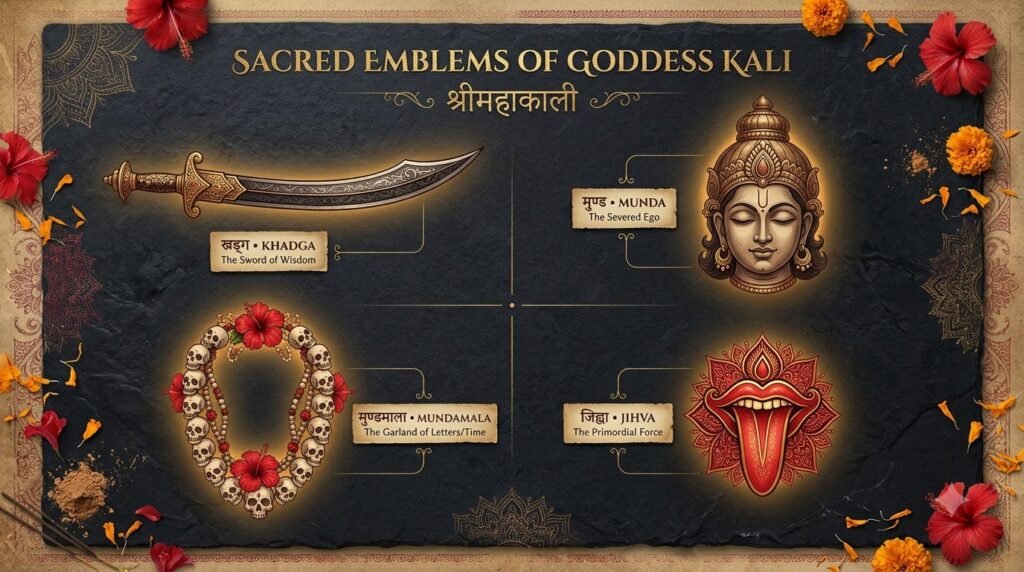
Traditional sources, including the scholar Sir John Woodroffe (writing as Arthur Avalon), explain that the garland often has 50 heads. They match the 50 letters of the Sanskrit alphabet. Sound creates language. Language creates our mental world. Kali wears these letters as ornaments, which means she is the source of thought and also its master.
The Red Tongue
The tongue is often explained in two ways. In folk stories, she bites it in shame after stepping on Shiva. In yogic reading, red is rajas, passionate energy, held in check by white teeth, which stand for sattva, purity. Raw power is being brought under awareness.
The Sword and the Severed Head
The sword is discriminating wisdom (viveka). It cuts illusion. The head is the ego, cut free.
The Raised Hand and the Offering Hand
In many images, one hand blesses and another grants freedom from fear. Terror and mercy appear together. This teaches that liberation is not gentle with the ego, yet it is deeply kind to the self.
Standing on Shiva
This is the most misunderstood image. She is not defeating him. She is dancing on still consciousness, which leads us to the next idea.
Shiva Shakti Philosophy: Stillness and Power
Shiva Shakti philosophy is the foundation of Tantra. It says that reality has two faces:
- Shiva is pure, still awareness. He does nothing, and he is everything.
- Shakti is dynamic energy. She creates, sustains, and dissolves the world.
They are not two beings. They are one reality seen from two sides, like fire and its heat.
In the Kashmir Shaiva tradition, the 11th-century master Abhinavagupta wrote that consciousness (prakasha) always carries the power to know and act (vimarsha). Without Shakti, Shiva would be a silent corpse (shava). Without Shiva, Shakti would have no ground.
This explains the image of Kali on Shiva. Many scholars note that Shiva without Shakti is described as a corpse, shava, in Tantric verse. The dance of Kali is energy moving on the ground of awareness. When the dance stops, the dancer sees she is never separate from the ground.
For your own life, this means:
- Your calm mind is Shiva.
- Your energy, emotion, and drive are Shakti.
- A healthy inner life needs both, and Kali teaches you to unite them.
Kali Tantra: The Path of Direct Transformation
The word “Tantra” means “to weave” or “to expand.” Kali Tantra is the stream of practice that places Kali as the supreme reality and uses every part of life, including fear, as fuel for awakening.
The Mahanirvana Tantra, a text probably composed between the 16th and 18th centuries, speaks of Kali as the formless one who swallows time. It also describes worship that is open to householders, not only monks.
Core Ideas in Kali Tantra
- Nothing is excluded. What you reject in yourself becomes a teacher.
- Direct experience over belief. Practice (sadhana) matters more than debate.
- A guide is needed. Traditional Tantra stresses learning from a qualified teacher, especially for intense practices.
- Inner worship first. Outer rituals are tools. The true altar is your own awareness.
A Note on Misunderstanding
Popular culture often links Tantra only with ritual shock or sensuality. Serious texts treat these elements as symbolic or as advanced practices under guidance. The heart of Kali Tantra is courage: seeing yourself clearly and letting what is false fall away.
Kali and Kundalini: The Serpent Power Within
In yogic anatomy, Kundalini is the coiled energy at the base of the spine. The word comes from “kundala,” “coil.” Texts such as the Hatha Yoga Pradipika (15th century) and the Shat-Chakra-Nirupana (16th century, translated by Woodroffe as The Serpent Power) describe it rising through the central channel (sushumna) and moving through the chakras until it meets Shiva at the crown.
The link between Kali and Kundalini is direct. Kundalini is Shakti in its sleeping form. Kali is Shakti in its fierce, awakening form.
When Kundalini rises, many traditions say, it burns through knots (granthis) in the body and mind. These knots are the very fears and ego patterns that Kali destroys in myth.

The Three Knots
- Brahma granthi (base): fear of survival, attachment to the body
- Vishnu granthi (heart): attachment to love, identity, and roles
- Rudra granthi (brow): attachment to the thinking self and spiritual pride
Seen this way, the stories of Kali are a map of what Kundalini does inside you.
Kali and Kundalini Yoga in Practice
Kali and Kundalini Yoga meet in practices that awaken energy safely and steadily. These include:
- Breathwork (pranayama), such as alternate nostril breathing
- Mantra repetition
- Locks (bandhas) that hold and direct energy
- Meditation on the chakras
- Sitting in silence with strong emotion
A word of care: strong Kundalini techniques can bring up intense feelings or physical effects. If you have a history of trauma, panic, or mental health conditions, go slowly and seek a trained teacher. Anyone with a medical condition should speak with a doctor before practicing advanced breathwork.
Goddess Kali and Yogic View: A Living Practice
Goddess Kali and Yoga are not two subjects. In the yogic view of Goddess Kali, each limb of Patanjali’s eightfold path has a Kali face:
- Yama and niyama(ethics): honesty about your shadow
- Asana(posture): grounding the body so energy can move
- Pranayama(breath): taming the wild force of life
- Pratyahara(withdrawal): turning from outer noise
- Dharana and dhyana(focus and meditation): staying with what arises
- Samadhi(absorption): the death of the small self and the birth of the true Self
This is the real meaning of “dying before you die,” a phrase echoed across mystic traditions.

Key Insights, Benefits and Honest Limits
Benefits Practitioners Often Report
- Less fear of change, loss, and uncertainty
- A steadier relationship with anger and intensity
- Greater honesty with oneself
- A deeper sense of meaning in hard seasons
- Stronger devotion and inner courage
Pros and Cons of This Path
Pros
- Gives a rich language for facing the shadow
- Combines devotion, philosophy, and practice
- Works with life as it is, not as we wish it to be
Cons
- Can be misread as violent or dark
- Intense practices need guidance
- It is not a substitute for therapy or medical care when those are needed
Key Insights to Remember
- Kali is time, and time ends every false identity.
- Her fierceness is compassion for the soul, even when it is a threat to the ego.
- Shiva Shakti philosophy shows that power and peace are one.
- Kundalini is Kali’s energy at work inside the body.
- Spiritual awakening is not an escape from life. It is a deeper entry into it.
Practical Steps: Begin Your Own Spiritual Awakening
You do not need a temple to start. Try this simple, gentle sequence for 10 to 20 minutes a day.
- Set an intention. Say quietly, “May what is false in me dissolve.” Keep it simple.
- Ground your body.Sit with a straight spine. Feel the weight of your body on the floor.
- Breathe evenly. Inhale for four counts, exhale for six. Do this for two minutes.
- Name one fear. Say it in a single sentence. Do not argue with it.
- Watch it like time passing. Notice how the fear rises, changes, and fades. This is Kali as
- Repeat a mantra. A well-known one is Om Krim Kalikayai Namah. Say it softly, slowly, 21 times.
- Rest in silence. Let the mind settle. Notice the quiet behind the thoughts. That quiet is Shiva.
- Close with gratitude. Thank the part of you that was brave enough to look.
Expert Recommendations
- Start small and stay consistent. Short daily practice beats occasional long sessions.
- Keep a journal of fears, dreams, and patterns.
- Study a text slowly, such as the Yoga Sutras or a trusted translation of the Devi Mahatmya, where you will get the details
- Find a qualified teacher before attempting strong Kundalini techniques.
- Combine inner practice with kindness in daily life. Awakening that does not soften the heart is incomplete.
Real-World Example: Ramakrishna and the Mother
The best-known example of Kali devotion in modern India is Sri Ramakrishna Paramahamsa (1836–1886). He served as a priest at the Dakshineswar Kali Temple, founded in 1855 by Rani Rashmoni. His disciples recorded that he wept for the Mother’s vision, nearly ending his own life in longing before he experienced what he described as an ocean of light.
Later, he taught that Kali is not separate from Brahman, the formless absolute. He compared them to fire and its power to burn: you cannot have one without the other. His disciple Swami Vivekananda carried this vision around the world, and his poem Kali the Mother speaks bluntly of embracing destruction as part of life.
What can we learn from his story?
- Devotion and philosophy are not opposites.
- Fear can become love when met with sincerity.
- Realisation often arrives through surrender, not control.
Scholars such as David Kinsley (The Sword and the Flute, Hindu Goddesses) and Rachel Fell McDermott (Mother of My Heart, Daughter of My Dreams) also show how Kali’s meaning has changed across centuries, from battlefield goddess to compassionate mother. That range proves how deep and flexible the image is.
Conclusion: Meeting Kali Within
The yogic view of Goddess Kali is a call to courage. She does not ask you to become fearless by force. She asks you to look at what you fear until it loses its hold. Her sword cuts ignorance, her garland honours the power of mind and sound, and her dance on Shiva shows that energy and stillness are one.
Through Kali Tantra, Kundalini, and the wider yogic philosophy, her image becomes a guide for spiritual awakening. She is time, truth, and the mother who holds you while the old self falls away.
If something in you is tired of hiding, begin today. Sit for ten minutes. Name one fear. Breathe. Let Kali’s quiet fire do its work. Share this article with a friend who is walking through a hard season, and start your practice tonight. The power you have been seeking was never outside you.
Frequently Asked Questions About the Yogic View of Goddess Kali
- What is the yogic view of Goddess Kali?
The yogic view of Goddess Kali sees her as a symbol of the inner force that destroys fear, ego and ignorance. Her fierce form points to the death of false identity so that the true Self can be known.
- What is the Goddess Kali’s spiritual meaning?
Kali means “time” and “black.” Her spiritual meaning is that all forms arise and dissolve in time, and that freedom comes when we stop clinging to what must change.
- Why does Kali stand on Shiva?
In Shiva Shakti philosophy, Shiva is still awareness, and Kali is active energy. She stands on him to show that power moves on the ground of consciousness. They are one reality in two aspects.
- What does the garland of skulls mean in Goddess Kali symbolism?
Traditional explanations link the 50 heads to the 50 letters of the Sanskrit alphabet. They represent the power of sound and thought, which Kali holds under her control.
- How are Kali and Kundalini connected?
Kundalini is Shakti resting at the base of the spine. Kali is the fierce form of that same Shakti, burning through inner knots as Kundalini rises toward the crown.
- What is Kali Tantra?
Kali Tantra is a spiritual stream that treats Kali as supreme reality. It uses meditation, mantra, ritual, and honest self-inquiry to move beyond fear and ego, ideally with a qualified teacher.
- Is Kali and Kundalini Yoga safe for beginners?
Gentle practices such as slow breathing, mantra, and meditation are generally suitable for beginners. Intense techniques should be learned from a trained teacher, and anyone with health concerns should consult a doctor.
- How can I use Kali’s energy for spiritual awakening in daily life?
Face one fear each day with calm attention. Practise breath work, repeat a mantra, journal your patterns, and act with honesty and kindness. Small, steady steps build real inner strength.