
To start with yoga for PCOS, we should discuss in detail its root causes and relief through yoga. Polycystic Ovary Syndrome (PCOS) is a hormonal and lifestyle disorder that affects roughly 1 in 10 women of reproductive age, roughly 10-13%, as per a January 2026 report by the World Health Organization, making it one of the most common hormonal conditions worldwide. Nearly 70% of women worldwide are not aware whether they have this condition. If you’ve been newly diagnosed or have been managing symptoms for years, you’ve probably heard that yoga for PCOS can help—but does the science actually back that up, or is it just wellness-world hype?
In my view, yoga for PCOS is not the only solution. But clinical research from various renowned universities throughout the world repeatedly insisting their patients a consistent yoga practice for PCOS can meaningfully improve hormone levels, insulin sensitivity, menstrual regularity, and the anxiety and depression that so often come bundled with this condition. Here, we will give you an in-depth guide breaking down exactly how yoga for PCOS works, which poses and breathing techniques matter most, and how to build a realistic weekly routine—all backed by what the research actually says, not just wellness trends.
What Is PCOS, Exactly?
PCOS is a hormonal disorder that affects the ovaries, the female reproductive organ which make eggs for ovulation. This hormonal change can prevent ovarian follicles from maturing and releasing normally, which leads to:
- Irregular or missed periods
- Excess facial or body hair growth
- Acne and oily skin
- Weight gain, particularly around the abdomen
- Insulin resistance and higher risk of type 2 diabetes
- Difficulty in conceiving
- Anxiety and depression
This happens because PCOS affects hormones, metabolism, and mental health; effective management usually requires a multi-pronged approach—diet, sleep, medical care, and movement. This is exactly where yoga for PCOS earns its place: it’s one of the few forms of exercise that addresses the hormonal and the psychological side of the condition at the same time.
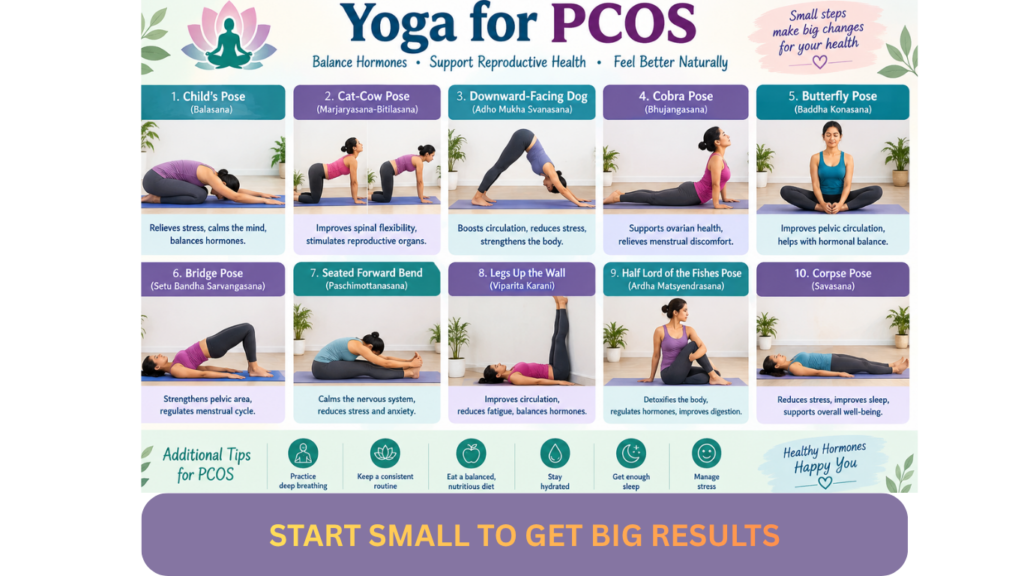
Can Yoga for PCOS Help? What Research Shows:
Several renowned universities are looking earnestly for proper care of their patients. Their clinical studies have also looked specifically at yoga for PCOS, and their findings are encouraging:
- Hormone regulation: Several studies found that women who are practicing yoga for an hour consistently over three to four months are lowering their testosterone levels compared to a group who are doing conventional exercise. Elevated testosterone is a hallmark of PCOS; therefore, it is significant that yoga for PCOS can reduce your problem.
- Improved insulin sensitivity: The researchers found that up to 70% of women with PCOS have some degree of insulin resistance, and this insulin resistance worsens androgen production; a consistent yoga practice can improve insulin sensitivity, which can help break that cycle.
- Reduced cortisol and stress: Women who are suffering from chronic stress show that their cortisol level is increased, which disrupts the communication pathway between the brain and ovaries (the hypothalamic-pituitary-ovarian axis). This may be a possible reason for worsening ovulation problems and androgen levels. Here, yoga for PCOS, especially pranayama (slow breathing exercise), can activate the parasympathetic nervous system, which can lower cortisol levels and interrupt this stress-hormone loop.
- Better menstrual regularity: By lowering androgen levels and easing stress, a consistent yoga practice has been associated with more predictable cycles in women with PCOS.
- Improved mental health: Women with PCOS are more susceptible and likely to experience anxiety or depression. Research on meditative and restorative yoga styles has shown remarkable reductions after one month of consistent practice of Yoga for PCOS.
This should also be kept in mind: yoga for PCOS itself isn’t a stand-alone treatment, but it is one of the most evidence-supported lifestyle interventions available, and it works on the actual root mechanisms of the condition rather than just masking symptoms.
How Yoga Helps With PCOS: The Mechanisms Explained
- Lowering Cortisol and Calming the Nervous System
Restorative yoga and slow-flow yoga underline long holds, deep breathing, and minimal strain. This helps internal modification of your body out of “fight or flight” and into “rest and digest” mode, which rightly lowers circulating cortisol—a hormone that, when chronically increased, leads to disrupted ovulation and increased androgen output. Here, yoga for PCOS plays an important role.
- Improving Insulin Sensitivity
Gentle and consistent yoga practice increases muscle glucose uptake without increasing cortisol levels, which paves the way for high-intensity training. For many women with PCOS, this makes yoga a more sustainable option than punishing cardio sessions that can backfire by adding to the stress load.
- Stimulating Pelvic and Abdominal Circulation
Poses that gently compress and release the pelvic region—like the butterfly pose or cat-cow—are thought to improve blood flow to the ovaries and reproductive organs, supporting healthier follicle development. Practicing Chakra Yoga with Pranayama, where every breath is counted with contraction of the genital organs while ascending through the chakras and expansion of the genital organs while descending through the chakras by releasing breath. This is highly helpful for blood flow to the ovaries, leading to follicle development.
- Supporting Emotional Regulation
This combined movement of breath and mindfulness in yoga activates the release of GABA, a calming neurotransmitter linked to lower anxiety. For a condition so closely tied to mood, this matters as much as the physical benefits.
- Aiding Weight Management
In PCOS, the weight gain is often driven by insulin resistance rather than diet alone. Consistent practice of yoga burns fewer calories than high-intensity workouts; its stress- and insulin-related benefits make it a useful complement to strength training and cardio, but not a replacement for them.
10 Best Yoga Poses for PCOS
How to practice safely: Move slowly, breathe through your nose, and never push into pain. If you’re new to yoga, learn these yoga poses for PCOS from a certified instructor first, especially Bow Pose and Camel Pose, which require some flexibility. 10 such yoga poses are mentioned below in a tabulated form for PCOS.
A COMPARATIVE TABLE OF POSES AND THEIR BENEFITS
| POSE (SANSKRIT NAME)
|
PRIMARY BENEFIT | HOW LONG TO HOLD |
| Butterfly Pose (Baddha Konasana) | Stimulates the ovaries and improves pelvic circulation | 1-2 Minutes |
| Cobra Pose (Bhujangasana) | Stimulates abdominal organs and eases menstrual discomfort | 15-30 Seconds |
| Bridge Pose (Setu Bandhasana) | Relieves stress, supports cycle regulation | 30–60 seconds |
| Bow Pose (Dhanurasana) | Improves pelvic circulation, relieves cramps | 15–20 seconds |
| Garland Pose (Malasana) | Opens the pelvic floor, supports digestion | 5–10 breaths |
| Seated Forward
Fold (Paschimottanasana) |
Calms the nervous system, stretches the hips | 1 Minute |
| Cat-Cow Pose (Marjariasana-Bitilasana) | Improves spinal and pelvic circulation | 8–10 rounds |
| Child’s Pose (Balasana) | Activates the relaxation response, lowers cortisol | 1–3 minutes |
| Legs-Up-The-Wall (Viparita Karani) | Improves circulation to the reproductive organs | 5–10 minutes |
| Camel Pose (Ustrasana) | Opens the chest, counterbalances forward-folding poses | 15–20 seconds |
A summary of how to do the above poses is given hereunder:
01: Butterfly Pose:
- Sit comfortably on a mat on the floor with your legs extended forward
- Now, bend the knees and bring the soles of the feet together
- Hold the feet or ankles with your hands and gently draw the heels towards your pelvis
- Sit straight to keep your spine upright and relax your shoulders
- Gently move knees up and down
- Breath slow and continue knee movement for 4-5 minutes
- Finish this pose by extending your legs forward and relaxing
- Cobra Pose:
- Lie on a mat on the floor on your stomach with your legs extended and feet together or slightly apart;
- Now, place your palms on the floor beside your chest with elbows close to your body
- Inhale gently and lift your chest and head from the ground, and keep your waist and pelvis on the floor
- Keep shoulders relaxed and avoid pushing your body forcefully
- Look forward and keep your neck comfortable and spine long
- Breath slow and hold this position for 20-30 seconds
- Now, exhale and slowly lower your chest.
- Bridge Pose:
- Lie on the floor over your mat and lie on your back with knees bent and feet flat on the floor, keeping hip-width apart,
- Now, place your arms beside your body
- Inhale slowly and lift your hips towards the ceiling
- Keep your thighs parallel and press your feet firmly on the floor
- Keep your shoulders and head relaxed and avoid turning your neck
- Hold this position for 30-40 seconds and breathe slowly and comfortably
- Exhale and slowly lower your hips back to the floor.
- Bow Pose:
- Lie on your stomach with your legs straight and arms beside your body.
- Bend your knees and bring your heels toward your hips.
- Reach back and hold your ankles with your hands.
- Inhale and gently lift your chest and thighs off the floor.
- Pull your ankles upward and backward to create a bow-like shape with your body.
- Keep your gaze forward and breathe slowly. Hold for 15–20 seconds.
- Exhale and slowly release your ankles and lower your body to the floor.
- Garland Pose:
- Stand straight with legs slightly wider than hip width apart
- Now, bend your knees and slowly lower your hips towards the floor
- If you feel comfortable, keep your heels grounded and turn your toes slightly outward
- Now, bring your palms together in front of your chest
- Press your elbows gently against your inner knees
- Breathe slowly and hold this position for 20-30 seconds
- Press through your feet and slowly stand up to release.
- Seated Forward Pose:
- Sit on your mat on the floor with legs stretched in front of you
- Keep the spine straight and upright and toes pointing upward
- Now, inhale and raise your hands overhead
- Exhale and slowly bend forward your body from your hips, keeping your back as long as possible
- Try to reach toward your feet, ankles, and shins, but don’t put pressure to touch your toes
- Relax your neck and shoulders and breathe slowly
- Try to remain in this position for 20-30 seconds and then inhale slowly and return to the upright position.
- Cat Cow Pose:
- Place your hands under your shoulders and your knees under your hips
- Inhale slowly and lift your chest and tailbone and look straight forward—this is Cow Pose
- Exhale and round your spine towards the ceiling, tuck your chin towards your chest, and draw your belly inward—this is Cat Pose.
- Now try to move slowly, coordinating your breath with each movement
- Repeat this 8-10 times or continue this as comfortably as possible.
- Child’s Pose:
- Kneel on the floor, keeping the knees together or slightly apart
- Sit back on your heels and try to keep your toes backward
- Now, bend forward slowly and try to bring your forehead to the floor
- Stretch your hands forward with your palms resting on the floor
- Relax your shoulders, neck, and back and breathe slowly
- Try to remain in this position for 30-40 seconds, and if possible, a minute
- Now, slowly return to the seated position and finish.
- Legs Up the Wall:
- Sit sideways next to the wall with hips close to the wall
- Lie back slowly and raise your legs on the wall
- Try to keep the legs straight and keep your heels on the wall
- Now, place your arms beside your waist and palms facing upward
- Relax your shoulders, face, and abdomen, and try to breathe slowly
- Try to remain in this as long as possible comfortably
- Now, bend your knees and bring them back to rest on the floor on one side before sitting up.
- Camel Pose:
- Kneel on the floor with your knees hip-width apart and thighs upright.
- Place your hands on your lower back, fingers pointing downward.
- Inhale and gently lift your chest, drawing your shoulders back.
- Slowly lean backward while keeping your hips above your knees.
- Reach your hands toward your heels if comfortable.
- Keep your neck relaxed and avoid dropping your head back if it feels uncomfortable.
- Hold for 15–30 seconds, breathing slowly.
- Return carefully by bringing your hands back to your lower back and slowly coming upright.
A Sample of Weekly Yoga-for-PCOS Routine
Consistency in yoga is the primary requirement rather than intensity. Here’s a realistic weekly structure most women with PCOS can perform:
- Monday & Thursday (25–30 min): Full restorative sequence—Cat-Cow, Butterfly Pose, Cobra Pose, Bridge Pose, Child’s Pose, plus 5 minutes of Nadi Shodhana (alternate nostril breathing)
- Tuesday & Friday (15–20 min): Gentle flow—Sun Salutations (slow pace), Seated Forward Fold, Legs-Up-The-Wall
- Wednesday & Saturday: Rest, walking, or light strength training
- Sunday (20 min): Pure breathwork and meditation — Nadi Shodhana and Kapalabhati (skip Kapalabhati during your period)
Studies by researchers indicate that measurable hormonal changes occurred when a minimum of three sessions per week for at least eight to twelve weeks is practiced, so give the practice time before judging results.
Pranayama (Breathing Techniques) for PCOS
Breathwork, or pranayama, is arguably the most appreciated part of yoga for PCOS, because it targets the stress-hormone connection directly.
- Nadi Shodhana (Alternate Nostril Breathing): Balances the nervous system and reduces cortisol; safe to practice daily.
- Bhramari (Bee Breath): Calms racing thoughts and is especially useful before bed if PCOS-related anxiety affects sleep.
- Kapalabhati (Skull-Shining Breath): Stimulates digestion and metabolism; avoid during menstruation or pregnancy.
Yoga vs. Other Exercise for PCOS: Which Is Better?
| FACTOR | YOGA | HIGH INTENSITY CARDIO | |
| Cortisol impact | Lowers cortisol | Can raise cortisol if overdone | |
| Insulin sensitivity | Improves gradually |
|
|
| Mental health benefit | Strong, well-documented | Moderate | |
| Sustainability | High — low injury risk | Lower for beginners | |
| Calorie burn | Lower | Higher |
The best approach isn’t choosing one over the other—it’s combining 2–3 yoga sessions a week with moderate strength training or walking for a well-rounded yoga plan for PCOS management.
Precautions: Who Should Be Careful
- The Garland Pose has to be avoided during heavy menstrual flow.
- If you are pregnant, you should avoid Kapalbhati Pranayama
- If you have severe hirsute-related joint or skin sensitivity, ease into back bends like the camel and cobra pose gradually.
- Consult a doctor if you have uncontrolled blood pressure or are trying to conceive through fertility treatment, or have any coexisting condition your doctor should weigh in on.
Combining Yoga With Other PCOS Management Strategies
Yoga for PCOS works best as part of a broader plan:
- Diet: A low-glycemic, anti-inflammatory diet supports the same insulin-sensitivity goals as yoga. Foods like fresh fruits, fresh vegetables, fatty fish, healthy oils, lean protein, legumes, nuts and seeds, and whole grains can be taken as an anti-inflammatory diet.
- Sleep: 7–9 hours of consistent sleep helps to regulate cortisol alongside your practice.
- Medical care: Yoga is a complement to, not a substitute for, medications like metformin or hormonal birth control when prescribed.
- Strength training: Builds muscle mass, which improves how your body uses insulin.
How are PCOS and PMOS connected?
Polycystic Ovarian Syndrome is now called Poly Endocrine Metabolic Ovarian Syndrome, and both of these terms are similar clinically. Both of these are defined by the presence of 2-3 findings like Hirsutism, Acne, ovulatory dysfunction, and polycystic ovarian morphology. Both of these are insulin resistant, and obesity is often observed. PCOS occurs in 5-10% of women in the United States, and it is the most common cause of infertility. PCOS affects hormones, metabolism, skin, the reproductive system, and mental health, with symptoms that start in the teenage years and continue through and beyond menopause.
Is PCOS and PCOD the same?
Polycystic Ovarian Syndrome (PCOS) is also known in some places as Polycystic Ovarian Disease (PCOD). Both of these are a common cause of hormonal disorders affecting women of reproductive age. Both of these two are marked by irregular or absent ovulation, higher than typical androgen levels, insulin resistance, etc.
Can yoga for PCOS flare?
To answer this—yes. Yoga may help to manage some PCOS-related problems, but this has to be noted that yoga for PCOS should be used as a supportive treatment, not a full treatment of PCOS. Research findings support that physical activity is an important part of PCOS management, and recent research from Monash University and the American Society of Reproductive Medicine recommends that regular physical activity be used for metabolic and health benefits and not for PCOS treatment. During the period when symptoms are getting worse, a gentle yoga routine will be helpful rather than an intense workout.
Conclusion: Yoga for PCOS is an important aspect for well-knit lifestyle combination for managing PCOS or PMOS—and it is not because it’s trendy, but because it acts directly on the cortisol, insulin, and hormonal pathways that drive PCOS symptoms. Combined with a balanced diet, proper sleep, and medical guidance, a long and consistent yoga practice can actually improve the quality of life for women living with PCOS or PMOS. To start with, do two to three sessions a week, stay consistent for at least eight weeks, and give your body time to respond.
Frequently Asked Questions
Can yoga cure PCOS?
No. PCOS has no cure, but yoga can meaningfully reduce symptoms like irregular periods, elevated androgens, and anxiety when practiced consistently.
How often should I do yoga for PCOS?
Most research points to at least three sessions per week, 45–60 minutes each, for measurable hormonal benefits within two to three months.
Which yoga is best for PCOS weight loss?
A combination of gentle Vinyasa flow (for calorie burn) and restorative poses (for cortisol control) tends to work better than either alone.
Is yoga better than the gym for PCOS?
Neither replaces the other. Yoga targets stress and hormone regulation; strength and cardio training target metabolism and weight. Combining both gives the best results.
Can beginners do yoga for PCOS?
Yes. Most of the poses listed above are beginner-friendly. Start with shorter holds and build up gradually, ideally with guidance from a certified instructor.
Are there any side effects of yoga for PCOS, PCOD, or PCMO?
Yoga for PCOS is generally safe when practised appropriately, but it can cause ordinary exercise-related problems such as muscle soreness, strains, dizziness or injury if poses are performed incorrectly or the practice is too intense. Current research has not established significant PCOS-specific adverse effects from yoga, although many studies have not adequately reported adverse events. Yoga should therefore be viewed as a complementary lifestyle practice—not a replacement for medical treatment.