Introduction: Power Yoga has been acclaimed widely throughout the world amongst fitness lovers. This is a combination of traditional wisdom of ancient yoga practices with the intensity of modern yoga postures for creating a powerful system to get tangible and quick results of strength, stamina, and mental clarity. Some of the people use Power Yoga for strength building or weight loss, but there are numerous benefits hidden under the surface that those people never realize.
In this comprehensive Article, I will delve into 10 incredible benefits that you never knew – the benefits that can truly transform your physical, mental, and emotional well-being.
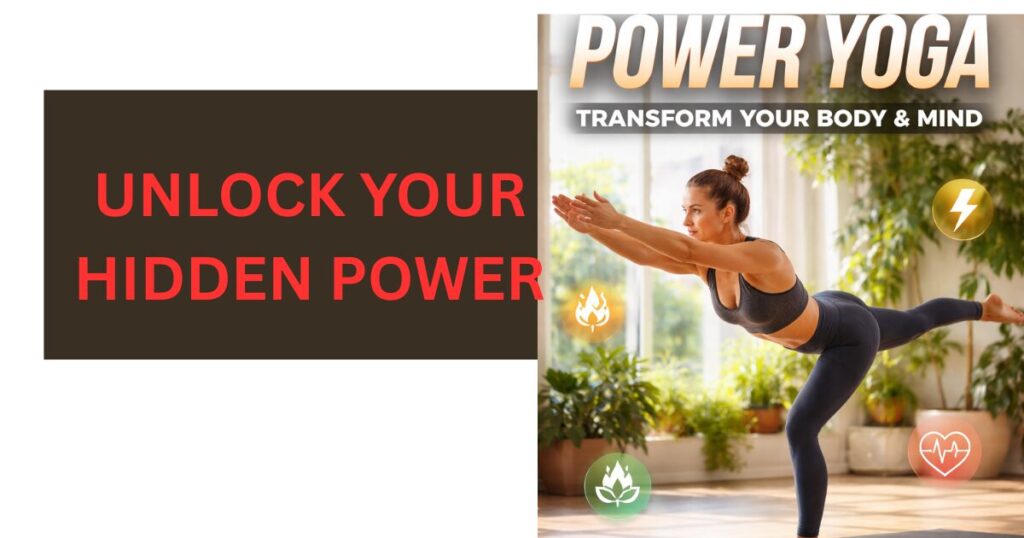
A Brief Historical Timeline of Power Yoga:
Power Yoga is a new form of yoga technique that emerged in the late 20th century, a fraction of the traditional yoga teachings of Patanjali’s Ashtanga Yoga.
A chronological timeline of Power yoga is placed hereunder:
1948-1970: Ashtanga Vinyasa Yoga was developed by Shri K. Pattabhi Jois in Mysore City, Karnataka, and he established his training center. After getting recognition, the Western students began travelling to India for learning this vigorous practice.
1970-1980: Throughout the USA, Ashtanga Yoga gained popularity through the students who came from the Western World and learnt this technique from K. Pattabhi Jois. This has become the main attraction for sports persons and fitness enthusiasts.
Late 1980s: To suit the western fitness needs, two American Yoga Teachers (Bryan Kest) and (Beryl Bender Birch) modified the Ashtanga Yoga system. They removed the rigid sequencing and created more flexible and creative flows.
Early 1990s: The term “Power Yoga” was first introduced by Bryan Kest, emphasizing a fast-paced, strength-building, and heat-generating practice.
1995: A book on “Power Yoga” was published by Beryl Bender Birch, which became popular in the United States and rest of the world.
2000s – Present: Power Yoga has become a global fitness trend that is being widely taught in studios and gyms for its intensity, strength benefits, and accessible structure.
01. Why is Power Yoga so unique?
Power Yoga is completely different from other forms of Yoga since it blends ancient yoga wisdom with a modern athletic approach. It not only helps in stretching the body or relaxation, but also helps to experience strength building, stamina, flexibility, and mental focus, all at the same time.
Here are some important points that make Power Yoga truly unique:
- It Offers Complete Workout
- It follows a Dynamic and Creative Flow
- It generates Heat naturally
- It strengthens the mind as much as the Body needs
- It fits Modern Lifestyles perfectly
02. What is Power Yoga?
Power Yoga is a new form of Yoga which is a modern, dynamic, and fitness-oriented style of yoga that combines traditional yoga principles with athletic movement. For tracing out the origin of Power, it has been found that the root is Patanjali’s Ashtanga Yoga, but Power Yoga does not emphasize the rigidity like Ashtanga Yoga. Power Yoga helps to create a flow from one pose to another instead of approaching each yoga posture separately. These poses are not disconnected from each other, unlike some other forms of Yoga.
Unlike slow and meditative postures, Power Yoga creates continuous and flowing movements that help to create strong and steady breathing. Each session of Power Yoga resembles a full-body workout – improving strength, endurance, flexibility, and mental steadiness.
3. Important Features of Power Yoga:
Power Yoga is regarded as one of the most transformative and energizing yoga styles, combined with traditional yoga principles and athletic intensity. Power has been designed to generate heat within the body, increase strength and endurance, and improve mental focus. It extends a full-body workout that feels both empowering and meditative.
Why is Power Yoga appealing? Because its nature is dynamic and each of its sessions flows rapidly from one Yoga posture to another, thereby creating a sense of momentum which keeps both the body and mind fully engaged. Generally, the traditional yoga follows a strict sequence, but Power Yoga embraces creativity, allowing the instructors to make unique and challenging routines that motivate the practitioners.
On the other hand, Power Yoga’s foundation lies in the mindful breathing (Pranayama), which is grounded in Yoga’s spiritual root. If anyone amongst the practitioners looks for building muscle, improving flexibility, or releasing stress, Power Yoga is highly beneficial for invigorating, and it has been proven to be a rewarding practice.
The key features are appended hereunder:
- It is a fast-paced, dynamic flow that keeps the body moving continuously.
- Postures that extend strength to the core, arms, back, and legs.
- Ujjayi Pranayama is practiced to create heat within the body and improve concentration.
- Creative, non-fixed sequences that vary from class to class.
- High-calorie burn due to vigorous movement and strong poses.
- Improves flexibility and endurance through repeated transitions.
- Power Yoga coordinates mental focus with breathing movement.
- It boosts cardiovascular health
- Power Yoga is suitable for multiple fitness levels with some minor modifications.
- Emphasis on mindfulness despite its physically intense nature.
4. How Power Yoga is different from Traditional Yoga:
Both Power Yoga and Traditional Yoga originate from the same ancient roots, but their approach, intensity, and purpose are different in practice. While exploring the difference in a tabulated form, it is important to understand that neither style is better than the other.
But their needs are different, like Power Yoga extends help to fitness-driven practitioners, while Traditional Yoga extends holistic wellbeing and inner transformation. The key differences are appended hereunder in a tabulated form to give a quick look at choosing the right style that aligns best to achieve your goal, lifestyle, and level of experience.
| Aspect | Power Yoga | Traditional Yoga |
| Initial Focus | Strength, stamina, and cardio-based movement | Mind-body balance, breath control, and inner awareness |
| Style of Practice | Fast-paced, vigorous, and athletic flow | Slow-paced, steady, and meditative postures |
| Origin | Modern adaptation inspired by Ashtanga Vinyasa Yoga | Ancient roots date back to more than 5000 years in India |
| Structure of Sequence | Creative sequences are not fixed that changes from time to time | Mostly structured based on ancient Yogic principles |
| Level of Intensity | High-intensity sweat-inducing | Intensity is gentle, mainly focused on relaxation |
| Breathing technique | Kapal Bhati and Ujjayi Pranayama to generate heat | Various Pranayama techniques for calm and control |
| Calorie Burn | High-calorie burns | Low to moderate calorie burn |
| Flexibility improvement | Flexibility gained quickly due to heat and movement | Gradual development of flexibility over time |
| Strength Development | Mainly focused on muscle building and endurance | Strength develops over time |
| Spiritual development | Less importance on spiritual development | High emphasis on spirituality |
| Goal of practice | The main goal is to gain fitness, weight loss, and an energy boost | The main aim is to gain balance, longevity, mental peace, and inner harmony. |
| Suitable for | People seeking a workout, like a yoga session | People mainly look for holistic wellbeing |
| Class of Atmosphere | The atmosphere is energetic, dynamic, and music-oriented | Atmosphere is calm, quiet, and meditation-friendly environment |
| Accessibility | Requires a moderate fitness level | Accessibility to all ages and abilities. |
5. How does Scientifically Power Yoga work in the Human Body?
Power Yoga is not just a fast-paced form of traditional yoga; it creates measurable physiological changes. Its strength-building, aerobic, and dynamic nature helps the body through various scientific mechanisms. A few examples are discussed below:
- It activates the Cardiovascular System: The Heart Rate is increased by Power Yoga, and is similar to aerobic exercise and gyms. This enhances blood circulation in the body, strengthens the heart muscles, and boosts oxygen supply to the tissues, improving overall endurance.
- Enhances Muscular Strength and Lean Body Mass: The changes between poses like Chaturanga, Plank, and Warrior Poses engage the muscle groups. This creates a mechanical tension within the body and thereby promotes muscle growth. Continuous practice, it increases the muscle mass, metabolic rate, and overall strength.
- Boosts Flexibility through Heat and Movement: Continuous flowing movements combined with Ujjayi and Kapal Bhati Pranayama generate heat within the body. This heat helps to increase Synovial Fluid Production, reduces the stiffness in the muscles, and boosts the range of motion in joints, which helps the progress of flexibility better and faster.
- Improves Insulin Sensitivity: Vigorous practice of Power Yoga improves glucose metabolism by increasing the insulin sensitivity in the muscles. This activity helps to regulate blood sugar levels and thereby helps proper weight management.
- Triggers the Endocrine System: Power Yoga stimulates the hormones that are responsible for:
- Stress reduction
- Improved Mood
- Better Metabolic Efficiency
These shifting of hormones lead to better emotional health and a more stable energy level.
- Enhances Neuroplasticity and Mental focus: The combination of movement and breath requires coordinated attention, activating the following:
- Prefrontal Cortex – Improves focus and decision making
- Cerebellum – Enhances balance and coordination
- Motor Cortex – Improves body awareness
Continuous practice strengthens the neural pathways, supporting better concentration and emotional resilience.
Many more examples can be cited. But since it requires enough time and viewers’ interest, a few of them are cited above.
6. What are the popular Power Yoga poses?
Before mentioning the Popular Power Yoga poses, it is worthwhile to mention why these postures/poses are important in Power Yoga. Since Power Yoga is not structured like Hatha Yoga, the Yoga Teacher determines the postures based on their experience and the physical demands of the seeker. Therefore, Power Yoga has more variations and is less structured. Power Yoga has more intense yoga poses, unlike chanting or meditation. But, despite being fast-paced, there is no compromise on holding the postures.
There are various yoga poses, but basic poses include Four-Limbed Staff Pose (Chaturanga Dandasana), Plank Pose (Phalak asana), Cobra Pose (Bhujanga Asana), Sun Salutation (Surya Namaskar), and Downward Facing Dog Pose (Adho Mukha Svasana). Moreover, jumpbacks and jump throughs like Jump Back Flow and Downward-facing Dog jump upward forward flow are an integral part of Power Yoga.
Some of the above Yoga poses are described hereunder:
Plank Pose or Chaturanga Dandasana:
Plank Pose is also called Chaturanga Dandasana. But if we break this word, we get four. Chatur is generally meant for Clever, but here it is meant as Four Anga means Limbs. Danda is a stick or a Staff. But here it refers to standing still. Asana means Posture
Chaturanga Dandasana is a highly difficult and complicated strength dependent Yoga Pose. Chaturanga Dandasana is usually practiced in Power Yoga and Vinyasa Yoga. This Yoga Pose demands not only strong core engagement but also strong arms and controlled movement. This helps in creating a smooth transition from Plank Pose to Upward-Facing Dog Pose for forming a more dynamic yoga sequence.
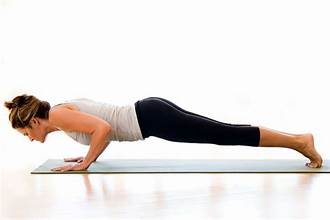
How to Perform: To start with, we should start with Adho Mukha Svanasana. We should keep the toes tucked, come into a high plank with arms straight so that the shoulders are in line with elbow and wrists. Now, engage the core and draw the navel towards the spine. Let the head fall naturally.
Now, lower the body parallel to the base. The legs should be extended and engaged, and the knees slightly above the base/floor. While doing so, the practitioner should be careful that there is a tendency to drop the upper back while poking up the tailbone towards the ceiling.
Now, the practitioner should engage the core and draw the pubis towards the navel to keep the tailbone and hips tightly. Don’t allow the elbows go out to the sides and hold the elbows firmly to the upper body and send them towards the heel. The upper arms should be kept parallel to the floor. The shoulders should be kept right above the writs and away from the ears. Now, lift the sternum and look forward.
Now, hold your breath as much as you can and relax the body, leaving the breath, and come to a normal position.
There are various variations depending on the strength of the practitioner.
Benefits: The benefits include:
- Chaturanga Dandasana adds strength to arms, shoulders, and wrists
- It helps to tone the abdominal muscles and core
- Builds upper-body endurance essential for advanced poses
- Enhances posture by activating stabilizing muscles
- Improves body alignment and balance in dynamic yoga flows
- Prepares the body for inversions and arm balances
- Boosts confidence by encouraging mindful control and resilience
Striking Cobra Pose (Shashank Bhujangasana):
Bhujangasana and Shashankasana combinedly form Shashank Bhujangasana. This pairing in this pose creates a gentle flow between activation and relaxation, thereby creating an excellent practice for improving spinal mobility and balancing the nervous system. This pose harmonizes breath with movement, helping the practitioners to shift smoothly between contraction and expansion. Owing to its soothing and strengthening effect, it is widely recommended by yoga teachers for stress relief, back discomfort, and a mind-body combination.
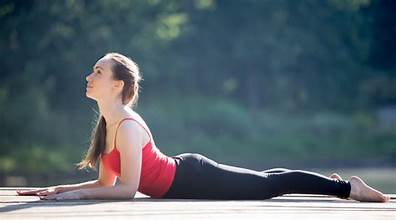
How to practice: Place the arms on the floor beneath the shoulders, keeping a distance of about half a meter. Move into Shashankasana with the arms outstretched in front of the shoulders. Then, without moving the position of the hands, slowly move the chest upward, sliding it just above the floor until it is in line with the hands. Move the chest further forward and then upward, as the arms straighten, and lower the pelvis to the floor.
Ideally, the nose and chest should just brush the surface of the floor as the body moves forward, like the movement of a snake. In the final position, the arms should be straight, the back arched, and the head raised as in Bhujangasana. The navel does not touch the floor.
Hold this position as long as you can and retain your breath. Now, slowly raise the buttocks and move backwards, keeping the arms straight, and return to Shashankasana. Please do not try to reverse the previous movement, but keep the arms straight. This is one round. Try to do this for 4-5 rounds.
This should be practiced directly after Shashankasana and followed by Tadasana.
Benefits: This pose helps to tone and improve the functioning of lever, kidneys, and other visceral organs. It is particularly useful for relieving back pain and general stiffness of the spine since it helps to stimulate and balance all the spinal nerves.
Surya Namaskar (Sun Salutation):
The combination of two Sanskrit Words, Surya (Sun) and Namaskar (Salutation), is Surya Namaskar (Sun Salutation). The sun is the symbol of internal light, which means spiritual enlightenment, and in earlier days Sun was worshipped regularly to gain physical as well as spiritual enlightenment. In classical yoga practice, the sun is represented by Pingala Nadi (Surya Nadi), which is the pranic channel that carries the vital living force.
It is the combination of various Poses, Pranayama, and mindful movement extending a complete practice for physical, mental, and overall well-being. It is commonly used in Power Yoga as a foundational flow for building strength, flexibility, and stamina.
On the other hand, it is the most effective way for loosening up the body, stretching, and toning all the joints, muscles, and internal organs. Its versatility and application in Power Yoga make it one of the most useful methods of inducing a healthy, vigorous, and active life while at the same time preparing for spiritual awakening and the resulting expansion of awareness.
Surya Namaskara is composed of three elements – form, energy, and rhythm. The twelve Asanas are the physical matrix around which the form of the practice is woven.
How to Practice: We already know that Surya Namaskara (Sun Salutation) is the combination of 12 Asanas.
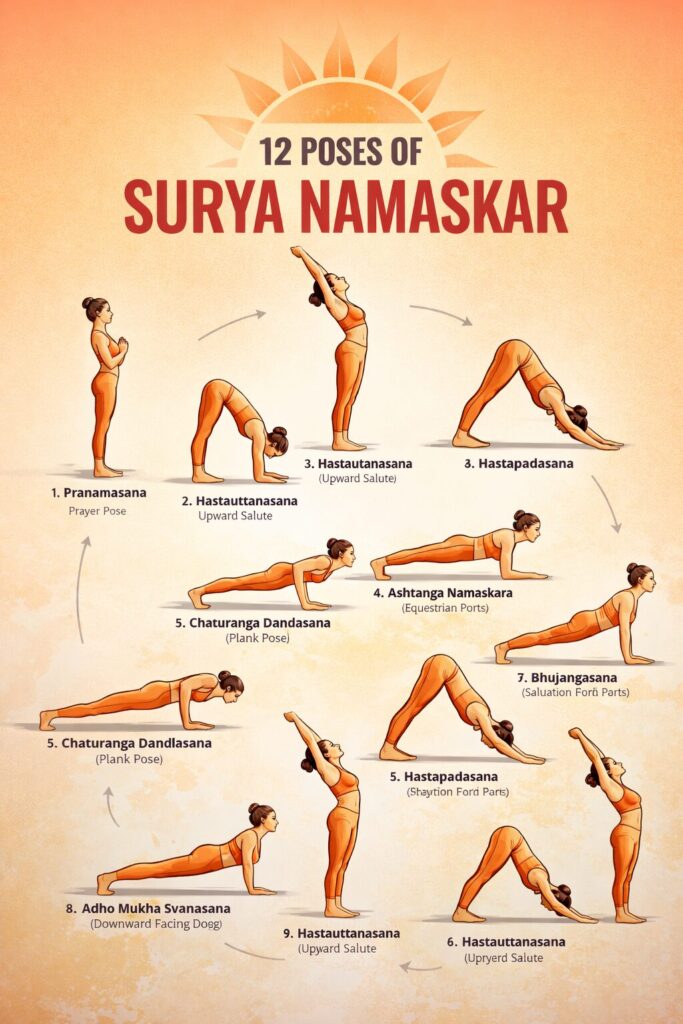
Now, let us discuss these twelve Asanas:
- Pranamasana (Prayer Pose): Stand upright with the feet together. Keep your eyes closed. Now slowly bend your elbows and join the palms together in front of your chest, looking like the Prayer Pose (Pranamasana), mentally offer homage to the Sun, which is the source of energy.
- Hasta Utthanasana (Raised Arms Pose): In this pose, the practitioner should raise and stretch the arms above the head and keep the arms slightly away with the width apart. Now, bend your head, arms, and upper trunk backward.
- Padahastasana (Hand to Foot Pose): Bend the body forward until the palm touches the floor on either side of the feet. Now, try to touch your head with your forehead. If feels trouble, then hold the legs with your hands and bend your body slowly, but keep the knees straight.
- Ashwa Sanchalanasana (Equesterian Pose): Place the palms of the hands on the floor beside the feet. Now, stretch the right leg back as much as possible and at the same time, bend the left knee, keeping the arms straight. In the final position, the weight of the body should be supported by both hands, the left foot, the right knee, and the toes of the right foot. The head should be tilted slightly backward, the back arched and the inner gaze directed upward to the eyebrow center.
- Parvatasana (Mountain Pose): To practice this pose, take the left foot back beside the right foot. At the same time, raise the buttocks and lower the head between the arms so that the back and legs form two sides of a triangle. The legs and arms should be straight in the final position. Now, try to keep the heels on the floor in the final pose and bring the head towards the knees as much as possible without straining the body.
- Ashtanga Namaskara (Salute with eight parts of the body): Lower the knees, chest, and chin to the floor. In the final position, only the toes, knees, chest, hands, and chin should touch the floor. Simultaneously, the knees, chest, and chin should touch the floor. If this is strenuous, first lower the knees and then the chest, and finally the chin. The buttocks, hips, and abdomen should be raised.
- Bhujangasana (Cobra Pose): This pose is very important for Power Yoga practitioners. To practice this, lower the buttocks and hips to the floor. Straighten the elbows, arch, and back, and push the chest forward into the cobra pose. Bend the head back and direct the gaze upward to the eyebrow center. The thighs and hips remain on the floor, and the arms support the trunk till the spine is very flexible, and the arms will be slightly bent.
- Parvatasana (Mountain Pose): This posture should not be elaborated further. This is identical to Parvatasana as stated in Item No. 5.
- Ashwa Sanchalasana (Equestrian Pose): This posture is also identical to Item No. 4.
- Padahastasana (Hand to foot Pose): This posture has been mentioned in Item No. 3.
- Hasta Utthanasana (Raised Arms Pose): This posture is also identical to item No. 2.
- Pranamasana (Prayer Pose): This posture is identical to item No. 1.
Surya Namaskar (Sun salutation) energizes the body, improves flexibility, and prepares the mind for deeper yoga practice
7. 10 Incredible Benefits of Power Yoga: Power Yoga is a powerful and dynamic style of yoga practice that combines strength, continuous movement, and conscious breathing into one energizing flow. Power yoga has been designed for heat and endurance. Unlike slower yoga styles, the power yoga’s continuous movement activates multiple muscle groups and raises the heart rate, delivering the benefits that go beyond flexibility. Power Yoga extends numerous benefits for both the body and mind. The ten incredible benefits are explained hereunder as to why this Yoga practice has gained widespread popularity among those who are searching for building strength, boosting energy, and supporting overall well-being.
- Builds Strength and Muscle Tone: Power Yoga builds Strength and Muscle Tone by continuous and controlled movement, thereby helping to build body weight resistance. Postures like Chaturanga, Surya Namaskara, Plank, and the Warrior series keep muscles activated for extended durations, promoting both static and flowing muscle contraction. This continuous effort helps to build strength in arms, legs, shoulders, and back.
- Boosts Cardiovascular Health: Power Yoga helps to boost Cardiovascular Health by engaging the body through continuous and rhythmic motion, which gently raises the heart rate throughout the practice. This flow of poses with controlled breathing improves blood circulation and increases oxygen delivery to the muscles and organs of the body. This continuous engagement strengthens the heart, increases lung capacity, and improves overall well-being.
- Supports Effective Weight Loss: Power Yoga supports effective weight loss by dynamic practice combining strength training, continuous movement, and controlled movement. This flow of practice raises the heart rate, which in turn helps to burn calories during the practice session, while strength-based poses build lean muscle that increases the metabolism even during rest. This combined action makes Power yoga highly effective for Weight Loss.
- Improves Flexibility and Mobility: Power Yoga improves flexibility and mobility by dynamic, flowing movements that slowly stretch muscles, keeping them warm and active. The continuous transition between poses allows the joints and muscles to move through their full range of motion, thereby reducing stiffness and increasing the elasticity of the muscles.
- Enhances Core Strength and Stability: Power Yoga improves Core Strength and Stability by consistently activating the abdominal muscles, especially in the pelvic region and lower back. Poses like Chaturanga, Plank, Boat, and other balancing postures require ongoing core engagement to support proper alignment and controlled movement. Therefore, Power Yoga helps to develop a firm, well-toned core while also supporting better balance, coordination, and overall spinal stability. With continuous practice of Power Yoga, the risk of lower back pain improves the overall functional movement in regular activities.
- Reduces Stress and Anxiety: Power Yoga also reduces the Stress and Anxiety by combining the deep, mindful movement with controlled breathing, which calms the nervous system. This systematic and rhythmic flow decreases the stored physical tension, while focused breathing lowers the cortisol level and promotes relaxation.
- Sharpens Mental Focus and Clarity: Power Yoga sharpens the Mental Focus and Clarity with the help of continuous awareness of breath, movement, and alignment throughout the practice of Power Yoga. This practice demands full attention, helping the mind to stay present and reducing mental distraction. By combining breath with movement, Power Yoga helps to improve oxygen flow to the Brain and strengthen the neural connections related to concentration and decision making. Continuous practice of Power Yoga enhances clarity, improves focus, and promotes a calm and alert mental state in regular life.
- Increases Energy and Endurance: Engagement of the body with continuous strength-based movement with deep rhythmic breathing, Power Yoga helps to increase Energy and Endurance. These activities improve oxygen intake within the body, boost blood circulation, and strengthen muscle allowing the body to sustain physical activity for a long time without any physical tiredness.
- Improves Balance and Coordination: By practicing Tadasana, which requires steady focus and controlled movement, the Balance and Coordination are improved in Power yoga. This posture boosts stabilizing muscles in the core, legs, and ankles, thereby helping the body to maintain Balance and Coordination.
- Promotes overall Mind-Body Harmony: The combination of physical movement, controlled breathing, and focused awareness promotes overall Mind-Body Harmony in Power yoga. As the body moves with the intention and strength, with a focused mind that creates a deep connection between action and awareness.
Practicing various postures releases stored tension while mindful breathing calms the nervous system and balances emotions. On continuous practice, the practitioners get more centered, resilient, and aligned both physically and mentally, thereby resulting in a more harmonious state of well-being.
8. Conclusion – Unlock the Hidden Power of Power Yoga:
Power Yoga has been widely acclaimed as a high-energy fitness trend. It is a complete Mind-Body practice which strengthens the muscles, the mental focus is sharpened, and inner balance is restored. As I have discussed above, the 10 incredible benefits of Power Yoga go beyond flexibility and weight loss, thereby offering prolonged improvements in cardiovascular health, stress management, energy level, and overall well-being. Power Yoga’s dynamic flow makes it ideal for a modern lifestyle where practitioners want to get effective results without sacrificing mindfulness.
FAQ:
- How does Power Yoga work?
Ans: Power Yoga works by amalgamating physical movement, mindful breathing, and mental engagement into a continuous and flowing movement. Unlike Hatha Yoga practices, Power Yoga uses strength-based postures for performing in a steady sequence, which keeps the body active and increases the heart rate. Through regular practice, this integrated approach helps the body to become stronger and more flexible, and helps the mind to stay calm and more balanced.
- What are the Health Benefits of Power Yoga?
Ans: Power Yoga extends a wide range of health benefits like improved strength, strong cardiovascular health, and endurance. It also extends healthy weight management, reduces stress and anxiety, enhances mental focus, improves balance and posture, and helps to promote mind-body harmony.
- How does Power Yoga work for Beginners?
Ans: Power Yoga helps to build strength gradually, extends flexibility and stamina through simple and modified poses in a comfortable space for beginners. With guided breathing and mindful movement, the beginners can easily and safely improve fitness and reduce stress.
- How does Power Yoga work for Women?
Ans: Power Yoga works effectively for women by increasing muscle strength, improving flexibility, and supporting hormonal balance through conscious breathing and mindful movement. It also helps women to reduce stress, boost energy, increase metabolism, and also help to promote overall physical and emotional well-being.
- How does Power Yoga work for Weight Loss?
Ans: Power Yoga works for weight loss by combining fast-paced movement with strength-based poses that burn calories and boost metabolism. It builds lean muscle, reduces stress-related fat storage, and supports sustainable, healthy weight loss when practiced regularly.
- Does it enhance Bone Density?
Ans: Since Power Yoga is weight-bearing, it supports bone health for women. Poses such as Chaturanga, Plank, Warrior poses, and Chair Yoga can apply healthy stress to bones, which can help with age-related bone loss when it is practiced regularly.
- Does Power yoga improve Sleep quality?
Ans: Power Yoga stimulates the Parasympathetic nerves, which leads to a reduction in Cortisol level and thereby improves Sleep Quality as well as stress recovery.
- Does Power Yoga have any drawbacks?
Ans: Power Yoga extends many benefits, but its drawbacks are also to be acknowledged, especially for beginners and lesser healthy population. Some of the drawbacks are furnished hereunder:
- Higher risk of injury if practiced incorrectly
- Not ideal for beginners
- Puts less emphasis on the traditional yoga philosophy
- Can lead to overexertion and quick burnout
- Limited personalization in Group Classes
- May not suit people with certain health conditions
- Breathing awareness can be compromised
- Not restorative enough for high-stress individuals
- Requires proper recovery and complementary practices