Introduction
Shakti Chalani Mudra is our ancient inner-energy practice in the category of Mudra yoga. Shakti Chalani Mudra means a tantric/yogic process of activating the energy center within the body where the sleeping power (Kundalini) is situated at the base of the spine/coccyx. A yogi/tantric tries to awaken the dormant spiritual energy and direct this energy upwards through various energy centers (chakras). This Shakti Chalani Mudra is considered a vital aspect of attaining higher spiritual enlightenment, which leads to liberation (Moksha). While practicing, a yogi must strictly adhere to a rigorous discipline involving Khechari Mudra, Nabho Mudra, Mahamudra, Pranayama, meditation, and seed mantra as advised by his guru.
During continuous practice of Shakti Chalini Mudra, many practitioners may feel a deep hunger for something more than work, unwanted happenings, a strong feeling at the vertebra as if something like ants are climbing within the vertebral column, hearing different types of sounds, etc. Shakti Chalani Mudra answers this unique feeling with silence, breath, and focused awareness. In Kriya Yoga, Shakti Chalani Mudra prepares the body and mind for deep meditation. When practiced with care, Shakti Chalani Mudra can turn scattered energy into steady inner light. At this stage, a yogi can see a bright star-like light at Kutastha (the center place of the eyebrow).
Here we will explain its roots, science, steps, and safety so you can approach it with respect and confidence.
What Is Shakti Chalani Mudra?
Shakti Chalani Mudra is an ancient yogic/tantric technique according to Hindu mythology. It includes Asana, Pranayama, Mudra, and inner focus to guide dormant energy upward along the spine. It is generally called Shakti Chalana or Shakti Chalini Mudra. This is an advanced type of yogic technique dedicated to the goddess of life energy. Shakti simply means energy or strength.
The Meaning of the Name
The name has three Sanskrit parts:
- Shakti: divine power, the living energy behind all life.
- Chalani (or Chalana): moving, stirring, setting in motion.
- Mudra: a seal or gesture that directs energy inward.
So Shakti Chalani Mudra is literally a ‘seal that moves energy‘. It is not a physical stretch. It is an inner gesture of awareness.
Where This Mudra Sits Among Yogic Practices
Most yoga practitioners are not aware of this mudra. Only a handful of Sadhaks are aware. But they do not teach their students about this Mudra; instead, they divert their students to Maha Mudra and Khechari Mudra for transmitting the base energy to the Shahrara. Shakti Chalani Mudra belongs to a highly advanced group called Kundalini or Arundhati. These mudras are used for the whole body, the breath, and the mind. They work with the pelvic floor, the abdomen, and the throat. Because Shakti Chalani Mudra is subtle, it is best learned step by step from an enlightened Guru.
Historical Background of Shakti Chalani Mudra
The roots of Shakti Chalani Mudra have been mentioned in Hatha Yoga, a little known in Kriya Yoga and Tantra traditions in India. Here, two known classical texts are central.
- The Hatha Yoga Pradipika
The Hatha Yoga Pradipika by Swami Muktibodhananda teaches that Kundalini is a sleeping serpent power at the base of the spine, which is called the coccyx. In its third chapter, on mudras, it treats Shakti Chalana Mudra as a key method to awaken Kundalini. This Shakti/Energy is a creative force of Ishwara, the cosmic causal body. The text says the practice should be learned with discipline and from a qualified teacher.
Hatha Yoga Pradipika says:
कुटिलाङ्गी कुण्डलिनी भुजङ्गी शक्तिरीश्वरी।
कुण्डल्यरुन्धती चैते शब्दाः पर्यायवाचकाः ॥
Kuṭilāṅgī kuṇḍalinī bhujaṅgī śaktir īśvarī |
Kuṇḍaly arundhatī caite śabdāḥ paryāya-vācakāḥ.
The Gheranda Samhita
The Gheranda Samhita also lists Mudra and its importance, but specifically there is no elaborate mention of Shakti Chalini Mudra as described in Hatha Yoga Pradipika. The old texts speak of it with great respect and with great caution.
From Tantra to Modern Kriya Yoga
Tantric schools had long ago taught that human body contains everything which are present in this cosmos. In later days, teachers, including the Bihar School of Yoga under Swami Satyananda Saraswati, preserved Shakti Chalani Mudra in modern practice. Paramahansa Yogananda brought Kriya Yoga to the West in the 20th century, and many Kriya Yoga practitioners use related Kundalini methods. The nomenclature differs between schools, yet the core idea has stayed the same for centuries.
Why Shakti Chalani Mudra Is Important for Kriya Yoga
Most of the Kriya Yoga practitioners are aware of the term “Kundalini Awakening” and its purpose to stimulate the subtle energy that lies at the mooladhara, which is the Kundalini from which fire is released like a snake. Kriya Yoga utilizes mental visualization, whereas Hatha Yoga does not. The importance of Shakti Chalani Mudra is to prepare the practitioner for attaining the deeper stages of meditation. In the broader context of the Kriya Yoga lineage, its importance is to direct the Prana (the vital energy) towards the central energy channel, which is known as Sushumna Nadi, to allow the practitioner to keep the mind and energy unscattered. In Kriya Yoga, Shakti Chalana Mudra is known as Shakti Chalini Mudra. Here, Maha Mudra, Khechari Mudra, and Yoni Mudra are important. However, it should be kept in mind that Shakti Chalani Mudra is a useful tool for Kriya Yoga rather than for Hatha Yoga.
Yogic Philosophy of Shakti Chalani Mudra
Before discussing the yogic philosophy of Shakti Chalani Mudra, we have to know the philosophy of Mudra in its broader sense. Mudra is based on the principle of mind, body, and energy connection. According to Ayurveda, the human body is composed of 5 elements, like the thumb, index finger, middle finger, and little finger, which are associated with fire, air, space, earth, and water. Our aim is to balance these elements for overall well-being. In connection with yoga, different Chakras and prana and mudras help to activate and balance the seven chakras, and they work with Pranayama , meditation, and spirituality. Here, yoga philosophy explains why Shakti Chalani Mudra matters. It is not only a technique, but also it is a path toward knowing who you truly are.
Shiva and Shakti: Consciousness and Energy
In Tantra, Shiva is pure consciousness, and Shakti is the internal energy (vital force) that expresses it. They are not separate. Shakti Chalani Mudra is a unique way of feeling that union inside the body. The practice reminds us that energy and consciousness are just two sides of a coin.
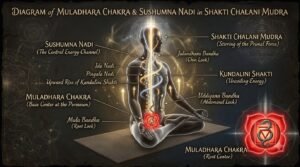
Kundalini, Nadis, and Chakras
We know that there are three channels in our body: Ida (cooling, lunar), Pingala (heating, solar), and Sushumna (central). Kundalini lies at the base of the spine, the Muladhara chakra. When Ida and Pingala are balanced, the breath flows through Sushumna. Shakti Chalani Mudra helps to balance. The Hatha Yoga Pradipika says that when Sushumna flows, the mind becomes still and higher consciousness is achieved.
Self-Realization as the Goal
The Yoga Sutras define yoga as “the stilling of mental fluctuations.” The Bhagavad Gita calls the yogi one whose mind is steady like a lamp in a windless place. Shakti Chalani Mudra serves that same goal. Its aim is not power or special visions. Its aim is “atma-jnana,” or self-realization. Every sensation in the Chakra is only a signpost.
How Does Shakti Chalani Mudra Work?
Shakti Chalani Mudra usually works on two levels—the energetic level and the physical level.
The Energetic View
According to our old tradition, the practice is in four stages:
- Shakti Chalani Mudra draws Apana Vayu upward through Moola Bandha.
- Shakti Chalani Mudra helps to join Apana Vayu with Prana Vayu (upward energy) near the navel.
- Shakti Chalani Mudra heats and rouses the stored energy at Muladhara.
- Shakti Chalini Mudra guides that energy to flow into Sushumna during retention of breath.
This is why Shakti Chalani Mudra is often paired with Ashwini Mudra, Moola Bandha, and Kumbhaka (breath retention).
The Physical View
Modern research on yoga is still growing in leaps and bounds, so claims should be measured. Studies on slow breathing and yoga suggest that these practices can reduce stress and support the parasympathetic nervous system. Pelvic floor engagement strengthens deep core muscles. Breath holds change in carbon dioxide tolerance. These effects may explain some of what students feel during Shakti Chalani Mudra, such as calm, warmth, and clarity. Direct clinical trials on Shakti Chalani Mudra itself are limited, and honest teachers can say so.
Pelvic Floor and Breath
The pelvic floor is the base of the body’s core. Gentle lifting of this area, with slow breath, steadies the spine and focuses the mind. Many students notice a quiet, upward sensation of energy.
Subjective Experience
Sensations like heat, tingling, or lightness vary from person to person. Some feel nothing at first. Both are normal. My advice is not to chase experiences during practice of Shakti Chalani Mudra.
How to Practice Shakti Chalani Mudra
This is a gentle, beginner-friendly version based on classical principles. Learn the full form from a qualified Kriya Yoga teacher.
Before You Begin
- Shakti Chalani Mudra should be practiced on an empty stomach, ideally at dawn or dusk.
- Choose a quiet, clean space
- Sit on a firm cushion or folded blanket.
- Wear loose clothing.
- Spend 10 minutes on gentle warm-ups and slow breathing first.
Step-by-Step Method
- Sit in Siddhasana or Yoni Asana
- Close your eyes. Watch your natural breath for two minutes.
- Begin Mulabandha as tightly as possible, concentrating on the area of contraction.
- Inhale slowly. Inhale slowly and deeply through the right nostril and perform internal breath retention, antar Kumbhaka.
- Hold lightly. Retain the breath for a comfortable few seconds only. Never strain.
- Perform Jalandhara and Uddiyana Bandha
- Then Practice Churning Nauli: move the rectus abdominis muscles clockwise in a circular motion from left to right and then directly back to the left and again circling to the right side, continuing the number of rotations up to ten.
- Now come back to Uddiyana Bandha and slowly release Uddiyana and Jalandhara. Only after the head is raised and inhalation is allowed, proceed slowly. This is one round
- Repeat 5 to 10 rounds. Beginners should start with fewer rounds.
- Sit quietly for five minutes. Then end with a few minutes of silent meditation.
Recommendations
- Keep your practice short and regular rather than long and rare.
- Never force breath retention for a long time.
- Practice Shakti Chalani Mudra only after you are comfortable with Moola Bandha and basic pranayama.
- Finish with Shavasana to let the body absorb the practice.
Benefits of Shakti Chalani Mudra in Kriya Yoga
Students and teachers report many benefits from regular, careful Shakti Chalani Mudra. These are drawn from traditional texts, general yoga research, and from enlightened Gurus, not from guaranteed outcomes.
- Deeper meditation. The mind settles faster and stays steady longer.
- Better stress balance. Slow breath and body focus calm the nervous system.
- Stronger core and pelvic floor. Moola Bandha tones the deep muscles.
- Emotional steadiness. Many feel lighter, kinder, and less reactive.
- Sharper focus and willpower. Consistent effort builds tapas.
- Spiritual growth. The practice supports a sense of connection and purpose.
Pros and Cons at a Glance
| Pros | Cons |
| Shakti Chalani Mudra supports meditation and calm | Needs patience and daily discipline |
| Shakti Chalani Mudra builds body awareness | Unsafe without teacher guidance for some people |
| Shakti Chalani Mudra is rooted in classical texts | Research on the exact practice is limited |
| Shakti Chalani Mudra costs nothing to practice | Can cause strong sensations if rushed |
A balanced view is a sign of respect for the tradition. Shakti Chalani Mudra rewards patience, not haste.
Precautions and Contraindications
Power needs care. Please read this section fully before you try Shakti Chalani Mudra.
Who Should Avoid It or Seek Medical Advice First
- Pregnant women are not advised to practice Shakti Chalani Mudra
- People with hernia, prolapse, or recent abdominal or pelvic surgery
- Those with high blood pressure, heart disease, or glaucoma (avoid breath retention) in Shakti Chalani Mudra
- Anyone with severe anxiety, panic disorder, psychosis, or trauma history, unless guided by a therapist and teacher
- People with epilepsy or serious spinal problems should avoid Shakti Chalani Mudra
- Anyone who is unwell, exhausted, or has an empty-minded ‘spacey’ feeling
Safe Practice Guidelines
- Shakti Chalani Mudra should be learned from an experienced teacher.
- Never practice Shakti Chalani Mudra on a full stomach.
- Stop at once if you feel dizzy, panicky, chest pain, or sharp pain.
- Avoid long breath holds during the practice of Shakti Chalani Mudra
- Keep your lifestyle simple: good sleep, light food, and kind company.
If you have a medical condition, speak with your doctor before starting. This guide is educational and does not replace medical care.
Common Myths About Shakti Chalani Mudra
Misunderstanding can lead to fear or risk. Let us clear up the most common myths.
Myth 1: Shakti Chalani Mudra gives instant enlightenment. Fact: The texts speak of years of steady practice. This mudra is a tool, not a shortcut.
Myth 2: Shakti Chalani Mudra is dangerous for everyone. Fact: Careless practice is risky. Gentle, guided practice is generally considered safe for healthy adults.
Myth 3: You must feel a rush of energy for it to work. Fact: Quiet results such as better sleep, calm, and kindness are real progress.
Myth 4: Only monks and renunciates can practice Shakti Chalani Mudra. Fact: Householders have practiced it for centuries. Balance in daily life is encouraged.
Myth 5: Shakti Chalani Mudra is only physical exercise. Fact: Its heart is awareness. Without attention and devotion, it is just muscle work.
Myth 6: Stronger and longer is always better. Fact: In Shakti Chalani Mudra, gentleness and regularity matter more than force.
Real-World Perspective: What Practitioners Notice
Different stories come out from different yogis. In my case, I can jot down here, although it is forbidden to tell publicly. For my readers’ interest, I am jotting down here. During my continuous practice of Shakti Chalani Mudra (Kriya Yoga) as taught by Guruji for three months, I felt a green serpent during the Aarohan and Avarohan passages, a bitter taste in my mouth, and heard conch/bell sounds. This serpent started rotating through the Arohan and Avarohana passages until the breath is released. This is a unique feeling. Different Yogis feel it in different ways.
Conclusion: Begin Your Inner Journey with Shakti Chalani Mudra
Shakti Chalani Mudra is more than a technique. It is a doorway to the quiet power already inside you. From the Hatha Yoga Pradipika to modern Kriya Yoga, the message is the same: awaken your energy with patience, respect, and guidance. Use Shakti Chalani Mudra to deepen meditation, steady your emotions, and move closer to self-realization.
You do not need to be perfect. You only need to begin. Find a qualified Kriya Yoga teacher, learn the foundations, and practice Shakti Chalani Mudra with patience every day. Start today with five minutes of silent breath awareness. Your inner light is waiting.
FAQ:
- What is Shakti Chalani Mudra in simple words?
Shakti Chalani Mudra is a yogic practice that uses Mudra, Pranayama, Kumbhaka, and pelvic floor engagement and focus to stir the dormant Kundalini energy at the base of the spine and guide it upward.
- Is Shakti Chalani Mudra the same as Shakti Chalana Mudra?
Yes. Chalani, Chalana, and Chalani are spelling variations of the same Sanskrit idea: the moving of Shakti. The classical texts use closely related names for this Mudra.
- Which ancient texts describe Shakti Chalani Mudra?
The Hatha Yoga Pradipika and the Gheranda Samhita both describe it in their sections of Mudras. Tantric traditions also support the broader Kundalini teachings behind it.
- Why is Shakti Chalani Mudra important in Kriya Yoga?
It strengthens discipline, builds awareness of the subtle body, and prepares the practitioner for deep pranayama and meditation, which are central to Kriya Yoga.
- How long should I practice Shakti Chalani Mudra each day?
Beginners can start with five to ten gentle rounds, about 10 to 15 minutes in total. Increase slowly and only with a teacher’s advice.
- Is Shakti Chalani Mudra safe for beginners?
It can be safe for healthy adults when practiced gently, with proper preparation and teacher guidance. Avoid long breath holds and stop if you feel any discomfort.
- Who should not practice Shakti Chalani Mudra?
Pregnant women, people with a hernia, prolapse, high blood pressure, heart conditions, epilepsy, or serious mental health conditions should consult a doctor and a qualified teacher first.
- What are the main benefits of Shakti Chalani Mudra?
Practitioners report deeper meditation, better stress balance, a stronger pelvic floor, emotional steadiness and a greater sense of spiritual connection. Results vary by person.