
Sword Yoga, recently brought to life by Sabina Storberg in South Florida, is gaining recognition as one of the most powerful movement practices rooted in ancient traditions, now making its way into the modern fitness and mindfulness scene. This unique practice fuses traditional blade work with the breath-synchronized flow of classical yoga, resulting in an experience that stands apart from anything else in the wellness world. If you’ve ever thought that Sword Yoga acts as a bridge between your inner warrior self and your meditative self, you’re absolutely right. Transforming from the ancient Hatha Yoga warrior tradition, this practice permits your body to act as both a weapon and a vessel. So, if you’re on the lookout for something that challenges you physically, sharpens your mind, and grounds your spirit, Sword Yoga is definitely the way to go.
What Is Sword Yoga? The Ancient Warrior Roots
From our ancient warrior roots, Sword Yoga found its way into the modern wellness industry; the foundation of this yoga a existed in the warrior traditions of ancient India and East Asia. Warrior Pose has not been derived from any ancient yogic culture; it is somewhat similar to the gymnastics of Niels Bookh in the early 20th century. Through continuous transformation, Sword Yoga has come to light. The iconic Virabhadrasana—Warrior Pose—is named after a mythical sword-wielding warrior conjured by Lord Shiva. This is not a coincidence. The warrior with a sword was the original symbol of a focused, disciplined, and fearless practitioner.
Sword Yoga takes that ancient symbolism and makes it literal.
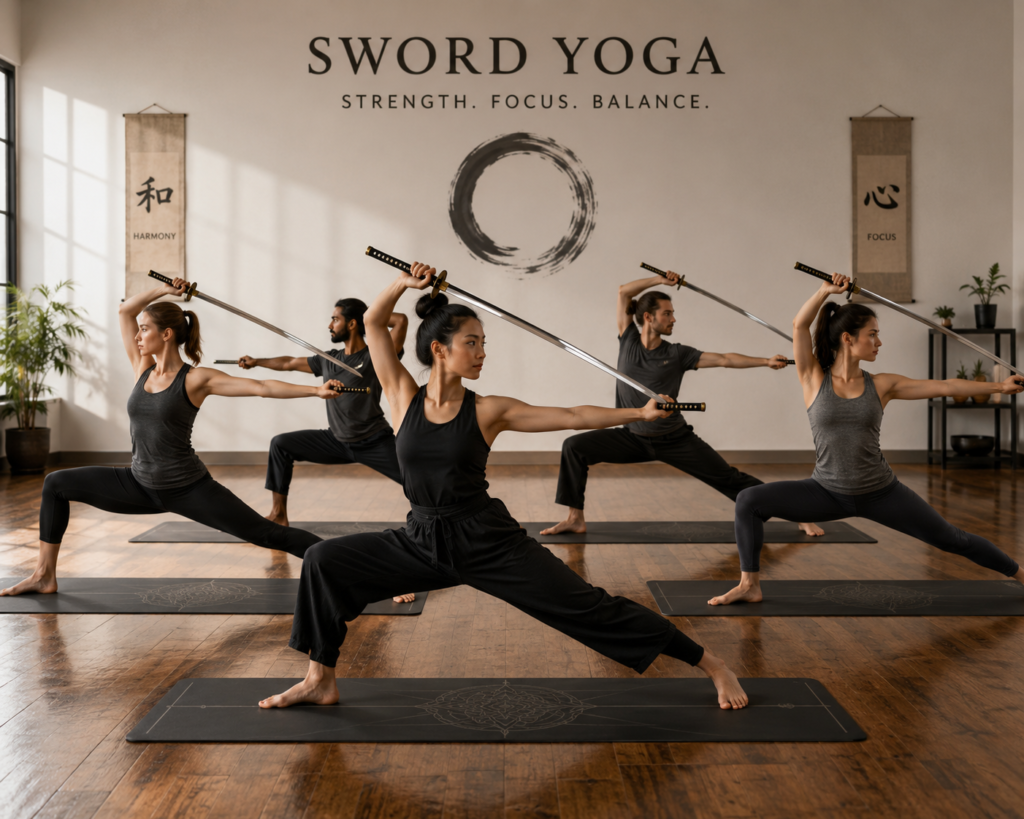
The Connection Between Sword Yoga and Hatha Yoga’s Warrior Tradition
Virbhadrasana is a yoga pose derived from the name Virbhadra, who was a powerful warrior of Lord Shiva. The name has been brought from Veera, meaning “warrior”; Bhadra means “good,” and Asana is “posture.” This pose requires strength, stability, and mindfulness. Veerbhadrasana is generally known as the Warrior Pose.
But Sword Yoga has been derived from the principle of the Warrior Pose; the exception is only to practice with controlled sword movement with yogic breathing, mindfulness, and body alignment. Here the sword is used as a weapon for developing concentration, coordination, and presence of mind, like the warrior’s weapon in ancient martial tradition. Sword Yoga emphasizes mastery over the practitioner’s mind and body rather than promoting combat.
Both of the above two encourage the practitioners to cultivate discipline, self-awareness, courage, and mental clarity. Attentive handling of a sword in sword yoga reflects the awareness developed through Hatha yoga’s warrior poses. Together, these two represent a fine balance of strength and sincerity, representing a true warriorhood, which is not at all aggression but balance, self-control, and inner transformation.
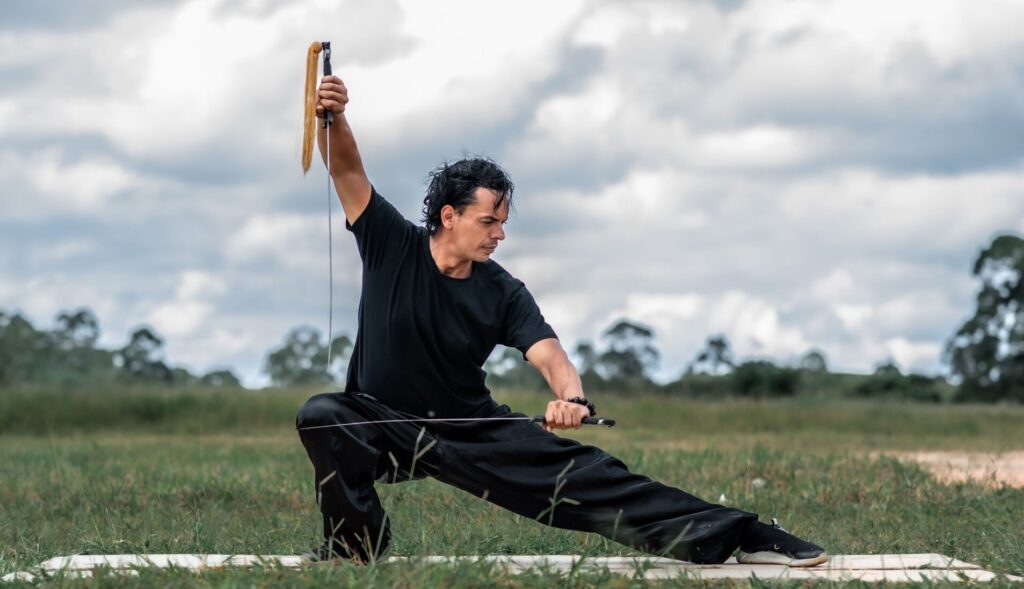
Benefits of Sword Yoga: Why This Practice Changes Everything
We all know that every yoga pose extends benefits to the human body for those who practice regularly. Here, Sword Yoga emphasizes scientifically supported yoga poses, the result of which can be felt immediately by practitioners at every level.
Physical Benefits
The benefits of Sword Yoga begin in the body and radiate outward:
- Improved muscular endurance — Holding a sword in extended positions while flowing through poses activates the posterior chain, shoulders, and core far more intensely than unloaded yoga.
- Superior balance and proprioception — Research in the Journal of Bodywork and Movement Therapies (2019) shows that unilateral load-bearing in yoga-style postures significantly improves neuromuscular coordination.
- Increased grip and forearm strength—A consistent practice of this yoga workout routine develops hand strength that carries over to sports, climbing, and daily function.
- Enhanced flexibility—The sweeping arc movements demand full shoulder, hip, and thoracic mobility.
- Cardiovascular engagement — A 45-minute Sword Yoga workout routine at moderate intensity elevates heart rate to 60–75% of maximum, providing meaningful aerobic conditioning.
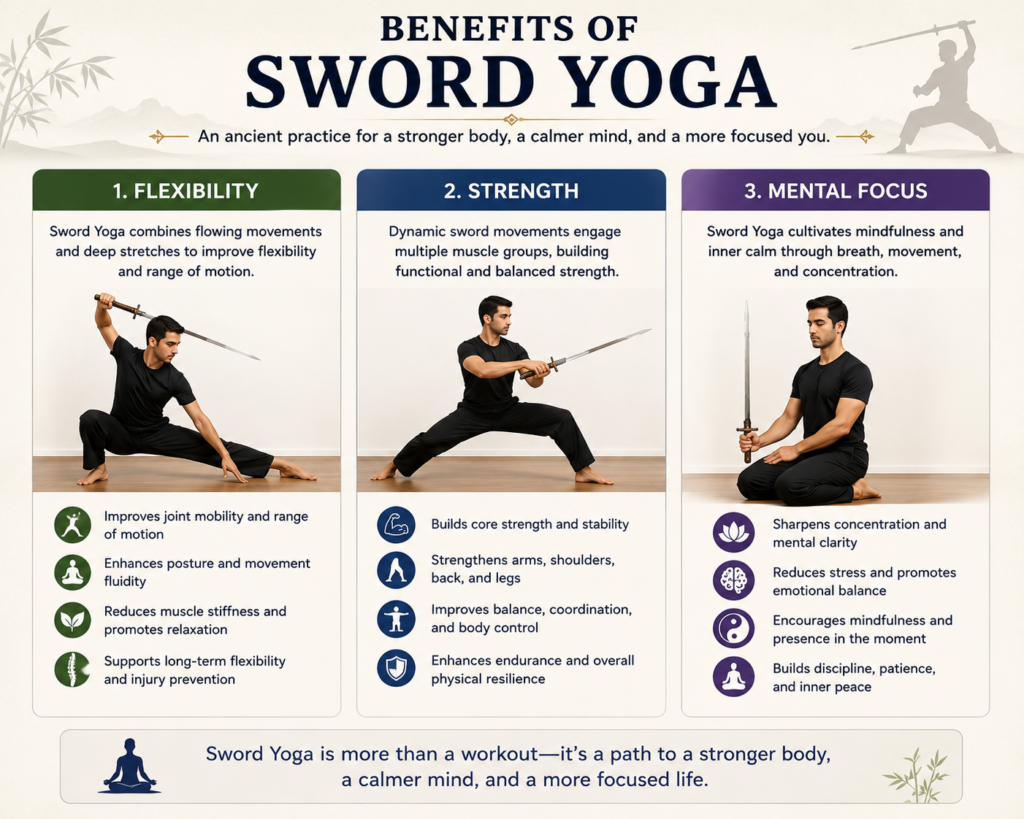
Mental and Emotional Benefits
Sword Yoga not only provides physical benefits but also mental benefits, which are summarized below:
- It sharpens concentration—blade work demands total present-moment awareness
- It reduces anxiety—rhythmic, breath-synchronized sword movement activates the parasympathetic nervous system
- It helps to release emotional feelings—the power and permission to swing with intention provide healthy cathartic expression
- Sword Yoga extends Confidence and self-efficacy—mastering a weapon-based movement art builds a sense of inner authority
Pros and Cons at a Glance
| Pros | Cons |
| Full-body conditioning | Requires proper equipment and space |
| Deeply meditative | Steeper learning curve than standard yoga |
| Combines strength + mindfulness | Must be practiced safely |
| Accessible to most ages | Initial instruction recommended |
| Rooted in ancient tradition | It can be intense for beginners |
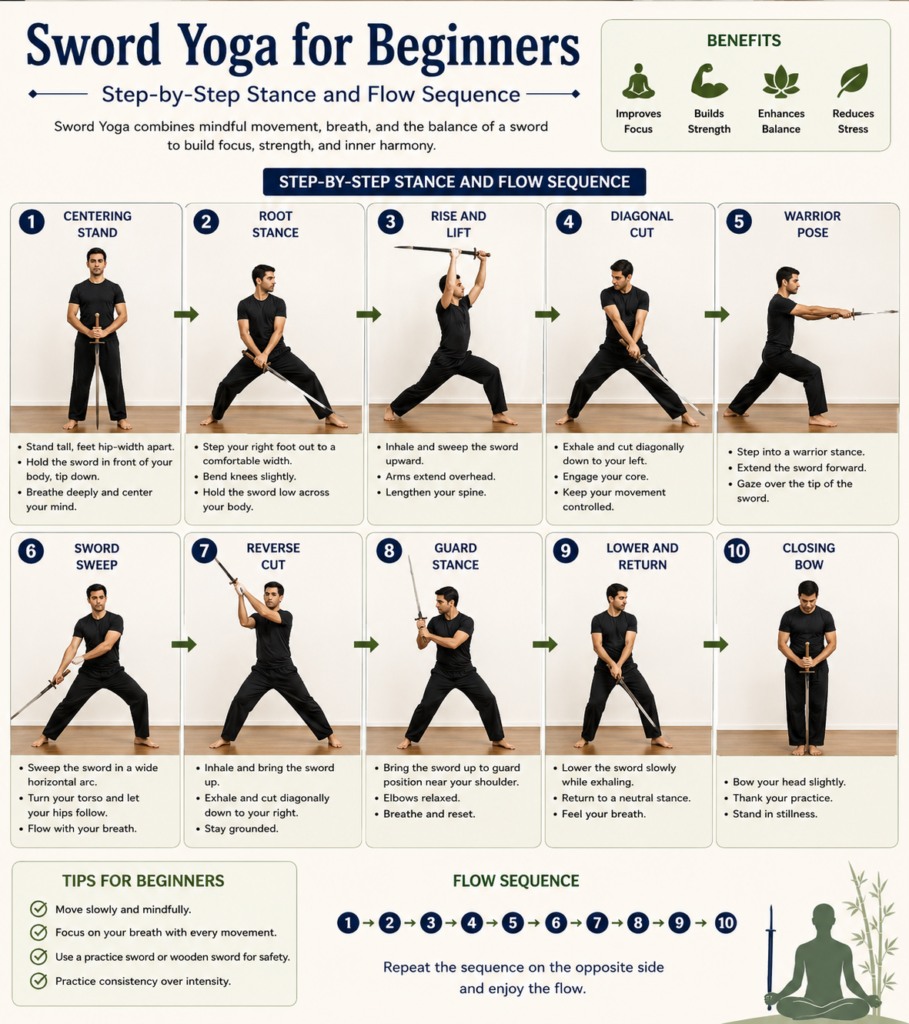
Sword Yoga for Beginners: Where to Start
The beginners of Sword Yoga should not use the real sword. They should use the artificial sword made up of wood, thick plastic, and any other material rather than the real one. Sword for beginners means learning the foundational postures, breath patterns, and movement vocabulary that make the full practice safe and effective.
What the practitioners need to begin
- A bokken (wooden training sword) or foam sword—never begin with a live blade
- Comfortable, non-restrictive clothing
- A space of at least 6 feet in all directions
- A yoga mat for grounding work
- A beginner’s video course or a qualified instructor
Essential Beginner Postures
Sword for beginners starts with these three foundations:
- Mountain Sword Stance (Tadasana with Draw) Stand in Tadasana (Mountain Pose). Hold the sword at your side. On an inhale, slowly draw the sword upward to heart level. On an exhale, extend it forward. Hold for 5 breaths. This is your anchor.
- Warrior I with Overhead Guard (Virabhadrasana I): Step into Warrior I. Raise the sword overhead in a two-hand guard position. Feel the posterior chain engage. Hold 5–8 breaths per side. This is where the sword for beginners meets the ancient Hatha warrior tradition directly.
- Flowing Side Arc from Warrior II allows the sword arm to sweep in a wide arc from low to high. Synchronize the arc with your inhale. Return on your exhale. Begin with 5 slow repetitions per side.
Weapon Up: The Sword Yoga Training System
Weapon Up Sword Yoga points to a systematic approach that gradually integrates blade-work into a full yoga-style flow. Weapon Up Sword Yoga is not unplanned. It is a planned system built on the same gradual overload principles used in athletic training.
The Weapon Up Sword Yoga Framework
Weapon Up Sword Yoga is typically structured in three tiers:
Tier 1 — Foundation (Weeks 1–4)
- Static postures with sword held at rest
- Breath and alignment calibration
- Basic cutting arcs (jodan, chudan, gedan — upper, middle, low)
Tier 2 — Integration (Weeks 5–10)
- Moving through yoga flows with a sword in hand
- Transition between warrior poses with sword guard changes
- Introduction of rotation and diagonal cuts
Tier 3 — Flow Mastery (Weeks 11+)
- Full Sword Yoga workout routine sequences lasting 30–60 minutes
- Breath-led spontaneous movement with blade
- Partner observation and mirror-work drills
Sword Yoga for Strength and Balance: The Science Behind the Practice
For balance and strength, sword yoga acts because it introduces a dynamic, balanced load into what would otherwise be a bodyweight practice. Sword yoga for strength and balance influences two powerful physiological principles:
Proprioceptive Challenge
When you hold a sword at arm’s length in Warrior III (a single-leg balance posture), your nervous system must work significantly harder to maintain equilibrium. A 2021 study in Frontiers in Sports and Active Living found that adding even a light external load to single-leg yoga poses increased EMG (muscle activation) in the stabilizing hip musculature by 23–31%.
Closed Kinetic Chain Engagement
Unlike isolation exercises, sword yoga for strength and balance engages the entire kinetic chain simultaneously. A single diagonal overhead cut requires the following:
- Glute max and hip flexor co-activation
- Core bracing and lumbar stabilization
- Scapular depression and rotator cuff control
- Wrist and forearm stabilization
- Lower leg and ankle proprioception
This is total-body training that no single gym machine can replicate.
Sword Yoga and Mindfulness: The Inner Dimension
Perhaps the most underestimated aspect of this practice is sword yoga and mindfulness. In Zen sword traditions, the concept of “mushin”—”no mind”—describes the state in which the swordsman acts without hesitation or internal commentary. Sword yoga and mindfulness create the conditions for exactly this.
How Sword Yoga Cultivates Mindfulness
Sword Yoga and mindfulness work together through these mechanisms:
- Sensory anchoring—the weight, texture, and movement of the sword anchors attention to the present moment
- Consequence-based focus—a misaligned cut or dropped guard gives immediate feedback; the mind cannot wander without noticing
- Breath as a bridge—every movement is breath-led, making the breath the continuous thread of awareness
- Ritual and intention—drawing and covering the sword with respect creates mindful conversion, identical to the Japanese practice of Rei (bowing before and after practice)
On experimental studies of martial arts and yoga practices, it steadily reduces the perceived stress, improves attention regulation, and boosts emotional self-regulation. A 2020 meta-analysis in Complementary Therapies in medical institutions found that movement practices combined with somatic awareness and structured breath-work reduce cortisol levels by an average of 14–22%.
Workout Routine for Sword Yoga: A Complete 45-Minute Session
The workout routine of this yoga can be used immediately as per the following timetable:
10 minutes for warm-up:
- Sun Salutation—Surya Namaskar (without sword)—activate breath and spinal mobility
- Wrist and shoulder circles—30 seconds each direction
- Standing hip circles in wide stance—60 seconds
- Slow bokken draw and return × 10 repetitions
Main Sequence (25 minutes)
Block 1: Warrior Foundation (8 minutes)
- Warrior I with overhead guard — 8 breaths, 3 sets per side
- Warrior II with extended sword point — 8 breaths, 3 sets per side
- Reverse Warrior with sweeping arc — 5 breaths, 3 sets per side
Block 2: Balance and Cut (10 minutes)
- Warrior III with forward thrust — 5 breaths per side × 3
- Half Moon with side arc—5 breaths per side × 3
- Tree Pose with sword at center guard — 8 breaths per side × 2
Block 3: Flow Sequence (7 minutes)
- Link Warrior I → II → Reverse Warrior in a continuous breath-led flow
- Add one diagonal cut per transition
- Complete the three full rounds
Cool-Down (10 minutes)
- Pigeon Pose — 90 seconds per side
- Supine spinal twist — 60 seconds per side
- Savasana with sword laid across the body at the heart center — 5 minutes
- Seated closing meditation: rest hands on hilt, close eyes, 10 slow breaths
The Broader Context of Martial Arts and Yoga:
Sword yoga has mainly been derived from martial arts yoga. Categorically, martial arts yoga includes the following:
- Tai Chi Yoga — Chinese internal martial arts fused with yoga breathwork
- Capoeira Flow — Brazilian martial art movement with yogic body awareness
- Kalaripayattu — the ancient Indian martial art that is widely considered a direct ancestor of both yoga and many Asian martial arts
- Sword Yoga — the most structured and equipment-specific form of martial arts yoga
- The Principle of Martial Arts Yoga indicates the body is not just a vehicle for combat or flexibility—it is an instrument of consciousness. When movement is precise, intentional, and breath-led, it becomes meditation in motion.
Expert Perspective
Dr. Anita Sharma, sports scientist and former Indian national martial arts coach, has written extensively about the intersection of warrior movement arts and yoga. Her position is clear: “The separation between yoga and martial arts is a modern invention. In their original forms, they were the same practice — control of body, breath, and mind in service of total human potential. Sword Yoga restores that unity.”
This is not nostalgic romanticism. It is a functionally superior training method.
Who Should Practice Sword Yoga?
Sword Yoga is appropriate for:
- Yoga practitioners seeking greater physical challenge
- Martial Yoga practitioners wanting to add meditative depth to their training
- Athletes require coordination, balance, and mental calm
- Individuals suffering from anxiety seeking embodied mindfulness practices
- History enthusiasts drawn to warrior traditions
Beginners should consult a health care professional, looking at the following points:
- Recent shoulder, wrist, or lower-back injuries
- Severe balance disorders
- Uncontrolled hypertension
Real-World Application: Sword Yoga in Practice
A practitioner named Arjun, a 38-year-old IT professional from Pune, began this yoga training after experiencing chronic shoulder tension and work-related anxiety. Within eight weeks of a structured sword yoga workout routine—practiced three times per week—he reported the following:
- Shoulder tension reduced by approximately 60% (self-reported pain scale)
- Sleep quality improved significantly
- Greater sense of mental clarity and focus at work
- Measurable improvement in posture confirmed by a physiotherapist
His case is not unusual. The combination of loaded movement, breathwork, and mindful intention that defines Sword Yoga and mindfulness practice produces benefits that isolated gym training or standard yoga simply cannot replicate.
Conclusion: Step Into Your Warrior Practice
Sword Yoga is not a trend. It is a rediscovery. It reconnects the modern practitioner to an unbroken lineage of warrior-sages who understood that physical mastery and inner stillness are not opposites—they are one. The benefits of Sword Yoga — from the physical gains of Sword Yoga for strength and balance to the deep calm cultivated through Sword Yoga and mindfulness — make this one of the most complete human development practices available today.
Whether you are just beginning to explore sword for beginners’ approaches, building a committed sword yoga workout routine, or advancing through the tiers of Weapon Up Sword Yoga training, the path is clear. Martial arts yoga in the form of sword yoga offers something rare: a practice that makes you simultaneously stronger, calmer, and more fully alive.
Begin today. Pick up a training sword. Step into Warrior I. Breathe. The ancient warrior tradition has been waiting for you.
FAQ:
Q1: What exactly is Sword Yoga?
Sword Yoga is a movement practice that combines classical yoga postures — particularly Hatha Yoga warrior sequences — with intentional blade-work using a training sword (bokken or waster). It builds strength, balance, and mindfulness simultaneously.
Q2: Is Sword Yoga safe for beginners?
Yes. Sword for beginners always starts with lightweight training swords or wooden bokkens — never live blades. Beginners learn foundational postures and basic cutting arcs before progressing to more complex sequences. A qualified instructor or structured beginner program is recommended.
Q3: What are the main benefits of Sword Yoga?
The benefits of Sword Yoga include full-body muscular conditioning, superior balance and coordination, grip strength, spinal mobility, reduced anxiety, improved focus, and a strong sense of personal empowerment.
Q4: How often should I practice a Sword Yoga workout routine?
For meaningful results, a Sword Yoga workout routine practiced 3 times per week is optimal for beginners. Advanced practitioners often practice 4–5 times per week, alternating intensity levels.
Q5: What is the connection between Sword Yoga and mindfulness?
Sword Yoga and mindfulness are inseparable. The weight and precision required in blade work demand complete present-moment awareness. Breath-synchronized movement, intentional ritual, and sensory anchoring to the sword all cultivate deep meditative focus—what Zen swordsmanship calls Mushin (no mind).
Q6: Is Sword Yoga considered a martial art?
Sword yoga sits within the category of martial arts yoga — it draws from martial traditions (Japanese swordsmanship, Indian Kalaripayattu) but frames the practice through the lens of yoga: breath, alignment, awareness, and non-competitive personal development. It is more accurately a warrior wellness practice than a combat system.