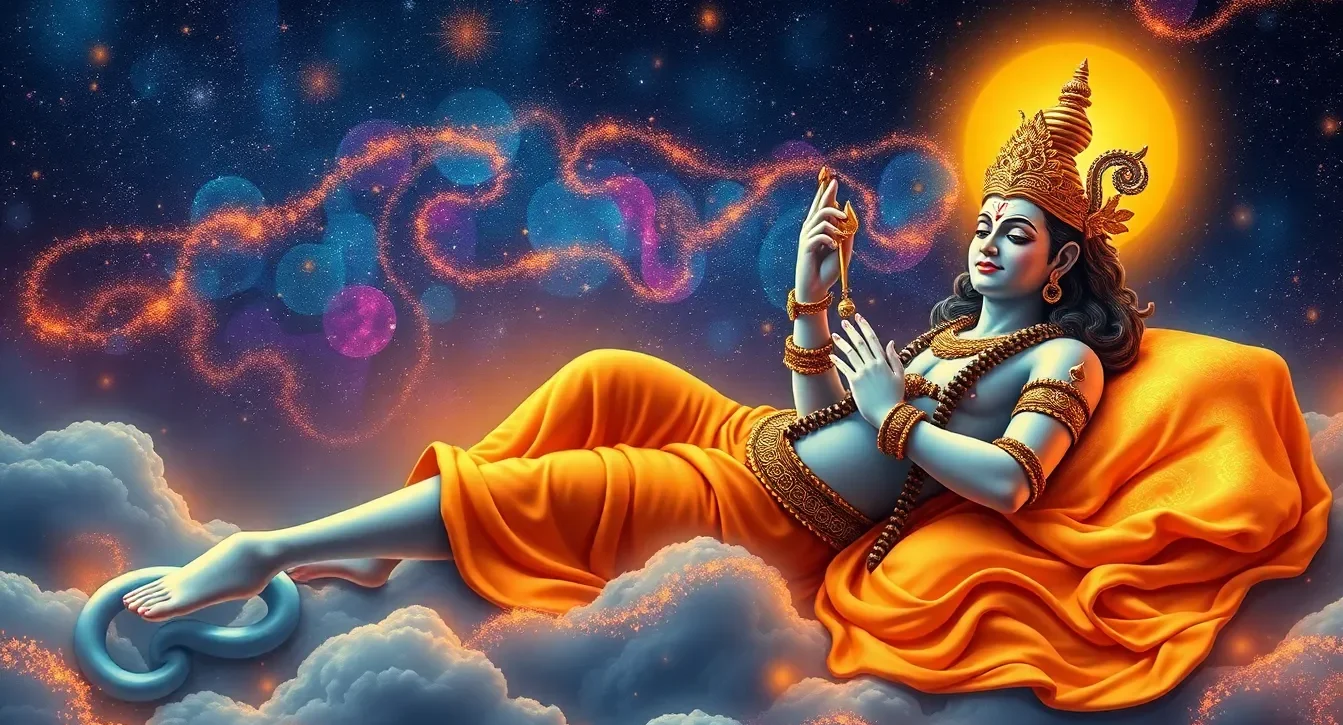
The Ancient Sacred Hand Gesture.
Introduction:
Prana Mudra and Jesus share an ancient connection so spiritually profound that exploring it can transform how you approach both prayer and healing. The relationship between Prana Mudra and Jesus is not a modern invention. It is rooted in the sacred wisdom traditions of the ancient world. When you study Prana Mudra and Jesus together, a breathtaking pattern emerges — one that unites East and West in the language of the divine hand.
Scholars of comparative religion, yoga historians, and theologians have long noted that Jesus of Nazareth lived in an era of remarkable cultural and spiritual exchange. Trade routes connected the Mediterranean world to India, Persia, and Egypt. Spiritual ideas traveled with merchants, sages, and pilgrims. The yoga and Christianity connection is not speculative — it is supported by historical, archaeological, and scriptural evidence that continues to grow.
Mudras — intentional hand gestures used to channel life-force energy, or prana — appear in some of the oldest sacred art on Earth. They appear on Egyptian temple walls, in Buddhist statues, in Hindu iconography, and, more so, in the earliest depictions of Jesus Christ in Christian art. The yoga mudras in Christianity reveal a shared spiritual language that transcends any single religion.
In this article, we will provide an evidence-based journey through history, spirituality, and healing science. By the end, you will understand the Prana Mudra benefits with fresh eyes — and you may never look at a painting of Jesus with his hand raised in blessing the same way again.
What Is Prana Mudra? Understanding the Life-Force Gesture
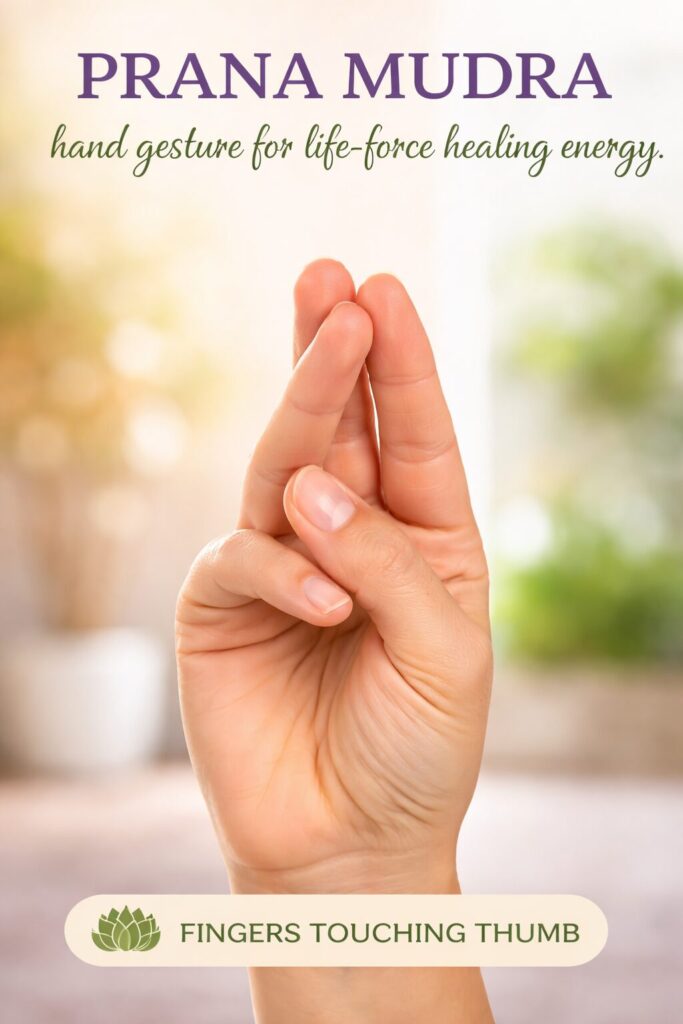
In Sanskrit, the word “mudra” means “seal” or “gesture.” Prana Mudra is specifically the gesture of life-force energy. It is performed by touching the tips of the ring finger and little finger to the tip of the thumb, while keeping the index and middle fingers straight and extended.
The Science of Energy in Prana Mudra
According to ancient yogic texts, the human body is governed by five fundamental energies, or Prana Vayu like Prana Vayu, Udana Vayu, Samana Vayu, Apana Vayu, and Vyana Vayu. These Vayus control respiration and thought process, govern the ability to communicate, are responsible for creating heat for better digestion, control the excretory system, and, more importantly, help to control proper circulation of blood throughout the body. But Prana Mudra activates and balances the root energy center, known as Muladhara, while simultaneously stimulating the Ajna (third eye) chakra. This dual activation is precisely what makes the gesture so powerful for both physical vitality and spiritual clarity.
Modern research on Mudras for healing and energy has confirmed measurable physiological effects. Studies published in the International Journal of Yoga (2013) showed that systematic practice of yoga mudras influences the autonomic nervous system, reduces cortisol levels, and enhances immune response. The fingers themselves, according to both Ayurvedic and alternative therapy, point to major organ systems and nerve networks.
Core Prana Mudra Benefits
The Prana Mudra benefits extend across physical, mental, and spiritual dimensions. Here is what consistent practice offers:
- Activates dormant life-force energy throughout the entire body
- Strengthens the immune system and increases overall vitality
- Improves vision and clarity of perception — both physical and intuitive
- Reduces chronic fatigue and restores energy during illness
- Calms the nervous system and reduces anxiety
- Enhances concentration, memory, and mental focus
- Supports the opening of the third eye chakra for deeper spiritual insight
- Facilitates deep meditative states and prayer alignment
These benefits are not merely traditional claims. Clinical studies, including research from AIIMS (All India Institute of Medical Sciences), have examined the role of specific yoga mudras in managing conditions such as hypertension, depression, and metabolic disorders, consistently finding statistically significant improvements in practitioners.
The Ancient Connection Between Yoga and Christianity
To understand the ancient connection between yoga and Christianity, we must travel back to the world of the first century C.E. The Roman Empire had created an unprecedented network of roads, sea lanes, and trade routes. Merchants from Alexandria regularly traveled to India. Greek philosophers had encountered Indian gymnosophists (naked philosophers, likely early Jains or yogis) as far back as the time of Alexander the Great in 325 B.C.E.
There was a cultural link between East and West. As per Greek philosophy, it appears that it is an indistinct expression of Indian philosophy. Persian Philosophy was the most advanced and was the center of cultural exchange from East to West for many centuries. It is learned that the Great Philosopher Plato spent 10 years in the East for studies, and it is presumed that he studied Indian Sankhya Philosophy and Patanjali Yoga Philosophy in a Persian University.
The lifestyle of Plato was similar to that of Indian philosophers, and he was a contemporary of Lord Buddha. The yoga system and culture of non-violence of the Lord Buddha was spread throughout Arab, Persia, Syria, Egypt, Palestine, and countless other countries. However, Indian Yoga culture was adopted by Plotinus, who was a Yogi of Syria and attained Samadhi several times in his lifetime.
It is also learnt that Lord Jesus, at the age between 18 and 29 years, spent nearly 11 years in India, and these years were neither written in the Bible nor in his Biography. He traveled throughout Kashmir with the Indian Monks and practiced Yoga and other Indian rituals in Indian Monasteries. These details can be found in the Library of an Old Monastery (Himish Math) in Kashmir. The description was published in The Daily News Paper Statesman, and different dailies of London, and this was published before the 2nd World War. The ideals of Jesus were similar to those of the Hindu Monks and Buddhists. Hence, we can say that Jesus was inspired by the Hindus and Buddhists.
India and the Middle East: A Forgotten Dialogue
Ancient texts and archaeological evidence point to sustained contact between India and the Levant (the region encompassing modern Israel, Palestine, Lebanon, and Syria). The Dead Sea Scrolls, discovered in 1947, reveal practices within the Essene community — a Jewish group with which many historians associate Jesus — that strikingly parallel Indian yogic disciplines:
- Ritual purification practices similar to Ayurvedic shuddhi kriyas
- Communal vegetarian meals resembling sattvic dietary principles
- Celibate, disciplined monastic community life
- Emphasis on inner light, breath, and healing through spiritual power
- Use of sacred silence and contemplative meditation
The first-century Jewish historian Josephus described the Essenes as masters of healing who “investigate medicinal roots and the properties of stones.” This description resonates profoundly with traditional Ayurvedic and yogic approaches to health and energy.
Jesus Hand Gestures Meaning in Ancient Christian Art
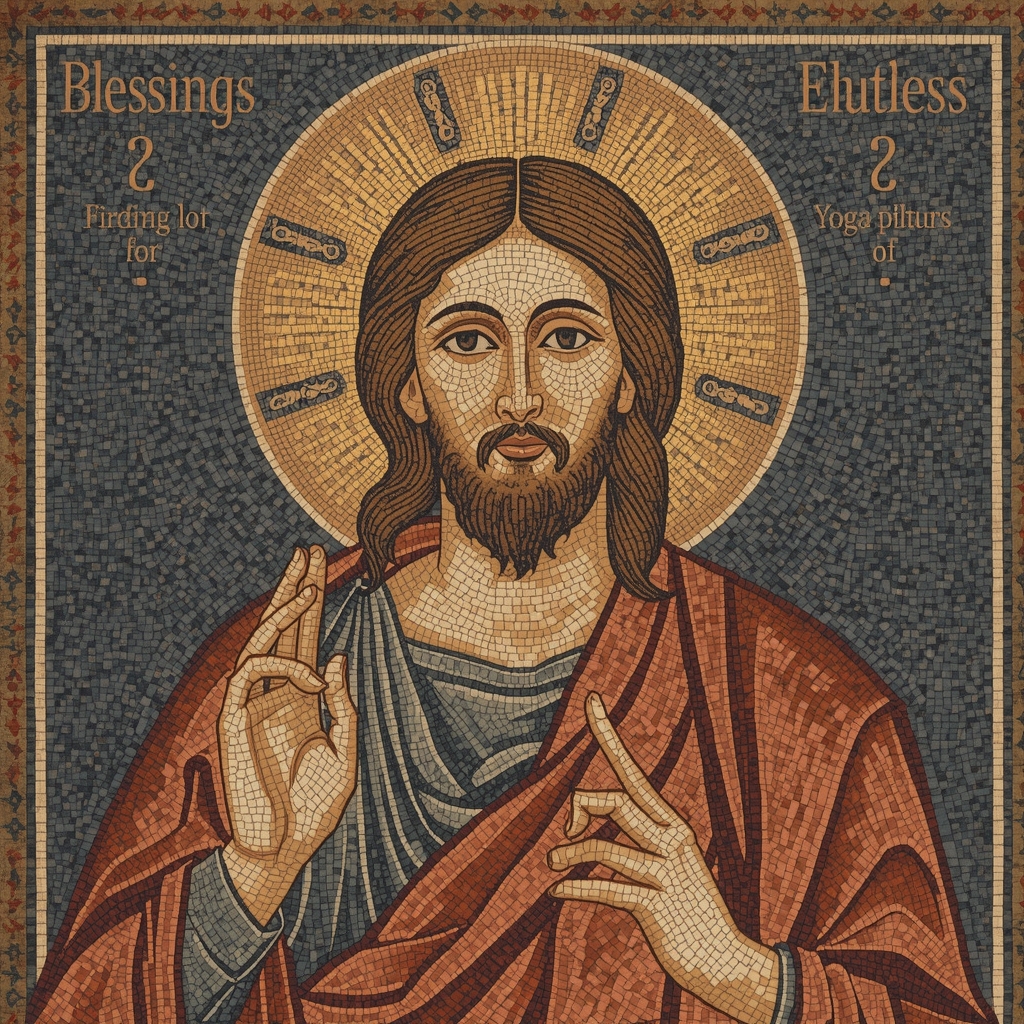
The visual evidence for the yoga and Christianity connection lies in the meaning of Jesus ‘ hand gestures in early Christian iconography. Visit any museum of Byzantine art, study the mosaics of Ravenna in Italy (5th–6th century C.E.), or examine the icons of the Eastern Orthodox tradition, and you will encounter a startling image:
Jesus Christ depicted with two fingers extended — typically the index and middle fingers — while the ring finger and thumb are joined. This gesture is called the “Benediction” or “Blessing Hand” in Christian art. It has been used in Christian sacred art for over 1,700 years.
Compare this to the classical Vitarka Mudra of yoga — a teaching gesture used by Buddhist and Hindu teachers — and the structural parallel is unmistakable. Compare it to Prana Mudra variants, and the convergence deepens.
Key Matching Hand Gestures: Yoga vs. Early Christianity
| Mudra Name | Yogic Tradition | Christian Parallel |
| Prana Mudra | Life-force activation, healing | Healing Miracles of Jesus |
| Vitarka Mudra | Teaching, transmission of wisdom | Christ Pantocrator (Christian Almighty) blessing gesture |
| Dhyana Mudra | Deep meditation, union with the divine | Orans prayer posture in early Christianity |
| Anjali Mudra | Reverence, devotion, prayer | Christian prayer hands (namaste position) |
Yoga Mudras in Christianity: The Hidden Sacred Art
The presence of yoga mudras in Christianity is not hidden from those who know what to look for. It is literally painted on the walls of the oldest churches in the world. The catacomb art of Rome (2nd–4th century C.E.) shows early Christians in the Orans position — arms raised, palms open — a gesture directly parallel to the Pranam or Dhyana Mudra positions in yoga tradition.
Saint Thomas and the Indian Church: A Direct Bridge
One of the most historically grounded bridges between yoga mudras in Christianity and Indian tradition is the story of Saint Thomas the Apostle. According to both Christian tradition and well-documented Indian church history, the Apostle Thomas traveled to India around 52 C.E., landing in Kerala on the southwest coast — then one of the most sophisticated centers of yoga and Vedic learning in the ancient world.
The St. Thomas Christians of Kerala, known as the “Nasrani” (Nazarenes), represent one of the oldest Christian communities in the world. Their liturgical art, their prayer gestures, and their contemplative practices show clear signs of mutual influence with the Hindu and Buddhist sacred traditions that surrounded them for two millennia.
This is not the combination of different systems of philosophical or religious belief or the corruption of faith. It is the natural expression of the universal spiritual language that rises above the boundaries of organized religion. The yoga and Christianity connection through Saint Thomas is one of the most concrete historical examples so far, we know.
The Lost Years of Jesus: India, Kashmir, and Yoga
The canonical Gospels contain almost no information about Jesus between the ages of twelve and thirty — a period scholars call “the lost years” or “the silent years.” This eighteen-year gap has fascinated historians, mystics, and theologians for centuries.
A remarkable document discovered in 1887 by Russian journalist Nicolas Notovitch at the Hemis Monastery in Ladakh (northern India) — later published as “The Unknown Life of Jesus Christ” — claims that Jesus, known in the text as “Issa,” traveled to India, Nepal, and Persia during these years. There, Issa studied with Brahmin priests and Buddhist monks, mastered the sacred texts, and is described as using his hands in healing in ways consistent with descriptions of mudras for healing and energy.
While the authenticity of Notovitch’s manuscript remains debated among historians, the theory is supported by multiple independent accounts, including a 1922 expedition by Swami Abhedananda (of the Ramakrishna Mission), who independently found and translated portions of the same text. The parallel traditions of healing through sacred gesture in both yogic and Christian traditions suggest, at minimum, a shared ancient source.
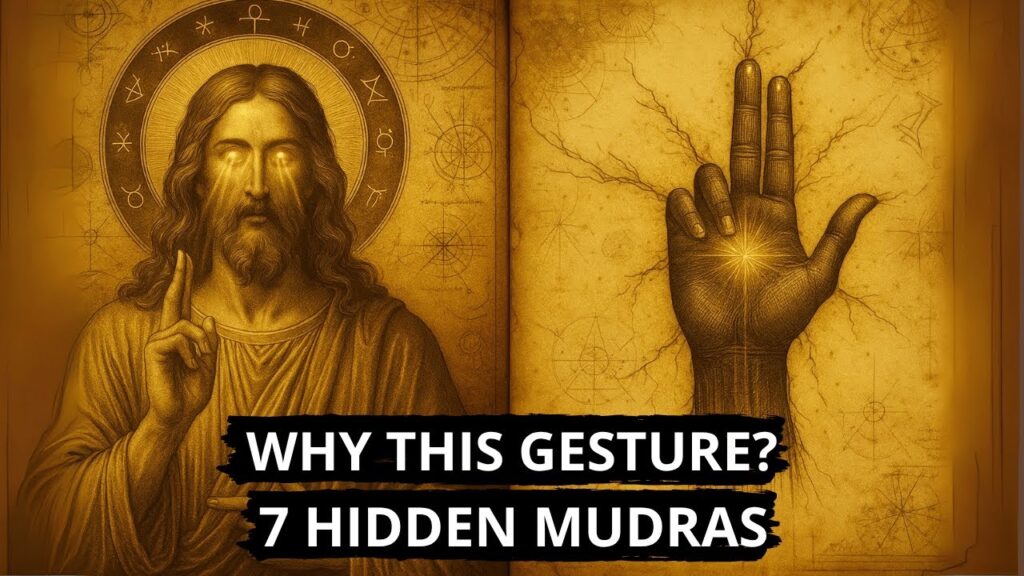
The Healing Miracles of Jesus Through the Lens of Mudras for Healing and Energy
When we read the Gospel accounts of Jesus healing the sick through the laying on of hands, we can see a striking parallel to the concept of mudras for healing and energy. In Mark 6:5, it is stated that Jesus “laid his hands on a few sick people and healed them.” In Luke 4:40, “He laid his hands on every one of them and healed them.”
This intentional, specific use of hands as instruments of divine healing energy resonates deeply with the yogic understanding that the hands are antennae for prana — life-force energy. Prana Mudra and Jesus are thus not merely parallel traditions. They may be expressions of the same primordial knowledge: that human hands, when consciously positioned with spiritual intention, can channel divine healing force.
Prana Mudra and Jesus: Theological and Spiritual Alignment
For many Christians, the idea of yoga mudras in Christianity can feel surprising — or even unsettling. This is entirely understandable. Centuries of institutional separation between Eastern and Western spiritual traditions have created the impression that they are fundamentally different in nature. But the evidence consistently points in the opposite direction.
Prana as the Holy Spirit: A Theological Parallel
The Hebrew Bible uses the word “ruach” — breath or spirit — for the divine life-force that animates all creation. In Genesis 2:7, God breathes life (ruach) into the nostrils of Adam. In the New Testament, the Greek word “pneuma” — breath, spirit — is used for the Holy Spirit that Jesus breathes upon his disciples (John 20:22).
In Sanskrit, the corresponding word is “prana” — literally “first breath” — the animating life-force of the universe. The theological parallel is not superficial. All three traditions — Hebrew, Greek-Christian, and Sanskrit-yogic — use breath as the primary symbol for the divine animating principle.
Prana Mudra, therefore, is a gesture for inviting, amplifying, and channeling the very force that the Christian tradition calls the Holy Spirit. Seen this way, the ancient connection between yoga and Christianity is not a compromise of faith — it is a deeper recognition of the same divine reality expressed in different cultural languages.
The Kingdom of Heaven Within: Yoga and Jesus Agree
One of the most quoted teachings of Jesus is found in Luke 17:21: “The Kingdom of God is within you.” This radical proclamation of inner divinity is the cornerstone of all yoga philosophy. The Upanishads declare “Tat tvam asi” — “Thou art That” — meaning the individual self and the universal divine are not separate.
Prana Mudra and Jesus both point inward — toward the inner temple of the human body as the dwelling place of divine energy. This is not a coincidence. It is the convergence of wisdom traditions that recognized the same truth: that the body is sacred, the breath is divine, and the hands are instruments of that divinity.
Expert Insight: What Theologians and Yoga Scholars Say
Father Bede Griffiths (1906–1993), a Benedictine monk who spent decades at the Shantivanam ashram in Tamil Nadu, India, wrote extensively on the yoga and Christianity connection. In his landmark work “The Marriage of East and West,” he argued that Christian contemplative tradition and Indian yoga share a single root — the direct experience of the divine through the disciplined transformation of body, breath, and mind.
Dr. Georg Feuerstein, one of the world’s foremost scholars of yoga philosophy, noted in “The Yoga Tradition” (2001) that the similarities between early Christian contemplative practice and classical yoga are “too consistent to be accidental.” He pointed specifically to the use of sacred gesture, breath, and postural discipline in both traditions.
How to Practice Prana Mudra: A Step-by-Step Sacred Guide
Whether you approach this practice from a yogic perspective, a Christian contemplative framework, or simply as someone seeking healing and vitality, Prana Mudra is accessible to everyone. Here is how to practice it effectively:
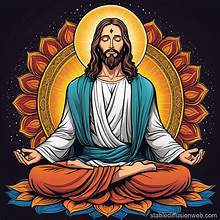
Step-by-Step Practice Instructions
- Sit in a comfortable, upright position — cross-legged (Lotus Pose) on the floor or in a chair with your spine tall and your chest open.
- Place both hands on your thighs or knees, palms facing upward toward the sky.
- On each hand, gently bring the tips of your ring finger and little finger to touch the tip of your thumb. Apply light, conscious pressure — enough to feel the contact without tension.
- Extend your index and middle fingers straight out, relaxed but not rigid.
- Close your eyes. Breathe slowly and naturally through your nose.
- With each inhale, silently affirm: “I draw life-force energy into my being.” With each exhale, affirm: “I release what no longer serves me.”
- Hold this position for a minimum of 15 minutes for therapeutic effects. Beginners can start with 5–10 minutes.
- Practice 2–3 times daily for maximum Prana Mudra benefits — especially at sunrise, noon, and sunset.
Christian Contemplative Enhancement: Praying with Prana Mudra
If you practice this from a Christian spiritual perspective, consider incorporating Prana Mudra into your prayer life in the following ways:
- Hold Prana Mudra during the Rosary, the Divine Office, or personal silent prayer
- Use the gesture during lectio divina (sacred reading) to maintain energetic receptivity
- Practice it while repeating the Jesus Prayer: “Lord Jesus Christ, Son of God, have mercy on me.”
- Incorporate it into healing prayers for yourself or others, following the example of Jesus hand gestures meaning in Christian healing ministry
- Use both hands to form the gesture during Eucharistic adoration or during the reception of Communion
Recommended Duration and Frequency
| Goal | Duration | Frequency |
| General Vitality | 15–30 minutes | Once or twice daily |
| Immune Support | 30–45 minutes | Three times daily |
| Spiritual Depth | 45–60 minutes | Morning + evening |
| Vision & Clarity | 20–30 minutes | Daily (consistent practice) |
Benefits, Pros, and Cons: An Honest Assessment
Pros of Practicing Prana Mudra
- Completely free — requires no equipment, no special location, and no formal training
- Integrates seamlessly into any spiritual practice, including Christian prayer
- Backed by growing scientific research on neuromodulation through hand positions
- Accessible to all ages, including children and the elderly
- Can be practiced during illness, mobility limitations, or hospitalization
- Reported Prana Mudra benefits include improved vision, greater vitality, and enhanced immunity
- Connects the practitioner to the ancient connection between yoga and Christianity
Cons and Considerations
- Results require consistent daily practice — not a one-session miracle
- Some conservative religious communities may misunderstand the yoga and Christianity connection
- Individual experiences vary — not all reported benefits will manifest in the same way or timeline
- Should not replace medical treatment for serious health conditions
- Requires quiet time and stillness, which can be challenging for busy individuals
Conclusion: Prana Mudra and Jesus — One Truth, Many Languages
The deeper you look into the relationship between Prana Mudra and Jesus, the more you discover that the boundaries we have drawn between spiritual traditions are far more recent — and far thinner — than we imagined. The same sacred intelligence that moved through the ancient yogis of India also moved through the healing hands of Jesus of Nazareth.
The yoga and Christianity connection is not about merging religions or abandoning faith. It is about recognizing that divine wisdom speaks in every language, in every culture, and through every sincere human hand raised in prayer, healing, and love.
Prana Mudra and Jesus together invite us to a practice that is both deeply ancient and strikingly relevant: to use our bodies as instruments of divine grace, to allow life-force energy to flow through our hands as it flowed through his, and to recognize that the Kingdom of God — the universe of prana — is, as Jesus promised, already within you.
The science of mudras for healing and energy supports what the mystics have always known: your hands are holy instruments. The ancient connection between yoga and Christianity is not a theological controversy. It is an invitation — to heal, to pray, to touch the sacred, and to become, through that touch, a vessel of the divine.
FAQ:
Q1: What is the connection between Prana Mudra and Jesus?
Prana Mudra and Jesus are connected through the ancient practice of using intentional sacred hand gestures as instruments of divine healing and spiritual transmission. Early Christian art consistently depicts Jesus with hand gestures structurally identical to classical yoga mudras, particularly Vitarka Mudra and Prana Mudra. Historical evidence also supports the possibility that Jesus encountered yogic traditions during his early years. Both traditions use the hands as channels for divine life-force energy — called “prana” in yoga and “the Holy Spirit” in Christianity.
Q2: Is the yoga and Christianity connection theologically valid?
Many respected theologians and contemplative scholars affirm the yoga and Christianity connection as theologically valid. Father Bede Griffiths, Father Thomas Keating, and numerous Eastern Orthodox theologians have explored the deep structural parallels between Christian contemplative practice and classical yoga. The shared emphasis on breath as divine spirit (ruach, pneuma, prana), inner stillness, and the body as a sacred instrument of God points to a shared primordial wisdom tradition. The yoga and Christianity connection does not require abandoning orthodox Christian faith — it enriches it.
Q3: What are the main Prana Mudra benefits?
The main Prana Mudra benefits include: increased physical vitality and immune function, improved vision and perceptual clarity, reduced fatigue and nervous system stress, enhanced spiritual focus and meditative depth, and greater receptivity during prayer. Clinical research confirms measurable effects on the autonomic nervous system and cortisol levels. Prana Mudra benefits accumulate with consistent daily practice of 15–45 minutes.
Q4: What does the Jesus hand gesture reveal about yoga mudras in Christianity?
The Jesus hand gestures in Christian sacred art reveal a direct structural parallel to classical yoga mudras in Christianity. The blessing hand — with two fingers extended and the thumb joined to the ring finger — mirrors the Vitarka and Prana Mudra configurations used in Indian spiritual traditions for centuries before and during the era of Jesus. These yoga mudras in Christianity appear in the oldest surviving Christian art, from Roman catacombs to Byzantine mosaics, indicating an ancient and enduring sacred gesture tradition that predates any denominational boundaries.
Q5: How long should I practice Prana Mudra for healing?
For mudras for healing and energy, the classical tradition recommends a minimum of 15 minutes per session to achieve measurable therapeutic effects. For immune support, 30–45 minutes practiced three times daily is recommended. For spiritual deepening and the activation of higher awareness (as in the Jesus hand gestures meaning tradition of transmission), a dedicated morning and evening practice of 45–60 minutes each brings the most profound results. Consistency over weeks and months is more important than occasional long sessions.
Q6: Did Jesus practice yoga?
There is no direct scriptural proof that Jesus practiced yoga as a formal system. However, the historical evidence for the ancient connection between yoga and Christianity is substantial. The trade routes, cultural exchanges, and the eighteen-year “silent period” in Jesus’s biography, combined with the striking parallels between his teachings (inner divinity, healing through touch, breath as spirit, contemplative prayer) and yogic philosophy, suggest that Jesus was deeply familiar with the spiritual wisdom of the East. Whether through formal study or the convergence of independent mystical insight, the ancient connection between yoga and Christianity in the life and teaching of Jesus remains one of history’s most compelling spiritual mysteries.