Introduction:
Pran Vayu Mudra is one of the most therapeutically powerful hand gestures in classical yoga, and Pran Vayu Mudra has been used for centuries to restore vital energy, support the heart, and calm the nervous system. If you have been searching for a simple, evidence-informed practice that delivers real physiological results, Pran Vayu Mudra is where that search ends.
This guide covers everything you need: the science, the correct technique, the full range of benefits, and the expert-backed protocols that make this mudra genuinely effective — not just in theory, but in daily life.
What Is Pran Vayu Mudra? Origins and Core Principles:
The Meaning of Pran Vayu Mudra:
The word prana means life force. Vayu means air or wind — specifically, one of the five directional currents of Pranic Energy that govern every physiological function in the body. Mudra means seal or gesture.
Therefore, the word Pran Vayu Mudra means the “seal of the life-force air.” It is the gesture that activates and amplifies the upward-moving Pranic current centered in the chest, which is responsible for:
- Heartbeat and cardiac rhythm
- Inhalation and lung function
- Sensory reception and alertness
- Emotional processing and resilience
In classical yogic texts, including the Hatha Yoga Pradipika, Gheranda Samhita, and Shiva Samhita, Mudras are described as energetic locks that redirect prana rather than allowing it to dissipate. Pran Vayu Mudra is specifically prescribed wherever there is depletion, cardiac weakness, respiratory difficulty, or nervous system dysregulation/malfunctioning.
How Pran Vayu Mudras Work: The Physiological Basis
Modern neuroscience offers a credible explanation for what ancient yogis mapped through direct observation. The fingertips contain one of the highest concentrations of nerve endings in the entire body — roughly 2,500 mechanoreceptors per square centimeter.
When specific fingers make sustained, intentional contact, they generate continuous afferent (sensory-to-brain) nerve signals. These signals influence the thalamus, hypothalamus, and limbic system — the brain structures governing autonomic regulation, emotional response, and hormonal balance.
This is not a folk medicine. It is applied to Neuroanatomy.
Prana Vayu Mudra for Heart Health: What Science and Tradition Agree On:
Why the Heart Is the Primary Target
Among the five Vayus (PRANA, APANA, SAMANA, UDANA, and VYANA), Prana Vayu is the one most directly associated with cardiac function. It governs the Anahata chakra (the heart energy center) and regulates the rhythm and force of the heartbeat.
When Prana Vayu is depleted or obstructed — through chronic stress, sedentary lifestyle, grief, or respiratory illness — the first organ to suffer measurable impairment is the heart.
Prana Vayu Mudra for heart health works by stimulating parasympathetic nervous system activity, which produces four clinically measurable effects:
- Reduced resting heart rate — the heart works more efficiently
- Improved heart rate variability (HRV) — a primary marker of cardiovascular resilience
- Lower systolic blood pressure — reduced mechanical stress on arterial walls
- Decreased serum cortisol — reducing chronic inflammation that drives cardiovascular disease
A 2019 study published in the Journal of Ayurveda and Integrative Medicine found that yoga mudra practice combined with pranayama produced significant reductions in blood pressure and anxiety scores in participants with pre-hypertension after just eight weeks.
Using This as a Yoga Mudra to Improve Heart Function
Yoga therapists certified through the International Association of Yoga Therapists (IAYT) use this yoga mudra to improve heart function in integrative cardiac rehabilitation programs. The protocol typically combines:
- Pran Vayu Mudra held for 20–30 minutes
- Slow nasal breathing at 5–6 breaths per minute
- Supine or seated posture with spinal support
This combination activates the baroreflex — the body’s internal blood pressure regulator — producing a compounding cardiovascular benefit that exceeds what either practice achieves alone.
Important: Prana Vayu Mudra supports heart health as a complementary practice. Anyone with a diagnosed cardiac condition must work with their cardiologist before adopting any new therapeutic protocol.
Key Clinical Insight
Heart rate variability (HRV) is currently considered the gold standard metric for autonomic nervous system health. Low HRV predicts not just cardiovascular events, but also depression, metabolic syndrome, and immune suppression. Regular Pran Vayu Mudra practice — by consistently activating vagal tone — is one of the most accessible HRV-improvement strategies available to any practitioner.
Prana Vayu Mudra for Breathing Problems: A Respiratory Perspective
The Breath-Heart Connection
Breathing and cardiac function are not separate systems. They are one integrated rhythm. The respiratory diaphragm and the heart share fascial connections, pericardial attachments, and overlapping autonomic innervation.
When breathing becomes shallow, rapid, or predominantly chest-based — as it does during chronic stress, asthma episodes, or post-viral fatigue — the heart immediately responds with increased rate and reduced variability.
Prana Vayu Mudra for breathing problems intervenes at this shared physiological root.
Conditions That Respond Well
Yoga therapists and respiratory physiotherapists working in integrative settings report positive responses to this mudra practice in the following conditions:
- Mild to moderate asthma — reduces bronchospasm frequency through parasympathetic airway dilation
- Post-COVID respiratory fatigue restores diaphragmatic engagement after prolonged shallow breathing
- Stress-related hyperventilation — normalizes the CO₂/O₂ ratio disrupted by anxiety-driven over-breathing
- COPD (early stage) — improves breath efficiency and reduces perceived exertion during activity
- Habitual mouth breathing — encourages nasal breathing through postural and energetic cues
Why Nasal Breathing Amplifies the Pran Vayu Mudra’s Effect:
Nasal breathing produces nitric oxide — a molecule that dilates blood vessels and bronchioles, improving both oxygen delivery and airway patency. Practicing Pran Vayu Mudra with consistent nasal breathing creates a synergistic effect that cannot be replicated through mouth breathing.
Dr. Sundar Balasubramanian’s peer-reviewed research at the Medical University of South Carolina confirmed that slow nasal breathing dramatically increases salivary nitric oxide — directly validating the yogic insistence on nasal practice.
Prana Vayu Mudra for Anxiety Relief: Resetting the Nervous System
Anxiety as a Physiological State
Anxiety is not primarily a thought problem. It is a nervous system state — specifically, a sympathetic nervous system activation that the body cannot switch off appropriately. The heart races. Breathing shortens. Muscles tighten. The mind generates threat narratives to explain the physical state it is already in.
Prana Vayu Mudra for anxiety relief works by directly interrupting this physiological loop — not by suppressing thoughts, but by changing the body state that generates them.
The Three-Layer Mechanism
Layer 1 — Proprioceptive input: The sustained fingertip contact sends calming sensory signals to the thalamus, down-regulating amygdala reactivity within minutes of practice.
Layer 2 — Breath modulation: The Pran Vayu Mudra naturally encourages slower, deeper breathing, which activates the vagus nerve and triggers the parasympathetic “rest and digest” response.
Layer 3 — Elemental rebalancing: In Ayurvedic physiology, anxiety is primarily a Vata excess condition — too much air and space, not enough earth and water. This Pran Vayu Mudra activates the earth (ring finger) and water (little finger) elements, directly counterbalancing the excess Vata driving the anxious state.
What Practitioners Report After 21 Days
Across yoga therapy program surveys, participants practicing Pran Vayu Mudra daily for three weeks report:
- Noticeably reduced frequency of anxiety episodes
- Improved ability to self-regulate during stressful events
- Better sleep quality, particularly reduced middle-of-the-night waking
- Decreased muscular tension in the jaw, shoulders, and chest
- Reduced dependence on caffeine and other stimulants
How to Practice Prana Vayu Mudra Correctly: Full Step-by-Step Guide
This section answers the most important practical question directly. Learning how to practice Prana Vayu Mudra correctly is essential — an incorrectly formed mudra produces minimal energetic effect.
Prana Vayu Mudra Step-by-Step Guide
Prerequisites
Before beginning, ensure:
- The bladder is empty
- You have not eaten a heavy meal in the last 90 minutes
- You are in a quiet, distraction-free environment
- Your phone is silenced
Step 1 — Choose Your Posture
Sit in one of the following:
- Sukhasana (easy cross-legged pose)
- Vajrasana (kneeling/thunderbolt pose)
- Upright in a straight-backed chair, feet flat on the floor
The spine must be erect but not rigid. Imagine a thread gently lifting the crown of your head toward the ceiling. This alignment opens the central energy channel (Sushumna Nadi) and allows pranic flow to move freely.
Step 2 — Ground and Settle
Rest both hands on your thighs, palms facing upward. Close your eyes. Take five natural breaths without controlling them. Simply observe. This brief settling period dramatically increases the mudra’s effectiveness by shifting brain state from beta (active/analytical) toward alpha (receptive/calm) before the practice begins.
Step 3 — Form the Pran Vayu Mudra (Both Hands)
On each hand simultaneously:
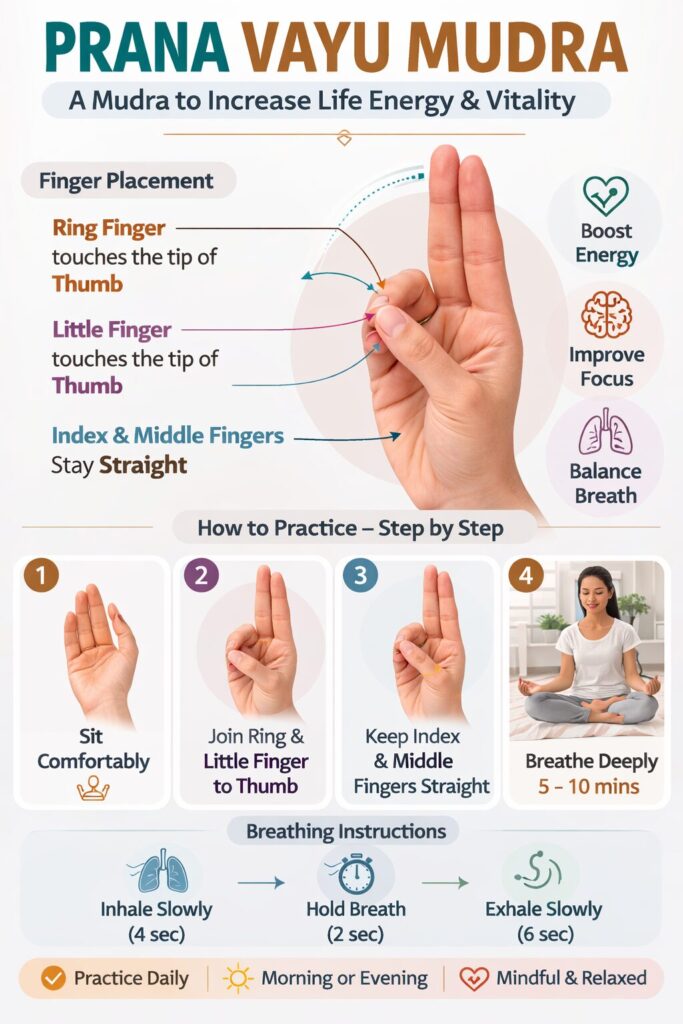
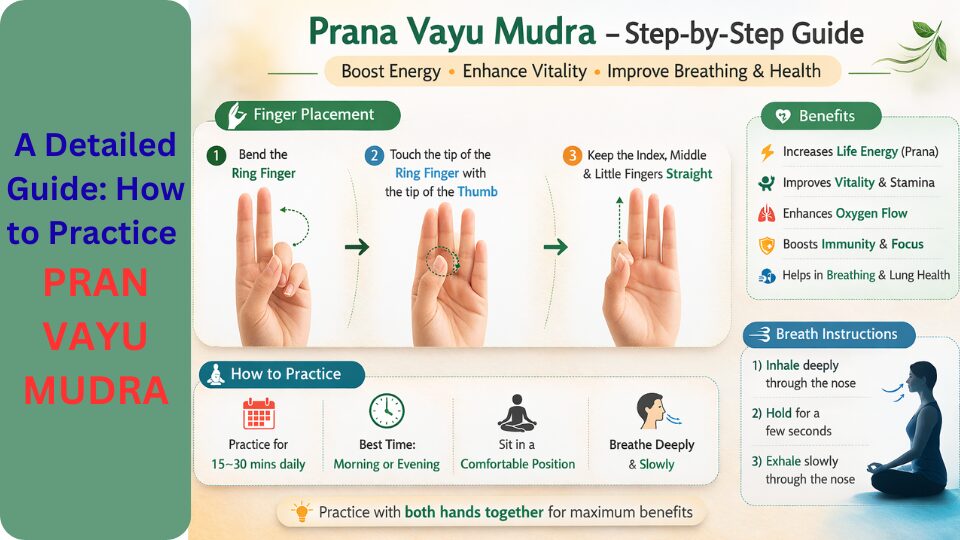
- Touch the tip of the ring finger (fourth finger) to the tip of the thumb
- Touch the tip of the little finger (fifth finger) to the tip of the thumb
- Keep the index finger and middle finger gently extended — not stiff, not curled
The thumb-to-fingertip contact should be feather-light. You are completing an energetic circuit, not gripping. Think of it as the gentleness with which you would hold a soap bubble without bursting it.
Step 4 — Regulate the Breath
Begin breathing through the nose only. Use the following ratio for best results:
- Inhale: 4–5 counts (belly expands first, then ribcage)
- Brief retention: 1–2 counts (optional for beginners)
- Exhale: 6–8 counts (slow, complete, relaxed)
The extended exhale is the most important variable. It is the exhale — not the inhale — that activates the vagus nerve and triggers the parasympathetic response.
Step 5 — Maintain Awareness
Keep your attention on:
- The sensation at the fingertip contact points
- The movement of the breath in the chest and belly
- Any warmth, tingling, or energetic movement in the heart region
If the mind wanders (it will), gently return attention to the fingertip contact without judgment.
Step 6 — Duration Guidelines:
| Experience Level | Duration | Frequency |
| Beginner | 10–15 minutes | Once daily |
| Intermediate | 20–30 minutes | Twice daily |
| Therapeutic / Advanced | 30–45 minutes | Morning +
Evening |
Step 7 — Close the Practice
Release the mudra slowly. Rub your palms together briskly for 10 seconds to generate warmth. Cup warm palms gently over closed eyes for 30 seconds. Take three deep breaths. Open your eyes slowly, avoiding immediate screen exposure.
Prana Vayu Mudra Meditation Technique: The Advanced Practice:
For practitioners ready to go deeper, the Prana Vayu Mudra meditation technique integrates the gesture into a complete meditative framework drawn from classical yoga and sound healing traditions.
The 40-Minute Protocol
Phase 1: Pranayama Foundation (10 minutes) Practice Nadi Shodhana (Alternate Nostril Breathing) while practicing the mudra. This bilateral breathing technique balances the sympathetic and parasympathetic branches of the autonomic nervous system and synchronizes left and right brain hemisphere activity — creating an ideal neurological state for deep meditation.
Phase 2: Mantra Integration (10 minutes) Silently repeat the mantra “So Hum” (I am that) synchronized with breath — “So” on the inhale, “Hum” on the exhale. This mantra directly corresponds to the sound of the breath itself and deepens parasympathetic activation through rhythmic neural entrainment.
Phase 3: Open Awareness (15–20 minutes). Release any technique. Simply sit with the mudra, allowing awareness to rest in the chest region. Notice any inner sensations — warmth, expansion, subtle vibration, or emotional movement. This non-directive awareness phase is where the deepest integrative healing occurs.
Phase 4: Return and Ground (5 minutes) Slowly increase breath depth. Gently move fingers and toes. Release the mudra. Observe the quality of awareness before re-engaging with the activity.
Why Consistency Matters More Than Duration
Neuroscientific research on neuroplasticity confirms what yogic tradition has always maintained: short, daily practice outperforms long, infrequent practice. Twenty minutes daily for 40 days produces more lasting structural brain change than three-hour sessions practiced sporadically.
Commit to the minimum. Build from there.
Benefits of Pran Vayu Mudra:
Proven and Reported Benefits
Cardiovascular:
- Improves heart rate variability
- Reduces resting heart rate
- Supports healthy blood pressure
- Strengthens vagal tone
Respiratory:
- Deepens diaphragmatic breathing
- Reduces breath rate at rest
- Supports airway relaxation
- Improves oxygen saturation in regular practitioners
Neurological and Psychological:
- Reduces anxiety and cortisol levels
- Improves sleep quality and onset
- Enhances emotional regulation
- Supports focus and cognitive clarity
Energetic (Yogic Framework):
- Activates Anahata (heart) chakra
- Balances Vata dosha
- Strengthens Prana Vayu current
- Supports Ojas (vital essence) retention
Honest Limitations
- Results require consistency — sporadic practice yields minimal benefit
- Not a medical treatment for acute cardiac or respiratory emergencies
- Posture quality directly affects outcome — slouched practice reduces effectiveness
- Individual response varies based on constitution, lifestyle, and baseline health
Experts Perspective: Real-World Application
Yoga therapists working in cardiac rehabilitation at major integrative health centers consistently observe one pattern: patients who add structured mudra and pranayama practice to their recovery protocols — even just 20 minutes daily — show faster normalization of blood pressure, lower reported anxiety, and better adherence to lifestyle changes than those receiving conventional care alone.
This is not surprising when you understand the physiology of Pran Vayu Mudra. Conventional cardiac rehabilitation focuses primarily on cardiovascular exercise and dietary modification. These are critical. But they do not directly address the autonomic dysregulation — the chronically elevated sympathetic tone — that underlies most cardiac events in the first place.
Pran Vayu Mudra addresses exactly that gap.
The most practical expert recommendation of Pran Vayu Mudra: begin today, track your resting heart rate each morning before practice, and review the data after 21 days. The numbers will tell you what the tradition already knows.
Conclusion: Why Pran Vayu Mudra Belongs in Your Daily Practice
Few practices deliver this much benefit with this little complexity. Pran Vayu Mudra requires no equipment, no special fitness level, no prior yoga experience, and no financial investment. What it does require is consistency and correct technique — both of which this guide has given you in full.
Whether your primary goal is Prana Vayu Mudra for heart health, easing chronic breathing difficulties, finding a natural tool for anxiety relief, or simply building a more grounded and energized daily life — this single practice, applied with the discipline the tradition recommends, will exceed your expectations.
Form the mudra. Sit upright. Breathe through your nose. Begin today. Give it 21 days before you evaluate. The evidence — both ancient and modern — strongly suggests you will not be disappointed.
Pran Vayu Mudra is not a trend. It is a time-tested technology for human health. Use it accordingly.
FAQ :
Q1: What is Pran Vayu Mudra, and what is it used for?
A: Pran Vayu Mudra is a classical yogic hand gesture formed by touching the ring finger and little finger to the tip of the thumb while keeping the index and middle fingers extended. It is used to activate and strengthen the Prana Vayu — the upward-moving vital energy that governs the heart, lungs, and sensory systems. It is commonly practiced for heart health, respiratory support, anxiety relief, and overall vitality.
Q2: How do I practice Prana Vayu Mudra correctly?
A: Sit upright in a comfortable position. On both hands, bring the ring finger and little finger to touch the tip of the thumb, keeping the remaining two fingers gently extended. Breathe slowly through the nose, inhaling for 4–5 counts and exhaling for 6–8 counts. Hold for 10–45 minutes, depending on your experience level. Practice daily for best results, ideally in the morning on an empty stomach.
Q3: How does Prana Vayu Mudra benefit heart health?
A: Prana Vayu Mudra for heart health works by activating the parasympathetic nervous system, which reduces resting heart rate, improves heart rate variability (HRV), lowers blood pressure, and decreases the cortisol-driven inflammation that underlies cardiovascular disease. Yoga therapists use it in integrative cardiac rehabilitation as a complementary tool alongside conventional medical treatment.
Q4: Can Prana Vayu Mudra help with breathing problems like asthma?
A: Yes. Prana Vayu Mudra for breathing problems encourages diaphragmatic breathing, promotes parasympathetic airway relaxation, and helps normalize the CO₂/O₂ balance disrupted by stress-related shallow breathing. It is beneficial as a complementary practice for mild asthma, post-COVID respiratory fatigue, and habitual chest breathing. It should not replace prescribed respiratory medication.
Q5: How long does it take to see results from Pran Vayu Mudra?
A: Most practitioners notice improved breath quality and reduced anxiety within the first 7 days of daily practice. Measurable cardiovascular improvements — such as reduced resting heart rate and better sleep quality — typically emerge after 21 to 40 days of consistent practice. Yogic tradition prescribes a minimum of 40 consecutive days for lasting neurological and energetic change.
Q6: Is Prana Vayu Mudra safe for everyone?
A: Pran Vayu Mudra is safe for the vast majority of people, including older adults, beginners, and those managing chronic conditions. It requires no physical exertion and carries no known contraindications when practiced correctly in a seated position with gentle nasal breathing. Individuals with diagnosed heart conditions, respiratory disease, or severe anxiety disorders should consult their healthcare provider before beginning any new complementary practice.