Bandha in classical yoga refers to an internal yoga technique to lock, seal, and direct the vital energy (Prana) within the body. This is not just a technical term in the study of Yoga, but a concept of interrelationship between the body, breath, and energy in spiritual yoga practice. It is a yogic practice intended for self-realization and health, reflecting a combination of physical, mental, and spiritual discipline.
The origin of the word Bandha has been derived by suffixing the word “Ghan” to the root of Bandh Dhatu. The other term of Bandha has been derived from the Sanskrit language, and it translates to words like “tie”, “bond”, or “bind” in English. The root word “Bandhu” is related to Bandha, and its meaning is to bind, fasten, or tie.
In the yogic context, this Bandha (binding) is not mechanical but energetic – a conscious sealing of prana to prevent dissipation and to guide it towards the central energy channel (Shushumna Nadi), and, therefore, it is described as an Energy Lock rather than a muscular contraction.
From Classical Yoga scriptures, we get:
According tothe Shiva Samhita:
बन्धनं प्राणवायूनां बन्धः स कथितो बुधैः ।
येन स्थिरं भवेद् देहं तेन सिद्धिर्न संशयः ॥
The meaning of the above sloka is: “This is described by the wise as the binding and regulation of the vital life forces (Prāṇa and Vāyus). Through this practice, the body becomes steady and stable, and through that steadiness, success in yoga is attained without doubt.”
According to Gheranda Samhita:
मुद्राबन्धादिभिः साध्यं स्थैर्यं चित्तस्य योगिनः ।
बन्धैः प्राणो निगृह्येत ततो जायेत् परं पदम् ॥
The meaning of the above sloka is: “Through Mudras, Bandhas, and related yogic practices, the yogi attains steadiness of the mind. With consistent practice, the Prāṇa/Vital Energy is regulated, and by this, a Yogi can attain the supreme state.
On analysing the above two Slokas, we can come to a conclusion that through the correct practice of it, Apana Vayu is drawn upward (Puraka), when this Vayu is retained, that is Kumbhaka, and when Prana Vayu is exhaled downward, it is called Rechaka, and their union leads to inner balance and spiritual refinement. During Pranayama practice, it is incomplete without practicing Bandha because the vital force remains scattered and unstable.
Thus, in classical yoga, it is not merely a technique but a discipline of inner science rooted in ancient wisdom that transforms breath into awareness, practice into stillness.
01. Role of Bandha in Tantra Sadhana: This has been entrusted with a transformative role in Tantra Sadhana. According to Tantra, the human body is considered a sacred vessel of Shakti (the Cosmic Energy). The various Bandhas are generally engaged to awaken, contain, and elevate this Cosmic Energy without any imbalance. This is used to redirect desire and vitality into spiritual evolution in Tantra.
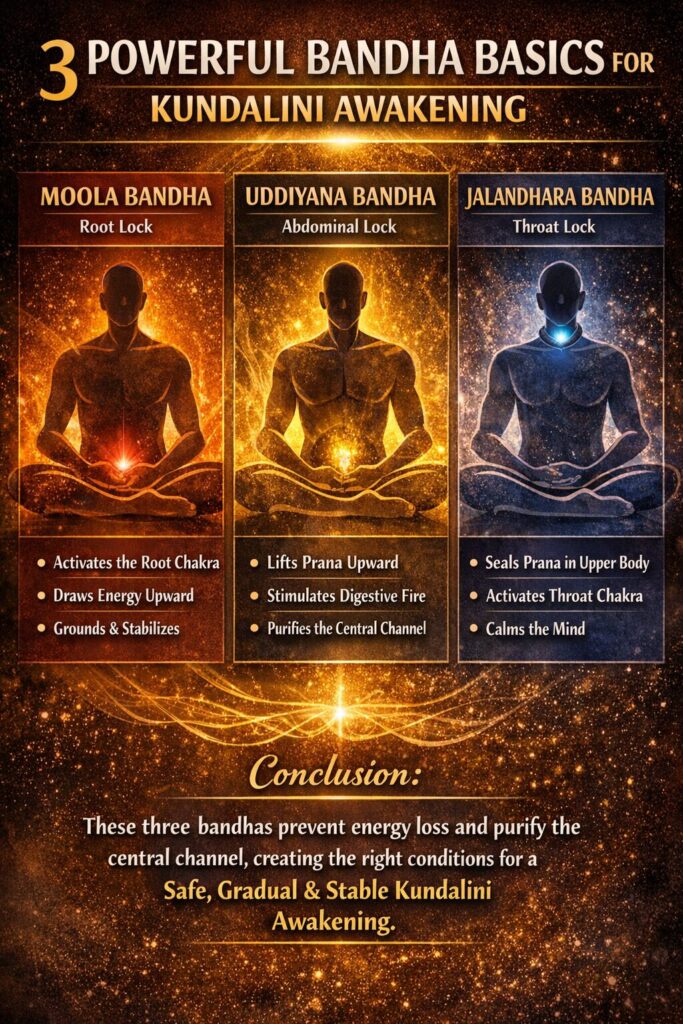
In Tantric practice, this is closely linked with Kundalini Awakening by sealing the lower outlets of energy within the human body through Mula Bandha and lifting the Prana through Uddiyana Bandha. Here, the practitioners encourage Shakti to rise through the Central Channel (Shushumna Nadi). Afterward, Jalandhara Bandha is used to stabilize this upward movement, preventing the energy overflow and supporting inner equilibrium.
In Tantra, Bandha is commonly combined with Mantra, Mudra, Visualization, and other Ritual Practices. This combination/integration allows the practitioners to experience a higher state of awareness, inner resonance, and cosmic perception. Therefore, this becomes a tool to achieve higher consciousness through moving the Prana (Energy) upward and transforming Prana into spiritual insight.
2. Role of Bandha in Hatha Yoga: It plays a pivotal role in practicing Asana and Pranaya. In ancient scriptures like Shiva Samhita, Gheranda Samhita, and Patanjali Yoga Sutra state that practicing Pranayama without this is incomplete. The main objective of it is to stabilize and seal the pranic energy to prevent its outward dissipation. Through practicing Mula Bandha, Jalandhara Bandha, and Uddiyana Bandha, the Yogi learns to control the upward and downward movement of Prana and Apana Vayu. This control helps the Yogi to regulate Physical Steadiness, Mental Clarity, and Nervous Imbalance. Through continuous practice, it supports the Nadi purification and helps to channelize the Prana through the Shushumna Nadi. This is considered a gateway to meditative absorption.
3. How Bandhas work to regulate and redirect the Energy Flow (Pranic Flow):
The ancient philosophy of Yoga indicates that Prana is the vital force that controls all physical, mental, and other internal or subtle functions of the body. Bandhas play an important role in controlling, regulating, conserving, and redirecting the vital Pranic flow (the vital energy flow) for practicing especially Maha Mudra and Khechari Mudra during Pranayama practices in Hatha Yoga, Kriya Yoga, and Tantra Sadhana. Without this, both Hatha Yoga, Kriya Yoga, and Tantra are incomplete.
These are the tools to regulate the flow of Prana that can either slow its flow or intensify it to increase focus and clarity. Bandhas can better be described as the postures where certain internal parts of the body are gripped, contracted, and controlled. These contractions of certain muscles within the body are not for strength building, but they are used for changing internal pressure, influencing circulation, and stimulating nerves and glands in their target region.
These work by creating energetic seals at the key junctions of the body to prevent the leakages of Pranic force (Energy) and guiding it to the higher channels of the body. Examples are – Mula Bandha lifts Apana Vayu upward from the Pelvic region, preventing dissipation of energy. Uddiyana Bandha pushes the Prana upward through the abdominal region, thereby activating the Manipura Chakra. This Bandha creates heat within the body and generates vitality. Jalandhara Bandha controls the upward movement of energy at the throat, ensuring balanced pressure in the head and nervous system.
When these are combined, they push the Prana to flow through the Shushumna Nadi. This redirection of Pranic energy results in mental stability, enhanced concentration, and deeper meditative states. Through continuous practice, Bandhas transform scattered energy into focused inner power, supporting spiritual growth, self-understanding, and mastery.
4. Relationship between Bandha, Kumbhaka, and Dhyana:
Bandha, Kumbhaka, and Dhyana, in classical yoga, are not separate, but they are independent practices for inner refinement. Together, they create a progressive system for stabilizing breath, Prana/Energy is regulated, and the mind is pushed towards meditation. Earlier, we have told that without Bandha, Pranayama, and Meditation is incomplete.
This acts as an energy seal that regulates the movement of Prana/Energy within the subtle body. Through practices of Mula Bandha, Uddiyana Bandha, and Jalandhara Bandha, the practitioners/yogis can prevent the dissipation of energy and direct the same upward. This creates the favorable condition for Kumbhaka.
When Prana/Energy is controlled, a sustained Kumbhaka is achieved. In this condition, Prana becomes balanced and steady, and the mind automatically withdraws from all distractions. Therefore, Kumbhaka acts as a gateway through which prana/energy flows through the Shushumna Nadi (the central channel). This is called Antar Kumbhaka. In this state, the Yogi inhales and exhales through the Shushumna Nadi when all openings of the body are closed. In this state, a strong hissing sound comes out as if a furious snake is attacking somebody. This is only felt by a Kriya Yogi during their 2nd stage of Kriya Yoga.
Through sustained Kumbhaka, a deep meditation (Dhyana) arises. As the Prana/Energy becomes steady, automatically the mind also becomes steady and withdraws from all distractions, which leads to deep concentration of the mind, and that is Dhyana.
From the above, we can infer that Bandha stabilizes the energy, Kumbhaka stills the breath, and Dhyana concentrates the mind. Together, they represent the inner science of Yoga where breath, energy, and consciousness merge into a single flow towards self-realization.
5. How Bandhas help to activate Kundalini?
From various scriptures of Classical Yoga, we get that Kundalini is the dormant energy that lies at the base of the Spine that is Muladhara Chakra (Coccyx). Awakening of this dormant energy is not possible through physical force; it can only be achieved through systematic regulation of Prana (Energy). Here, Bandha plays a pivotal role by sealing, refining, and redirecting the energy upward through the Shushumna Nadi (Central Channel) of the body.
The main function of it in Kundalini Awakening is to create a union of Prana and Apana Vayu. Moola Banda helps to restrict Apana Vayu from its downward-moving tendency in the pelvic region, preventing energy loss and creating a strong energy foundation.
Uddiyana Bandha draws Prana Vayu inward and lifts it upward from the abdominal region, which creates heat and pressure. When these Prana and Apana Vayu unite, they create an upward thrust which is necessary for awakening the dormant Kundalini.
In the last Jalandhara Bandha, the entire process is achieved by regulating the flow of energy at the throat region for stabilizing the nervous system and for preventing pressure at the head. These three Bandhas guide energy to flow through the Shushumna Nadi, through which the dormant Kundalini awakens and ascends upward.
With consistent practice, this transforms raw vital energy into spiritual energy, leading to heightened awareness, deep meditation, and inner transformation.
Now, let us describe the three important Bandhas, which are extremely essential for Kundalini Awakening:
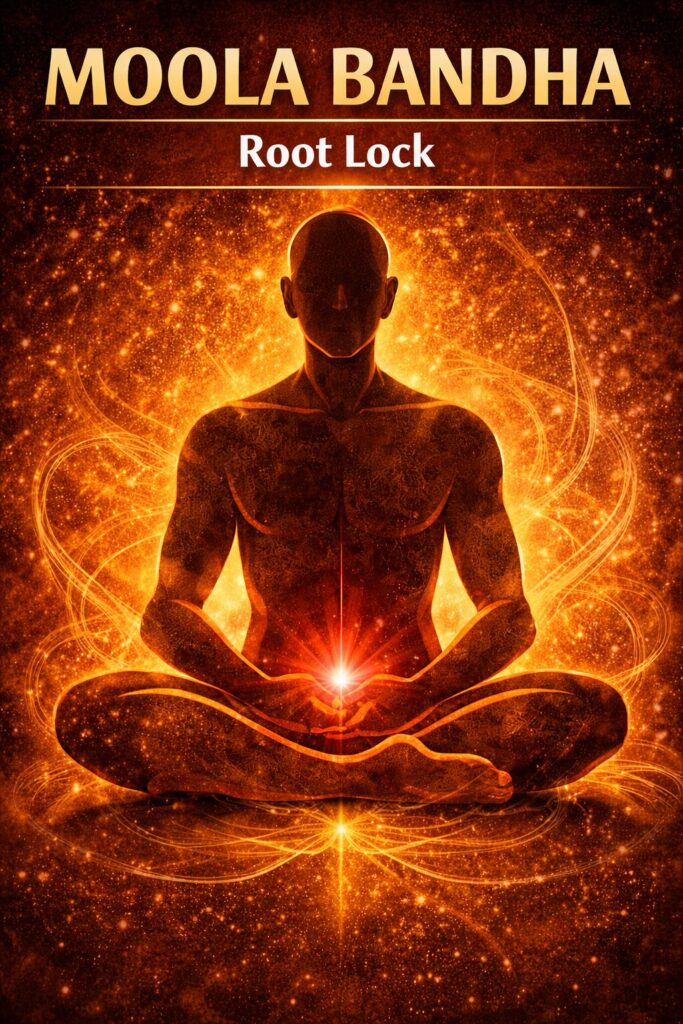
MOOLA BANDHA (PERINEUM CONTRACTION):
This is the process of contracting and expanding the pelvic floor. The muscles of the urethra and anus are separate. There are two Mudras involved in this process. One is Vajroli Mudra, when the urethra is contracted, and the other is Ashwini Mudra, when the Anus is contracted, because the urethra and anus are separate openings. Contraction of these two places is Moola Bandha.
Sage Gheranda Says:
Paarshina Vamapaadasya Yonimaakunchayettatah;
Naabhigranthim Merudande Sudhee Sampeedya Yatnatah.
The meaning of the above Sloka is: “Placing the heel of the left foot against the perineal region, the practitioner should contract the Yoni (Pelvic Floor). With focused effort, the wise practitioner presses and stabilizes the Nabhi Granthi (Navel Knot) along the spinal column.
When both these two Mudras are practiced alternately, a tingling sensation is created. In the case of men, this sensation is felt in the Mooladhara Chakra and is called Mooladhara Pinda. In the case of women, the point of physical concentration and physical contraction is just inside the entrance to the womb. This is almost identical to Mahamudra.
Medhram Dakshinagulphena Dridhabandhanam Samacharet;
Jaraavinashinee Mudra Moolabandho Nigadhyate.
The meaning of the above sloka is: Here, the practitioner should press the perineal region with the right heel and apply a steady lock. This practice is Moola Bandha. This Mudra destroys decay and old age.
This is widely accepted both by physiologists and yogis as a powerful Yoga Mudra that preserves vitality, slows degeneration of the body, and supports longevity by stabilizing the Prana (Vital Force) and directing upward through the Spinal pathway. This is recognized as a Siddhi in Yoga.
How Moola Bandha helps to awaken Kundalini:
This helps to awaken Kundalini. This Kundalini Shakti can be understood in many forms. The first one is awakening the element of energy hidden inside Mooladhara. The second one is awakening the brain center related to Mooladhara. The development of consciousness takes place on awakening. Mooladhara is regarded asa Kundalini experience because that state takes consciousness to a new dimension, which changes the Karma.
UDDIYANA BANDHA (Abdominal Contraction):
This is the process of contracting the Upper Abdomen inward and upward (above the Navel) towards the spine, after exhalation, thereby lifting the Prana (Energy) upward. It stimulates the digestive fire, massages the internal organs, and directs the Prana upward through the Central Energy Channel. This lifting of Prana through the Spinal Channel is called Uddiyana Bandha. Uddiyana Bandha is the foremost one, and by practicing Uddiyana Bandha, a yogi can attain liberation.
Sage Gheranda says:
“Udare Paschimam taanam naabhiroordhvam tu kaarayet;
Uddeenam kurute yasmaada vishraantam mahaakhagah;
Uddeeyaanam tvasau bandho mrityu maatanga kesaree.”
The meaning of the above sloka is to draw the abdomen inward to the back and lift the navel upward. This practice helps the Yogi raise Prana upward without much effort. This is called Uddiyana Bandha, the lion that conquers the elephant of death.
The interpretation is that the Uddiyana Bandha lifts energy upward with ease, like a bird in flight, and symbolizes achieving mastery over decay and mortality through a disciplined practice of this Bandha.
How Uddiyana Bandha helps to awaken Kundalini:
This plays a pivotal role in awakening Kundalini by powerfully regulating and uplifting the Prana (Energy) within the subtle body. This practice creates suction, which reverses the flow of Prana and Apana Vayu and unites them with Samana and stimulates Manipura Chakra. Uddiyana Bandha increases the flow of Prana towards Shushumna Nadi, resulting in increased awareness and creating a deep meditative state. Activation of this Chakra strengthens the will power, digestion (Agni), and vitality, which are essential aspects for awakening Kundalini.
This Bandha helps to open and purify the Shushumna Nadi. When practiced with Kumbhaka and awareness of the Spine, blockages of Granthis along the Shushumna Nadi get loose and help to ascend Kundalini Shakti smoothly.
The possibility remains there to return further this Kundalini Shakti into a dormant state, but when the Kundalini crosses Manipura Chakra, there will be no chance of its return. Therefore, to cross the Manipura Chakra is to open the door to liberation and remove all obstacles in the journey towards liberation. With regular practice of Uddiyana Bandha, Manipura Chakra is activated, and once the Kundalini crosses the Manipura Chakra, there is no possibility of falling back down. This is, therefore, regarded not merely as a physical block but as a powerful energetic key for achieving higher consciousness.
JALANDHARA BANDHA (Throat Lock):
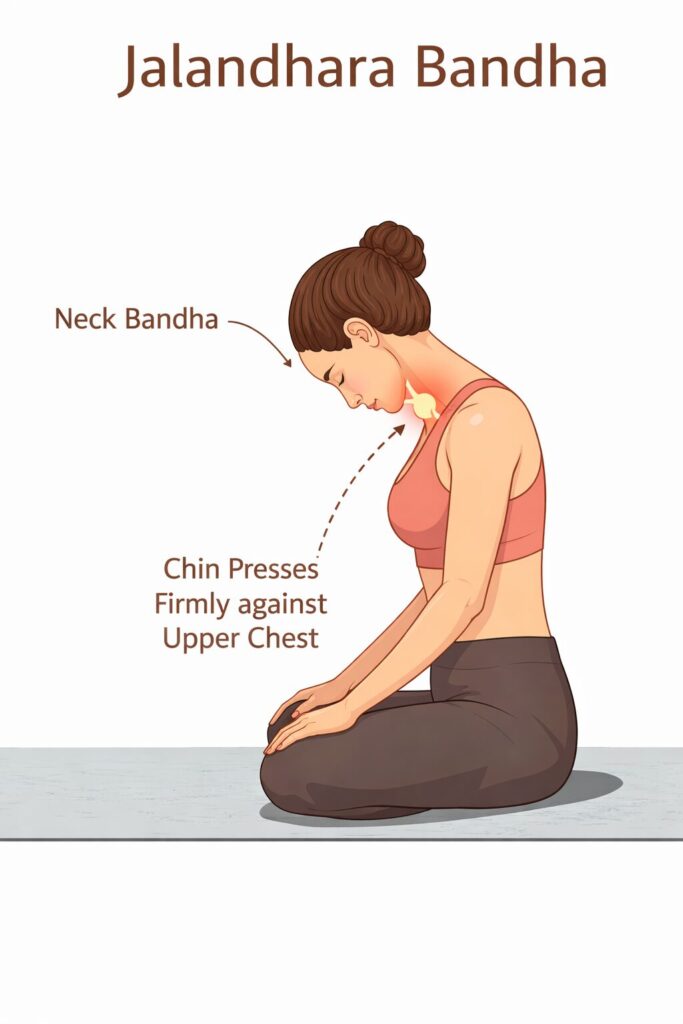
This is a yogic technique to contract the throat and place the chin on the chest while keeping the spine erect. It regulates the flow of Prana in the throat and head, stabilizes the breath during Kumbhaka, and helps to balance nervous and endocrine systems.
It gives control over the sixteen bases or receptacles, and this influences these bases. These sixteen bases are toes, ankles, knees, thighs, perineum, genitals, navel region, heart, base of the neck, throat, root of the tongue, nosetip, eyebrow center (Kutastha), forehead, brahmarandhra (Sahasrara), and Crown. The throat is locked by Jalandhara Bandha, combining with all the Nadis and Nerves which are passing through the neck to the head. Hence, Jalandhara Bandha influences the entire body. This gives victory over death. Mastery over this Bandha provides siddhis to Yogis, and by practicing it for just six months, a Yogi becomes a perfect being.
Sage Gheranda says:
Kanthasankochanam Kritva Chibukam Hridaye Nyset;
Jalandharekrite Bandhe Shodashadhara Bhadhanam.
Jalandharamahamudram Mritoscha Kshayakaarinee;
Siddho Jalandhara Bandho Yoginam Siddhi Dayakah;
Shanmaasam Bhyasedhyo Hi Sa Siddho Natra Samshaya.
The meaning of the above Slokas is:
The practitioners should contract the throat region and should firmly place the Chin against the Chest and lock the throat. When this lock is applied, the sixteen vital supports are controlled and restrained.
This Jalandhara Bandha (Mudra) destroys the fear of death and regulates the decay of the cells. When this is perfectly practiced, the Yogis attain their spiritual attainments (Siddhis). If it is practiced continuously for six months, it can firmly be said that Yogis must attain mastery over this.
How Jalandhara Bandha helps to awaken Kundalini:
This helps to awaken Kundalini Shakti by regulating and directing the Vital energy (Pranic Energy) in the upper energy center like throat and head region.
Initially, this prevents the dissipation of energy while practicing Pranayama and Kumbhaka. The energy is sealed within the central channel by gently locking the throat, allowing Prana to stabilize rather than scattering through various sensory organs.
Secondly, the Pran and Apan Vayus are balanced here. When it is practiced along with Moola Bandha and Uddiyana Bandha, Jalandhara completes a circle, creating a closed energetic circuit that encourages Kundalini Shakti to rise through Shushumna Nadi.
Finally, this energizes the Vishuddhi Chakra, the throat center associated with purity and refinement. This purification is essential for giving a safe passage of Kundalini Shakti to ascend. At this stage, the mind becomes calm and distraction-free, and at this stage, meditation becomes deep and sustained. This mental steadiness helps to attain inner stability, which is of utmost importance for Awakening Kundalini Shakti.
Therefore, Jalandhara Bandha is considered a protective and stabilized lock, ensuring that the rising of Kundalini energy is guided safely towards a higher state of awareness.
Conclusion: As we discussed above, the three Bandhas form the energetic foundation of Kundalini awakening. When these are practiced correctly and in harmony, they prevent the loss of Prana (Vital Energy) and purify the Shushumna Nadi (Central Channel) for guiding this Vital Energy to ascend through the Shushumna. There is no need to apply any force for raising Kundalini; these Bandhas create the right conditions for a safe, gradual, and stable awakening, supporting both spiritual growth and deep inner awareness.
FQA:
- What is the purpose of Bandha?
Ans: The purpose of this in Yoga is to regulate and control the Vital energy within the body. Bandha helps to prevent the dissipation of energy and directs this energy to the central energy channel (Shushumna Nadi). This helps to stabilize the energy during Pranayama, meditation, purify the central channel, and kundalini awakening.
- What is Bandha in Yoga?
Ans: This is a process to lock energy by willfully contracting certain specific muscle groups in the body. The main purpose of this lock is to direct the flow of Prana (Vital energy force) through the central channel (Shushumna Nadi) for attaining higher consciousness by awakening Kundalini.
- What is a Bandha in Sanskrit?
Ans: The word Bandha has been derived by suffixing the word “Ghan” to the root of Bandh Dhatu. The other term of Bandha in the Sanskrit language is to “tie”, “bond”, or “bind” in English. The root word “Bandhu” is related to Bandha, and its meaning is to bind, fasten, or tie.
- What is the difference between Bandha and Mudra?
Ans: Bandha is to lock, tie, bind, or seal. In Yoga, it is the process to lock energy that regulates and controls the Pranic flow within the specific region of the body and prevents dissipation of the vital energy.
Whereas Mudra means gesture, attitude, or seal. Mudra is a specific posture of the body, hands, tongue, and eyes. The purpose of Mudra is to redirect Prana and consciousness into a particular energetic pathway for supporting meditation and attaining higher consciousness.
- How long does it take to get benefits?
Ans: With regular practice of half an hour, the practitioner can achieve physical and energetic benefits like stronger core stability, improved digestion, and enhanced pranic flow. Within 4-6 weeks of regular practice, the yogi can achieve greater focus, emotional balance, and reduced restlessness.