
Introduction: How do I start yoga at home? That is one of the most searched wellness questions on the internet today, and for good reason. Yoga at home offers unmatched flexibility, zero commute, and complete privacy. Whether you are stepping on the mat for the very first time or returning after a long break, knowing how to start yoga at home the right way makes the difference between a sustainable practice and one that fizzles out in a week. In this article, I will provide a step-by-step guide grounded in yoga science, anatomy, and real practice experience.
According to a 2023 Yoga Alliance report, over a billion people throughout the world practice yoga, with home practice being the fastest-growing segment. The rise of streaming platforms and free online classes has made a home yoga practice more accessible than ever — but accessibility alone does not equal results. Structure does.
Why Starting Yoga at Home Is One of the Best Decisions You Can Make:
If you are wondering how do I start yoga at Home, then Studio yoga is wonderful, but it comes with barriers — membership fees, fixed schedules, and the social anxiety of learning in front of others. A home yoga practice removes all of that. You move at your own pace, in your own space, on your own schedule.
Science-Backed Benefits of a Daily Yoga Routine
A consistent daily yoga routine provides measurable physical and mental benefits, according to peer-reviewed research:
- Stress reduction: A 2018 study in the journal Psychoneuroendocrinology found that yoga significantly reduced cortisol (the stress hormone) after just eight weeks. Yoga for stress relief is one of the most evidence-backed applications of the practice.
- Improved flexibility & mobility: Regular yoga stretches connective tissue, increases range of motion, and reduces injury risk — benefits that compound over time.
- Better sleep: A meta-analysis of 19 studies (2020) confirmed yoga improves sleep quality across various populations.
- Pain management: The American College of Physicians recommends yoga as a first-line treatment for chronic lower back pain.
- Mental clarity & focus: Yoga’s mindfulness component has been linked to improved attention and reduced anxiety symptoms.
Pros and Cons of a Home Yoga Practice vs. Studio Classes
| Home Yoga Practice | Studio Classes | |
| Cost | Free or low-cost | ₹500–₹2,000+ per month |
| Flexibility | Any time, any place | Fixed schedule |
| Instruction | Self-guided or app-based | Live certified teacher |
| Privacy | Complete privacy | Public setting |
| Community | Limited (unless virtual) | Strong in-person community |
| Alignment feedback | Harder to self-correct | Real-time correction |
What You Actually Need to Start Yoga at Home: After extensive research on “How Do I Start Yoga at Home” and what I need to start yoga at Home, the following are the minimum requirements.
The good news: you need to spend very little. Here is what genuinely matters before you unroll your mat for the first time.
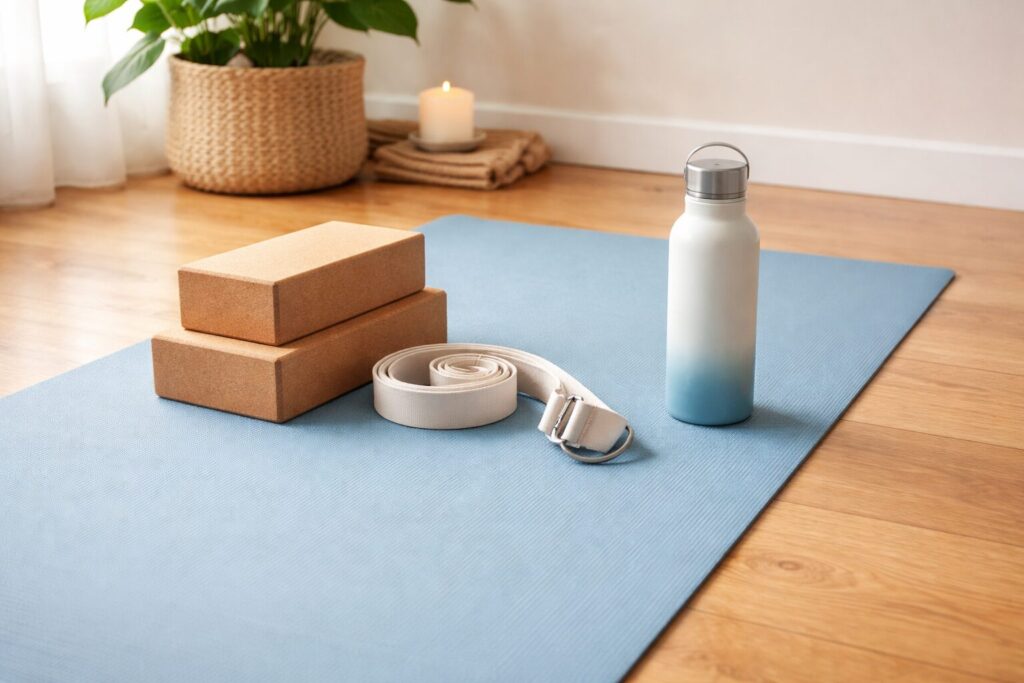
Essential Equipment for Your Home Yoga Practice
- Yoga mat: A non-slip mat 4–6mm thick is all you need to start. Budget options under Rs. 800 work perfectly for yoga for beginners.
- Comfortable clothing: Stretchy, breathable fabric that allows a full range of motion, preferably cotton-made.
- Two yoga blocks: These support beginner yoga poses and help you maintain proper alignment without strain.
- A yoga strap: Aids in stretching and is particularly helpful for tight hamstrings.
- Optional — a bolster or folded blanket: Useful for restorative and cool-down poses.
How to Set Up Your Yoga Space at Home
You do not need a dedicated yoga room. A 6-foot by 4-foot clear floor space is enough for most beginner yoga poses. Here is how to optimize it:
- Clear the area of furniture and hazards so you can move freely in all directions.
- Choose a spot with good ventilation — yoga breathing exercises are far more effective in fresh air.
- Keep lighting soft and natural where possible. Harsh overhead light can disrupt a meditative atmosphere.
- Place your phone on Do Not Disturb mode during sessions. Interruptions break focus and shorten practice time.
- Use a speaker for calming music or guided class audio — this signals the brain that practice time has begun.
How Do I Start Yoga at Home: A Step-by-Step Plan for Beginners
After my long search on ” How Do I Start Yoga at Home”, the following is a structured plan through which you can build a sustainable home yoga practice within 30 days — even if you have never touched a yoga mat before.
Week 1: Foundation — Learning to Breathe and Move
Step 1: Master Yoga Breathing Exercises First
Before attempting any physical pose, spend 5 minutes on pranayama — yoga breathing exercises. This is essential for beginners.
Start with Diaphragmatic Breathing (Belly Breathing):
- Lie flat on your back with one hand on your chest and one on your belly.
- Inhale through the nose for a count of 4, letting the belly rise (not the chest).
- Exhale slowly through the nose for a count of 6.
- Repeat 10 rounds every morning before your physical practice.
This simple yoga breathing exercise activates the parasympathetic nervous system — reducing heart rate and anxiety within minutes. Research from Harvard Medical School confirms that controlled breathing directly impacts stress hormones.
Step 2: Learn These 7 Core Beginner Yoga Poses
These foundational beginner yoga poses appear in virtually every yoga style and class. Master these first:
- Mountain Pose (Tadasana): The starting point of all standing sequences. Teaches proper posture and body awareness.
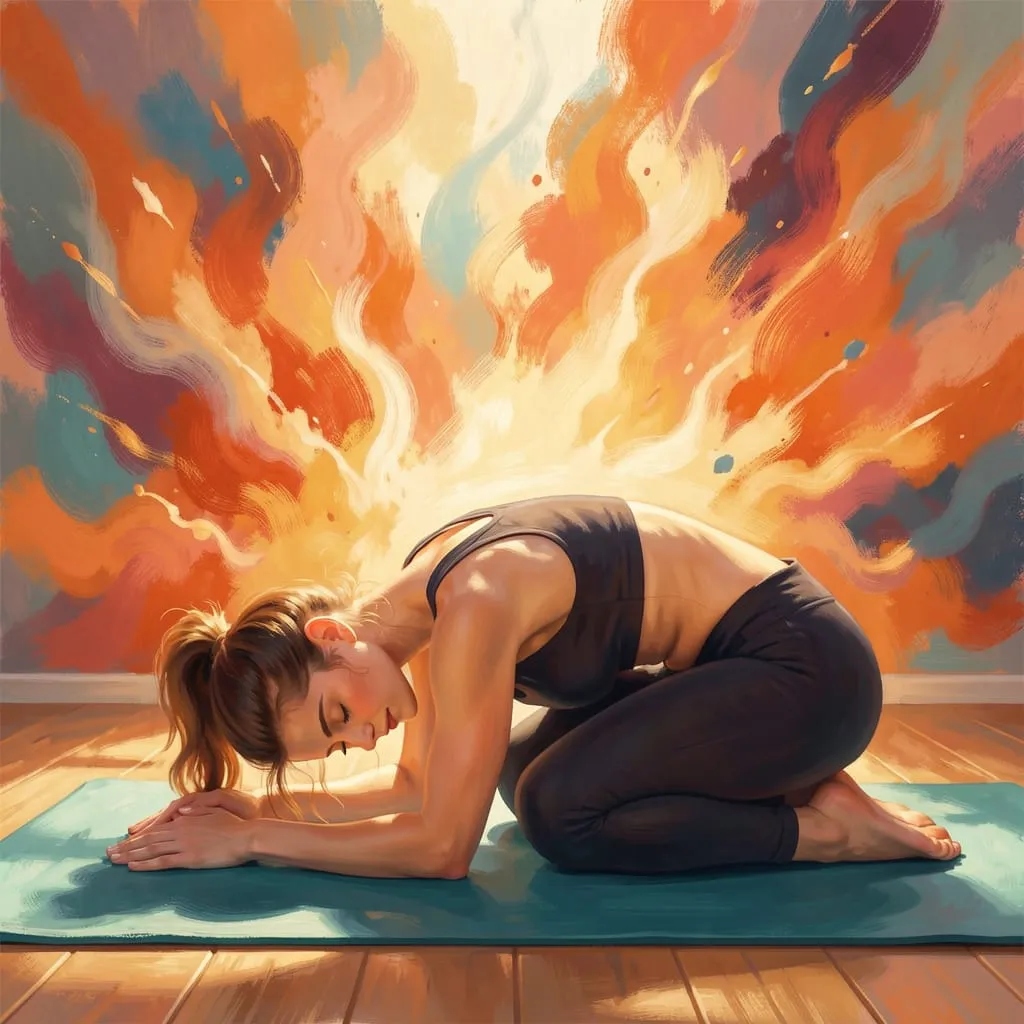
- Child’s Pose (Balasana): The most important resting pose. Return to it any time you need to catch your breath.
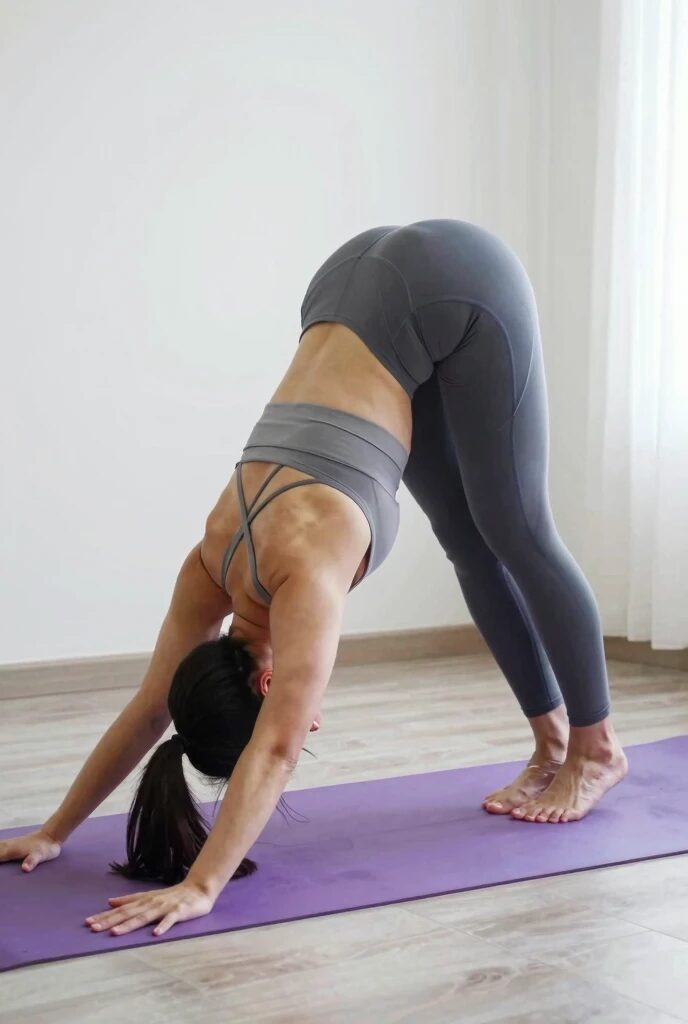
- Downward-Facing Dog (Adho Mukha Svanasana): Stretches the hamstrings, calves, and spine while building upper body strength.
- Cat-Cow Stretch (Marjaryasana-Bitilasana): A spinal warm-up that syncs breath with movement — perfect for beginners.
- Warrior I (Virabhadrasana I): Builds leg strength, opens the hip flexors, and improves balance.
- Seated Forward Fold (Paschimottanasana): Deep hamstring and lower back stretch. Use a strap if you cannot reach your feet.
- Corpse Pose (Savasana): Ends every session. Allows the nervous system to integrate the practice.
Weeks 2–3: Building Your Daily Yoga Routine
Step 3: Design a Realistic Daily Yoga Routine
Consistency beats intensity every time. A 20-minute daily yoga routine practiced six days a week will produce far better results than a 90-minute session done occasionally.
Here is a proven 20-minute beginner daily yoga routine structure:
| Time | Segment | Purpose |
| 0–3 min | Yoga breathing exercises (belly breathing) | Calm the mind, activate breath |
| 3–7 min | Warm-up (Cat-Cow, spinal rolls) | Lubricate joints, prepare the body |
| 7–16 min | Core beginner yoga poses (5–6 poses) | Build strength and flexibility |
| 16–18 min | Seated stretches | Deepen flexibility, release tension |
| 18–20 min | Savasana (Corpse Pose) | Integrate and restore |
Morning vs. Evening: When Should You Practice?
Both windows work — what matters more is consistency. That said, morning yoga raises cortisol slightly (which is healthy and energizing in the morning) and sets a positive tone for the day. Evening yoga — particularly yoga for stress relief — is ideal for unwinding and improving sleep quality.
Step 4: Choose the Right Style for Yoga for Beginners
Not all yoga styles suit beginners equally. Here is a quick guide:
- Hatha Yoga: Slow-paced, pose-by-pose instruction. The most recommended for yoga for beginners. Perfect for building a home yoga practice at your own pace.
- Yin Yoga: Long-held passive poses (2–5 minutes each). Outstanding for flexibility and yoga for stress relief.
- Vinyasa Yoga: Breath-linked flowing sequences. Slightly more demanding — ideal once you have 4+ weeks of Hatha practice.
- Restorative Yoga: Fully supported poses using props. Exceptional for recovery days and stress management.
- Avoid for beginners: Hot yoga (Bikram), Power yoga, Ashtanga — all excellent practices, but best after you have built a solid foundation.
Week 4: Deepening Your Home Yoga Practice
Step 5: Track Progress and Adjust
- Keep a brief practice journal — even just noting how you felt post-practice takes under two minutes and dramatically improves consistency.
- Add one new beginner yoga pose each week to steadily expand your vocabulary.
- Lengthen your daily yoga routine by 5 minutes every two weeks as your stamina builds.
- Revisit the same poses regularly — depth in familiar poses teaches you far more than constantly chasing new ones.
Common Mistakes When Starting Yoga at Home (And How to Avoid Them)
- Skipping the warm-up: Cold muscles and joints are vulnerable to strain. Never jump into deep stretches without 5 minutes of gentle movement.
- Pushing through pain: Discomfort (a stretch sensation) is okay. Pain — especially sharp, joint-specific pain — is not. Stop immediately and rest.
- Holding the breath: Yoga breathing exercises are not optional. Breath is the engine of every pose. If you cannot breathe comfortably, ease out of the pose.
- Comparing yourself to online instructors: The teachers in online videos have often practiced for 10–20 years. Your job is to meet your body where it is today.
- Skipping Savasana: Many beginners skip the final resting pose. Do not. It is where the nervous system integrates the work you have done.
- Practicing on a full stomach: Wait at least 2 hours after a main meal before starting yoga at home.
- Avoid smoking and alcohol.
Yoga for Stress Relief: A Home Practice That Actually Works
If reducing stress is your primary motivation, you are in the right place. Yoga outperforms most other interventions for stress management, primarily because it works on three levels simultaneously: the physical body, the breath, and the mind.
The 5-Pose Stress-Relief Sequence for Your Home Yoga Practice
Practice these in order, holding each for 5–8 slow breaths:
- Child’s Pose (Balasana): Activates the rest-and-digest system. Forward folds signal safety to the nervous system.
- Legs-Up-the-Wall (Viparita Karani): One of the most powerful yoga poses for stress relief — reverses blood flow and calms the heart rate.
- Seated Spinal Twist (Ardha Matsyendrasana): Releases tension stored in the thoracic spine, where stress accumulates.
- Supine Bound Angle (Supta Baddha Konasana): A fully supported hip opener. Use a bolster under the back for maximum release.
- Savasana with Extended Exhale Breathing: Inhale for 4, exhale for 8. This breathing ratio activates the vagus nerve, directly counteracting the stress response.
Expert Insight: What Yoga Teachers Recommend for Home Beginners
Dr. Khalsa, a Harvard Medical School researcher and leading yoga scientist, has published extensively on yoga’s therapeutic applications. His research consistently highlights one finding: the quality of attention during practice matters more than the duration or complexity of the poses performed.
This means a beginner who practices Mountain Pose with full breath awareness for three minutes gains more than someone rushing through ten poses on autopilot. When you start yoga at home, invest in presence before you invest in progress.
The Best Free and Low-Cost Resources for Yoga at Home
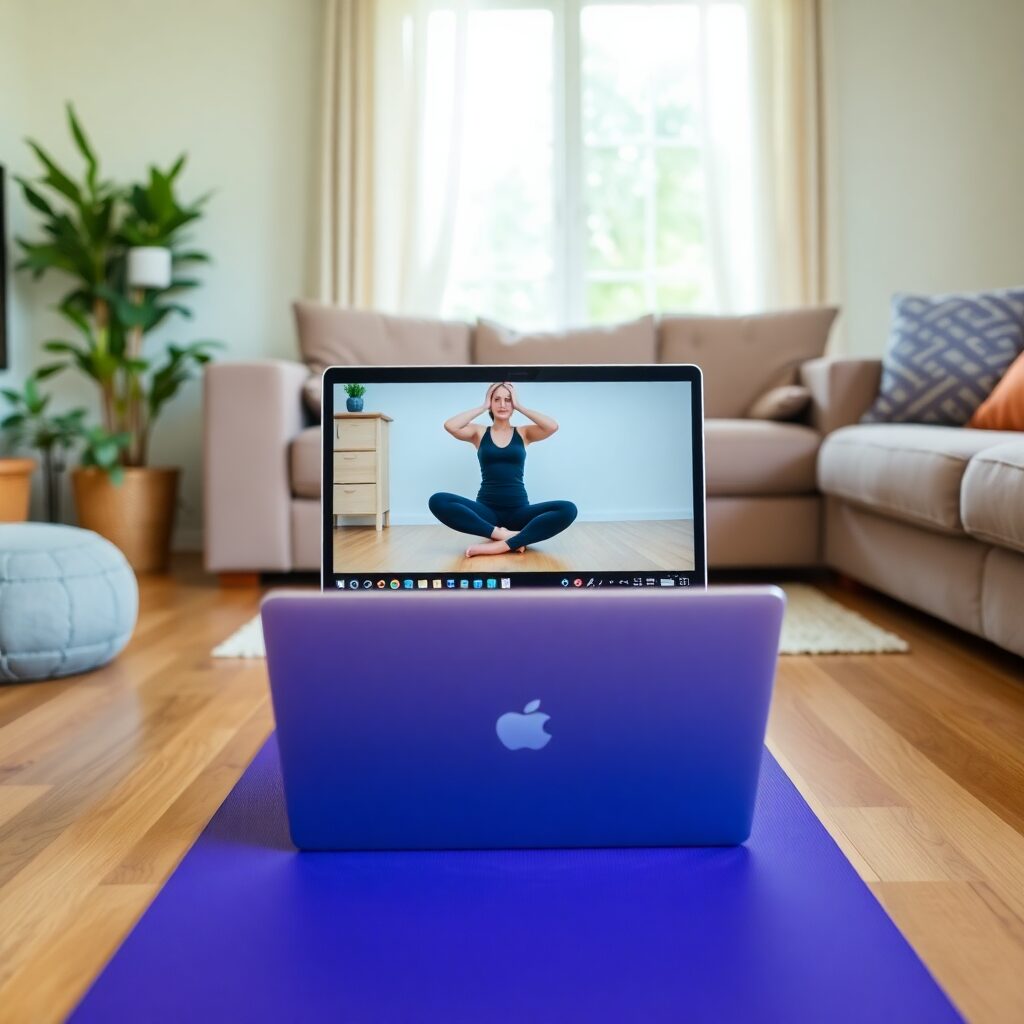
- YouTube channels: Yoga with Adriene (most recommended globally for yoga for beginners), Boho Beautiful, and Kassandra (excellent for Yin yoga and yoga for stress relief). Baba Ramdeva’s Yoga classes are also effective.
- Apps: Down Dog, Glo, and Daily Yoga offer structured programs that adapt to your level and goals.
- Books: “The Key Muscles of Yoga” by Ray Long is the definitive anatomy reference for understanding what beginner yoga poses actually do to your body. For encouragement, you can also read “Autobiography of a Yogi” by Paramhansa Yogananda. Hata yoga Pradipika is also an essential book for Yoga at Home practitioners (Beginners).
- Websites: Yoga Journal.com provides free pose libraries with alignment cues, modifications, and contraindications — essential for safe home practice.
Safety First: Practicing Yoga at Home Without Getting Injured
Home practice removes the safeguard of a teacher watching your alignment. That makes self-awareness even more critical. Follow these rules from day one:
- Always start with the easiest version of a pose and add depth gradually, session by session.
- Use props (blocks, straps, bolsters) without shame. Even advanced yogis use props.
- If you have a pre-existing injury or health condition, consult your doctor before starting yoga at home.
- Learn the Sanskrit or English name of poses you find challenging and search for their modifications.
- Warm up every single session — a cold stretch is an injury waiting to happen.
Conclusion: Are you ready to Start Yoga at Home Today?
The answer to “how do I start yoga at home” is simpler than most people think: begin with your breath, learn five to seven foundational beginner yoga poses, commit to a short daily yoga routine, and let consistency do the heavy lifting.
You do not need a perfect space, an expensive wardrobe, or years of experience. You need a mat, a willingness to show up, and the knowledge that your home yoga practice will look different from everyone else’s — and that is precisely its strength.
Whether you are drawn to yoga for stress relief, flexibility, strength, or simply a few minutes of daily stillness, the mat is waiting. Unroll it, take one long breath, and begin.
FQA:
Q1: How do I start yoga at home as a complete beginner?
A: Start with 5 minutes of yoga breathing exercises (belly breathing), then practice 5–7 foundational beginner yoga poses such as Mountain Pose, Child’s Pose, Cat-Cow, and Downward-Facing Dog. Keep sessions to 15–20 minutes daily, focusing on breath awareness and correct alignment over flexibility or intensity.
Q2: How long should my daily yoga routine be as a beginner?
A: A daily yoga routine of 15–20 minutes is ideal for beginners. This duration is sustainable, provides genuine physical and mental benefits, and can be expanded by 5 minutes every two weeks as your stamina and confidence grow.
Q3: Do I need equipment to start yoga at home?
A: The essential item for home yoga practice is a non-slip yoga mat. Two yoga blocks and a strap are highly recommended for beginner yoga poses, as they improve alignment and safety. Comfortable, stretchy clothing and a clear floor space of approximately 6 by 4 feet complete your setup.
Q4: Which yoga style is best for beginners at home?
A: Hatha yoga is the most recommended style for yoga for beginners at home. It is slow-paced, pose-by-pose, and allows time to understand alignment and breathwork. Yin yoga is also excellent for flexibility and yoga for stress relief. Avoid hot yoga or power yoga until you have at least 4–6 weeks of consistent home practice.
Q5: Can yoga at home really help with stress?
A: Yes — yoga for stress relief is one of the most evidence-backed applications of the practice. Multiple peer-reviewed studies confirm that yoga reduces cortisol levels, activates the parasympathetic nervous system, and improves sleep quality. Even a 20-minute home yoga practice that includes yoga breathing exercises can produce measurable stress reduction.
Q6: How often should I practice yoga at home to see results?
A: Practice a daily yoga routine at least 4–5 days per week for consistent results. Most beginners notice improved flexibility and reduced stress within 3–4 weeks of regular home yoga practice. The key variable is consistency — shorter daily sessions outperform infrequent longer ones.